
What is the Hazard Communication Standard, and what does it require?
The Hazard Communication Standard, HazCom or the right-to-know rule, is OSHA’s requirement that workers be told about the chemicals they work with. Chemical makers and importers must classify each hazardous chemical, put a standard label on it and write a safety data sheet. Every employer that has hazardous chemicals must keep a written program, a list of the chemicals, the labels on the containers, the safety data sheets where workers can get them, and must train every exposed worker before they start and whenever a new hazard shows up. It applies to any workplace with a hazardous chemical in it, which is nearly every one.
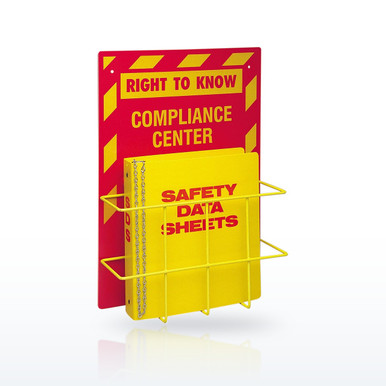 Brady Right-to-Know compliance centerWall station for the written program and the SDS binder
Why is HazCom cited so often? HazCom has been in OSHA’s top five most-cited standards every year since it was written, usually number two behind fall protection, and the citations are almost all the same four things: no written program, no training or no record of it, safety data sheets missing or not accessible, and containers without labels. None of those costs much to fix. The rule is cited so often because it applies everywhere and because employers assume the chemical supplier took care of it.
What are the five things every employer must have?
The employer side of the standard, in the order an inspector asks for them.
Who does the standard apply to?
Chemical manufacturers and importers must classify the hazards of the chemicals they produce or import and pass the information down the line in labels and safety data sheets. Distributors must pass the labels and SDSs along to the employers they sell to. Every employer must then communicate the information to its workers. The standard covers any chemical known to be present in the workplace in a way that employees may be exposed to under normal use or in a foreseeable emergency. It does not cover consumer products used the way a consumer would, at consumer frequency and duration; drugs in final form for a patient; food, alcohol and tobacco for consumption; articles that do not release a chemical in use; hazardous waste (covered by other rules); and a few others. Laboratories are covered by the lab standard instead, except for the labels and SDSs that still have to be there.
29 CFR 1910.1200(b)(1) through (b)(6) (scope, exemptions, laboratories, consumer products); 1910.1200(d) (hazard classification by manufacturers and importers); 1910.1450 (laboratories).Who does what under HazCom
| Duty | Manufacturer or importer | Distributor | Employer |
|---|---|---|---|
| Classify the hazards | Yes | No | Only if it makes its own chemicals or chooses to |
| Write the SDS | Yes | No | No, but must obtain one for each chemical |
| Label the shipped container | Yes | Must pass it along unchanged | Must leave it in place |
| Workplace labels on transferred containers | No | No | Yes |
| Written program and chemical list | As an employer, yes | As an employer, yes | Yes |
| Make SDSs accessible | As an employer, yes | As an employer, yes | Yes, every shift, every work area |
| Train employees | As an employer, yes | As an employer, yes | Yes, at assignment and on new hazards |
| Inform other employers on site | No | No | Yes, on multi-employer worksites |
Every link in the chain is also an employer for its own workers. A distributor of chemicals, for example, must pass along labels and SDSs to customers and run the full program for its own warehouse staff. The employer’s program must also cover how employees who work with chemicals from more than one source get the information, and how hazards of unlabeled pipes and non-routine tasks are communicated.
29 CFR 1910.1200(b)(1), (d), (e), (f), (g), (h); (e)(2) (multi-employer workplaces).
What has to be on labels and in the SDS?
The shipped label carries six elements: product identifier, signal word, hazard statements, pictograms, precautionary statements and supplier identification, in the GHS format OSHA adopted in 2012. The safety data sheet has 16 sections in a fixed order: identification, hazards, composition, first aid, firefighting, accidental release, handling and storage, exposure controls and PPE, physical and chemical properties, stability and reactivity, toxicology, ecology, disposal, transport, regulatory, and other information. OSHA does not enforce the content of sections 12 to 15 because other agencies own them, but the headings must be there. The GHS label guide covers the label elements in detail.
29 CFR 1910.1200(f)(1); 1910.1200(g)(2) and Appendix D (SDS sections).What changed in the 2024 update?
- Alignment with the seventh revision of the UN GHS: new hazard classes (desensitized explosives), new categories (flammable gases, aerosols, chemicals under pressure).
- Classification must consider the hazards of the chemical as shipped and the hazards of known or reasonably anticipated downstream use, including change of physical form.
- Labels for small containers: reduced label elements on containers of 100 mL or less, and a minimal label on 3 mL or less, with the full information on the outer package.
- Labels on chemicals released for shipment: the label need not be updated for new information once the container is packaged and released, as long as the new label goes out with the next shipment.
- Trade secret rules clarified; SDS section updates to match.
- Compliance dates: manufacturers, importers and distributors by May 19, 2026 for substances and November 19, 2027 for mixtures; employers update workplace labels and training by November 20, 2026 and May 19, 2028 respectively.
Does HazCom apply to construction?
Yes. 29 CFR 1926.59 incorporates 1910.1200 by reference, so a contractor has the same duties: a program, a chemical list, labels, SDSs on the site and accessible to the crew, and training. On a multi-employer site, each employer must tell the others about the chemicals its workers will expose them to and where the SDSs are, and the general contractor usually sets up the shared SDS station. The chemicals on a typical jobsite that trigger the rule: fuels, solvents, adhesives, sealants, concrete admixtures, form release, cleaners, welding gases, and silica-containing products.
29 CFR 1926.59; 29 CFR 1910.1200(e)(2).What are the common failures, and how are they fixed?
- No written program: write one; OSHA’s model program and most state consultation programs provide a template. It is a few pages.
- No training record: train, and keep a sign-in sheet with the date and the content. Training must be understandable to the workers, in a language they understand.
- Missing SDSs: request them from the supplier in writing and keep the request; download from the manufacturer; keep the binder or the electronic system current and known to every shift.
- Unlabeled secondary containers: a label printer or pre-printed GHS labels at the point of transfer, and a rule that nothing goes into a spray bottle without a label.
- Chemicals not on the list: walk the site quarterly and reconcile the list to what is on the shelves.
HazCom supplies: SDS stations and label printers
9 items · prices liveSupplies are as described by the manufacturer. Workplace container labels are printed with the hazard information from the product’s SDS; pre-printed GHS pictogram labels are quoted on request. Free shipping on orders over $199.



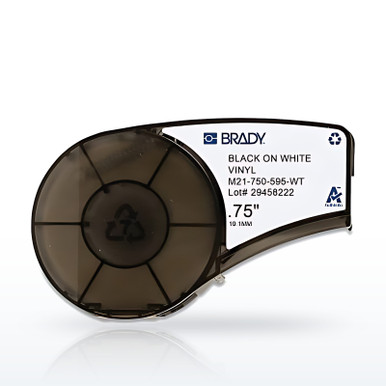
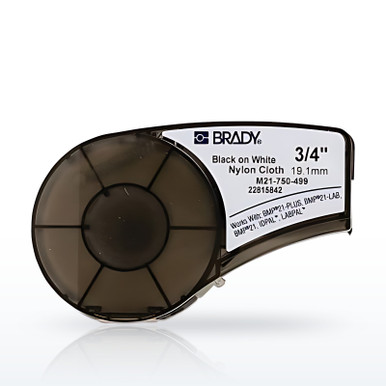



Pre-printed GHS pictogram labels, additional right-to-know centers and SDS binders are quoted on request: call (925) 215-7337.
Questions people ask
What is the purpose of the Hazard Communication Standard?
To make sure the hazards of all chemicals produced or imported are classified, and that the information reaches employers and workers through labels, safety data sheets and training. (1910.1200(a).)
What are the main requirements of HazCom?
For employers: a written program, a chemical list, labels on containers, accessible safety data sheets, and training. For manufacturers and importers: classification, labels and SDSs.
What is the difference between HazCom and GHS?
HazCom is the OSHA regulation. GHS is the United Nations system for classifying and labeling chemicals that HazCom adopted in 2012, so labels and SDSs follow one format worldwide.
How often is HazCom training required?
At initial assignment and whenever a new hazard is introduced into the work area. OSHA does not set an annual interval, though many employers train yearly and some states require it.
Do I need an SDS for every chemical?
For every hazardous chemical, yes, readily accessible to employees during their shift. Consumer products used as a consumer would are exempt.
Is HazCom required for a small business?
Yes. There is no size exemption; any employer with one hazardous chemical and one employee is covered.
What is the written HazCom program?
A document describing how the employer meets the labeling, SDS and training requirements, with the chemical list and the methods for non-routine tasks, unlabeled pipes and contractors. (1910.1200(e).)
When do the 2024 HazCom changes take effect?
May 19, 2026 for substances and November 19, 2027 for mixtures for manufacturers, importers and distributors; employers follow six months after each date. (1910.1200(j).)
Standards and ratings on this page are as published in the documents named and by the manufacturers named. The employer’s hazard assessment and written program decide what applies at a given workplace. Verify a rating on the product and its spec sheet before use.