
How does an auto-darkening welding helmet work, and what do the ratings mean?
An auto-darkening welding helmet has a liquid-crystal filter in the window with light sensors on the front. With no arc, the filter sits at a light shade (3 to 4 on most models), so you can see to set up. When the sensors see the arc strike, a circuit switches the liquid crystal to the dark shade you dialed in, typically 9 to 13, in a fraction of a millisecond. The UV and infrared protection is permanent in the glass behind the filter and does not depend on the switch. The ratings on the box are the light shade, the dark shade range, the switching time, the number of sensors, the lowest TIG amperage the sensors will catch, and the EN 379 optical class (1/1/1/1 is grade 1, the highest, in each of four clarity tests).
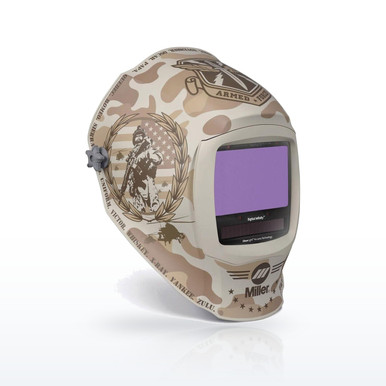
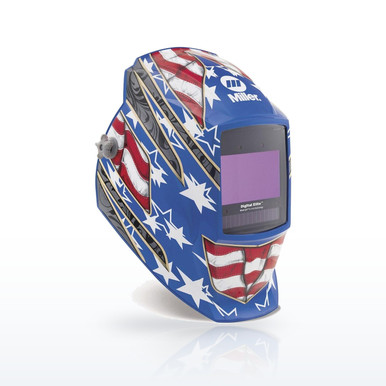 Miller Digital Elite auto-darkening helmetShades 2.5 light state, 5 to 13 dark state
Why does the filter need to switch at all? A passive shade 10 lens is black until the arc is lit. The welder positions the torch blind, nods the helmet down, and strikes; every restart means another flip of the hood. The auto-darkening filter removes the nod. It is clear enough to see the joint, darkens the instant the arc starts, and clears again when it stops, so tacks, restarts and short welds go faster and the welder’s neck and the fit of the hood are no longer part of the job. The protection against the arc’s ultraviolet and infrared is built into the filter stack whether or not it is switched, which is why a dead battery does not burn your eyes; it only leaves the filter stuck at the light or fail-safe shade.
What do the ratings on an auto-darkening helmet mean?
Six numbers appear on nearly every spec sheet. Here is what each one measures.
How does the filter actually work?
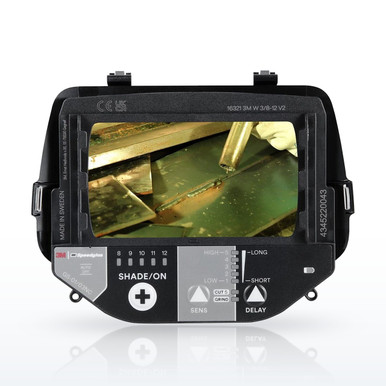
The window is a stack. On the outside is a clear cover plate that takes the spatter. Behind it sits a layer that blocks ultraviolet and infrared all the time, in every state; on the Speedglas 9100 filter, for example, that permanent layer is the equivalent of shade 13 against UV and IR whether the filter is light, dark or switched off. Behind that are one or more liquid-crystal cells between polarizers. With no voltage the cells pass light and the filter is at its light shade. When the sensors detect the arc, the circuit applies voltage, the crystals rotate, the polarizers cross and the filter goes to the dark shade set on the dial. When the arc stops, a delay (adjustable on most helmets) holds the dark state for a moment so the glowing weld pool does not dazzle, then the cells relax and the filter clears.
Manufacturer datasheets: 3M Speedglas 9100 welding filter (permanent shade 13 equivalent UV and IR protection in all states; three optical sensors; 0.1 ms light-to-dark at 23 °C; adjustable dark-to-light delay; fail-safe shade 5). Construction as published by the manufacturers.Power comes from replaceable lithium cells, solar cells on the front, or both. Because the UV and IR protection does not depend on power, a flat battery is a visibility problem, not a burn problem: the filter will not darken, so you cannot weld, but you are not exposed to the arc through a clear window if you do not strike one. Some filters also carry a fail-safe dark state that engages if the electronics fail during a weld.
3M Speedglas 9100 datasheet (2 x CR2032 cells, solar assist on some models, fail-safe shade 5). Battery and fail-safe behavior vary by model; the helmet’s own instructions govern.What does ANSI Z87.1 require of an auto-darkening filter?
Z87.1 treats an auto-darkening filter as a welding filter with a variable shade. It must be marked with a W and its dark-state shade range (for example W9-12), and the measured dark shade must be within one integer of the marked shade. The standard sets a maximum switching index for every combination of light and dark shade (Table 12), tests switching at three temperatures (-5 °C, 23 °C and 55 °C), and requires the light-state and dark-state transmittance to meet the welding filter limits of Table 7. The helmet itself is an impact protector and is tested with the quarter-inch steel ball at 150 feet per second like spectacles.
ANSI/ISEA Z87.1-2020 Table 3 footnote 5 (variable filters marked with the dark-state range); 7.2.3 and 7.2.3.1 (dark-state tolerance); 7.2.3.3 and 7.2.3.4 (test temperatures); Table 12 (switching index); Table 7 (welding filter transmittance); 7.1.4.3 and Table 6 (welding helmet impact speed).OSHA’s welding rule requires a helmet or hand shield for arc welding and arc cutting, with a filter plate and cover plate that are easy to replace, a permanent mark on the lens showing its source and shade, and filter lenses that pass the transmittance test in the Z87.1 editions named in 1910.133. The shade table in 1910.133(a)(5) sets the minimum shade by process and amperage. An auto-darkening filter satisfies all of that as long as its dark state is set at or above the minimum shade for the job.
29 CFR 1910.252(b)(2)(i)(A) (helmet or hand shield for arc welding), (b)(2)(ii)(C) (replaceable filter and cover plates), (b)(2)(ii)(G) (permanent source and shade marking), (b)(2)(ii)(I) (transmittance test per the standards in 1910.133(b)(1)); 1910.133(a)(5) (minimum shade numbers).How do you choose and set one?
- Set the dark shade from the OSHA table, then adjust. The table gives the minimum shade for the process and current; the OSHA guidance is to start darker than you need and lighten until you can see the weld zone, never going below the minimum. Shade 10 is the floor for stick welding with 1/16 to 5/32-inch rods, and gas-shielded arc welding on ferrous metal with small electrodes calls for 12.
- Match the shade range to the work. A 9 to 13 helmet covers nearly all arc welding. If you also cut and braze with a torch, a helmet that goes down to 5 lets you use it for that; otherwise cutting goggles are separate.
- Check the light state and the grind mode if you grind in the hood. A 3 or 4 light state and a grind lock that holds the filter clear is what lets the helmet stay on between passes.
- Check the TIG amperage rating if you TIG at low current. Sensors that catch 5 amps are made for it.
- Sensitivity and delay are adjustments, not ratings. Sensitivity sets how dim an arc triggers the filter; delay sets how long it stays dark after the arc stops. Both are on the filter or inside the hood.
- Safety glasses go under the helmet where chips, slag or grinding dust can fly. The helmet protects from the arc; it does not have side protection for a chipping hammer.
Auto-darkening welding helmets and filters by shade range
25 items · prices liveShade range, light state, switching time, sensor count and TIG rating are as published by each manufacturer on the product page and spec sheet. Shade shown is the manufacturer’s stated dark-state range. Contractor Direct orders ship free.
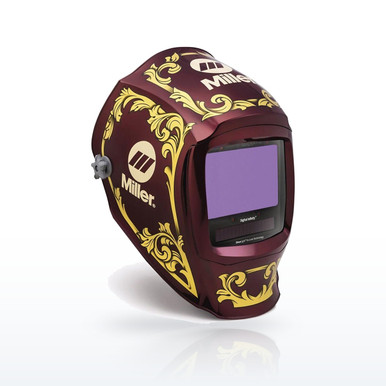
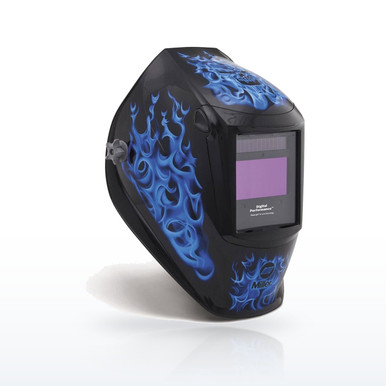
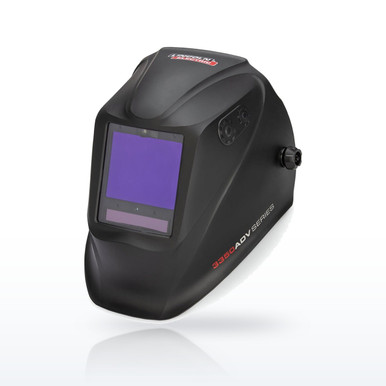
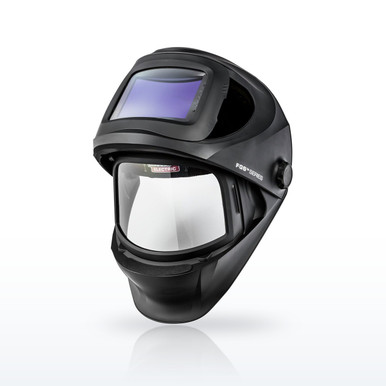
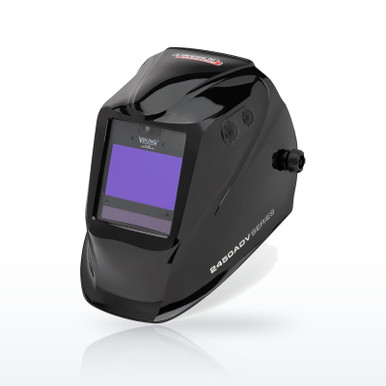
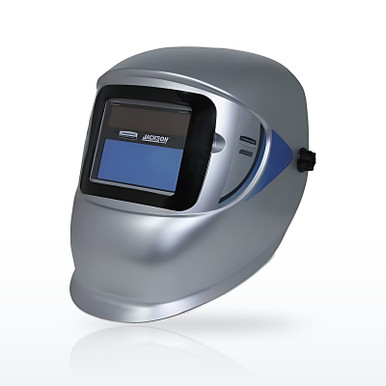
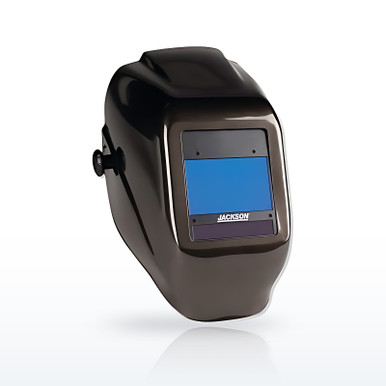
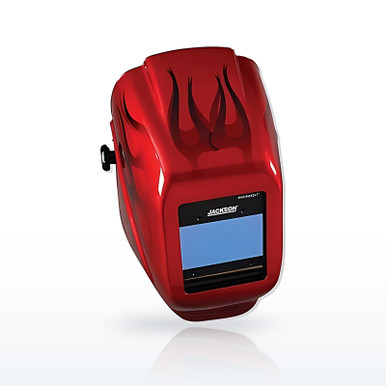
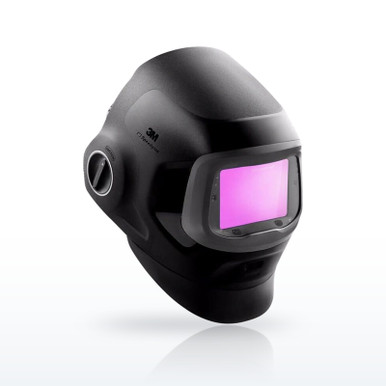
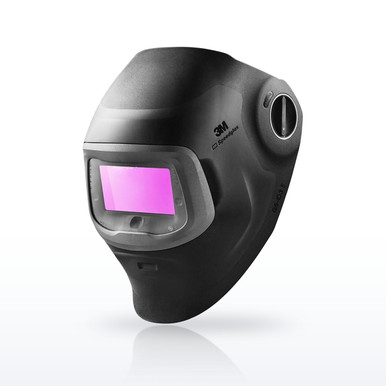
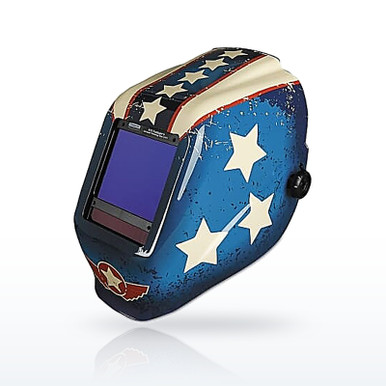
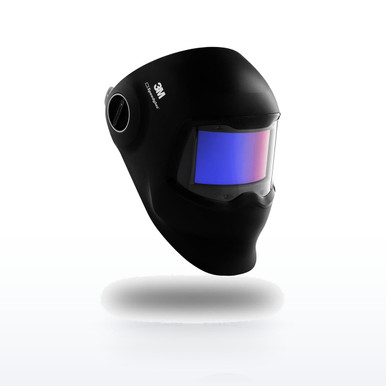
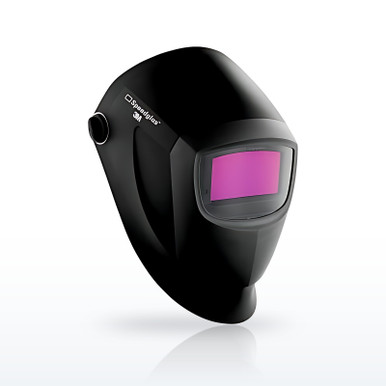
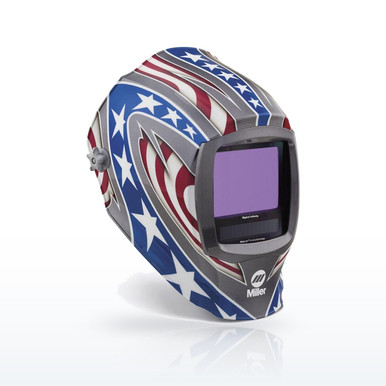
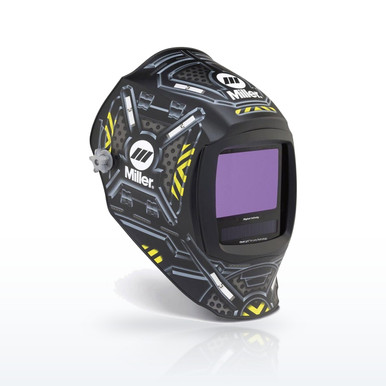


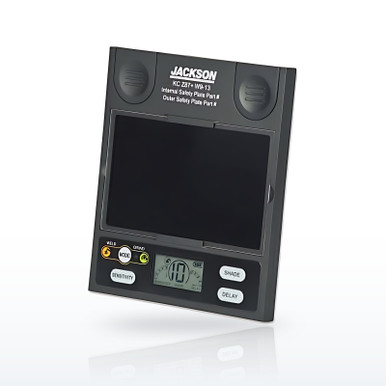
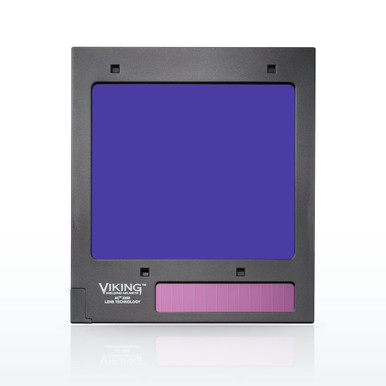
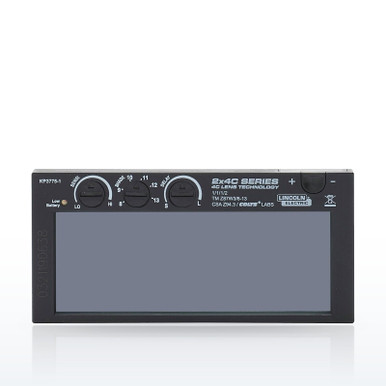
Passive helmets, filter plates and cutting goggles are in the welding PPE finder. Replacement cover plates are on each helmet’s product page.
Questions people ask
How does an auto-darkening welding helmet work?
Light sensors on the front see the arc and a circuit switches a liquid-crystal filter from a light shade (about 3) to the dark shade you set (9 to 13) in a fraction of a millisecond. UV and IR protection is permanent in the filter stack and does not depend on the switch.
What shade should an auto-darkening helmet be set to?
At or above the OSHA minimum for the process and amperage: shade 10 for stick welding with 1/16 to 5/32-inch electrodes, 11 for gas-shielded arc welding of nonferrous metal with small electrodes, 12 for ferrous. Start darker and lighten until the weld zone is visible. (1910.133(a)(5); 1910.252(b)(2)(ii)(H).)
What does 1/1/1/1 mean on a welding helmet?
The EN 379 optical class: distortion, blur, evenness of shade and shade at an angle, each graded 1 (best) to 3. A 1/1/1/1 filter scored grade 1 in all four. (EN 379 as published by the manufacturers.)
Is an auto-darkening helmet safe if the battery dies?
Your eyes are not exposed to the arc through a clear window, because the UV and IR filtering is permanent and does not need power. The filter will not darken, so you cannot see to weld until the battery or solar cell is restored. Some filters also have a fail-safe dark shade.
What is the light state on a welding helmet?
The shade of the filter when it is not darkened. Z87.1 lists light shades from 1.7 to 6.0; a 3 or 4 light state is clear enough to set up and grind without lifting the hood. (Z87.1-2020 Section 3 and Table 12.)
How fast does an auto-darkening lens switch?
Manufacturers publish about 0.1 millisecond (1/10,000 of a second) at room temperature. Z87.1 sets the legal maximum per shade pair in Table 12; current filters are far inside it. Switching slows in the cold, which is why the standard tests at -5 °C.
Do I need safety glasses under a welding helmet?
Where chips, slag or grinding dust can fly, yes: the helmet has no side protection, and OSHA requires side protection for flying-object hazards. OSHA’s guidance lists welding helmets as worn over primary eye protection. (1910.133(a)(2); Appendix B Note 9.)
Does an auto-darkening helmet meet OSHA?
Yes, when it is marked by the manufacturer and its filter meets the Z87.1 transmittance test, which current ADF helmets are certified to. The employer still has to set the dark shade at or above the table minimum. (1910.252(b)(2)(ii)(G) and (I); 1910.133(a)(5).)
Standards and ratings on this page are as published in the documents named and by the manufacturers named. The employer’s hazard assessment and written program decide what applies at a given workplace. Verify a rating on the product and its spec sheet before use.