
How do respirators work? Air-purifying vs atmosphere-supplying, filters vs cartridges
A respirator works one of two ways. An air-purifying respirator cleans the air you pull through it: a particulate filter catches dust, fume and mist in a tangle of fibers, and a chemical cartridge holds a bed of activated carbon or a treated sorbent that grabs gas and vapor molecules as they pass. An atmosphere-supplying respirator does not clean the air at all; it gives you different air from a tank on your back or a hose from a compressor. The first kind only works if there is enough oxygen and the contaminant is one the filter or cartridge is approved for, at a concentration it can handle. The second kind works anywhere, which is why it is the only kind allowed where the air itself could kill you.
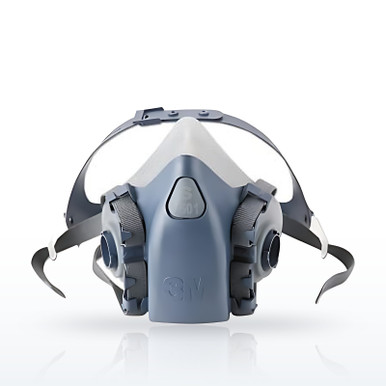 3M Half Facepiece Respirator SeriesHalf-mask air-purifying respirator; takes filters, cartridges or both
Why does it matter how they work? Because every respirator failure in the field traces back to one of three misunderstandings: that a filter stops gases (it does not), that a cartridge makes oxygen (it does not), or that a respirator that is on your face is protecting you (only if it seals). Knowing the mechanism tells you which mistake you are about to make.
What are the two families?
Everything NIOSH approves falls into one or the other.
How does a particulate filter capture particles?
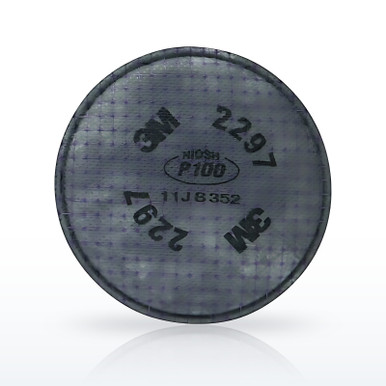
A filter is not a sieve. The fibers are much farther apart than the particles they stop, and particles are caught by four effects as the air winds through the mat: large particles cannot follow the airflow around a fiber and slam into it (impaction); medium ones follow the flow but brush a fiber and stick (interception); the smallest ones jitter randomly in the air and bump into fibers (diffusion); and an electrostatic charge on the fibers pulls particles in from a distance (electrostatic attraction, which is how a thin N95 does the work of a thick one). The hardest particle to catch is the one too small for impaction and too large for diffusion, around 0.3 micron, which is why NIOSH tests at that size and rates filters by it. Captured particles stay captured; a filter gets harder to breathe through as it loads, not leakier.
NIOSH, Filtration and Respiratory Protection: how filters work; 42 CFR 84 Subpart K (particulate filter test: 0.3 micron count median diameter aerosol); manufacturer technical data (3M Technical Data Bulletin on filter mechanisms).How does a chemical cartridge remove gases and vapors?
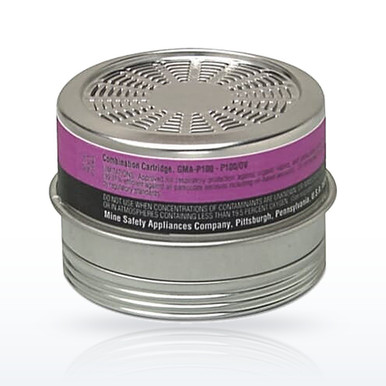
A cartridge is a canister of granules with an enormous internal surface: a few grams of activated carbon have the surface area of a football field. Gas and vapor molecules passing through stick to that surface (adsorption) and stay there; for some gases the carbon is impregnated with a chemical that reacts with the target (ammonia, acid gases, formaldehyde). The carbon fills up from the inlet side toward the outlet. When the whole bed is saturated, the contaminant breaks through and you are breathing it, and nothing tells you except smell, taste or irritation, which is why OSHA no longer allows relying on those. The cartridge must be approved for the specific contaminant: organic vapor carbon does nothing for ammonia or acid gases, and no cartridge stops carbon monoxide.
29 CFR 1910.134(d)(3)(iii)(B) (change schedules or end-of-service-life indicators required; warning properties alone not permitted); 42 CFR 84 Subpart L (chemical cartridges); NIOSH cartridge color codes; manufacturer service-life guidance.Filters, cartridges and combinations: what each stops
| Element | Stops | Does not stop | Replaced when |
|---|---|---|---|
| Particulate filter (N95, R95, P95, N99, N100, P100) | Dust, mist, fume, smoke, biological particles | Gases and vapors | Hard to breathe through, damaged, soiled, or per the schedule |
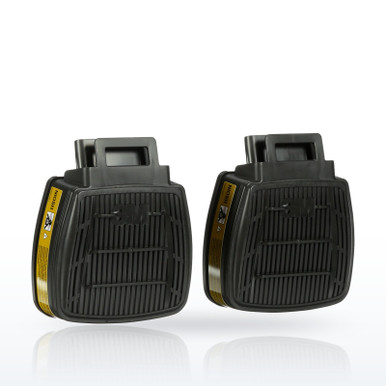
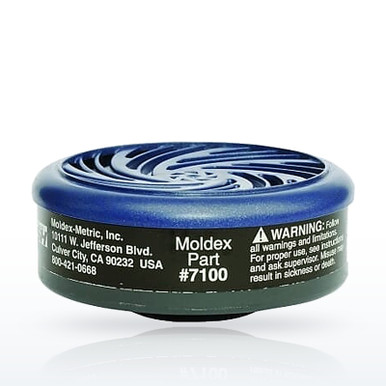
| Organic vapor cartridge | Solvents, paint vapors, fuels, many hydrocarbons | Particles, ammonia, acid gases, CO | Per the change schedule, never by smell |
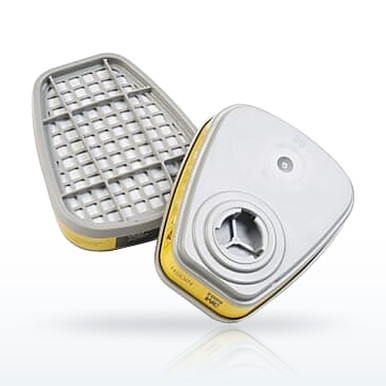
| Acid gas cartridge | Chlorine, hydrogen chloride, sulfur dioxide | Particles, organic vapors, CO | Per the change schedule |
| Ammonia / methylamine cartridge | Ammonia, methylamine | Everything else | Per the change schedule |
| Multi-gas cartridge | The combination listed on its label | Anything not listed, CO | Per the change schedule |
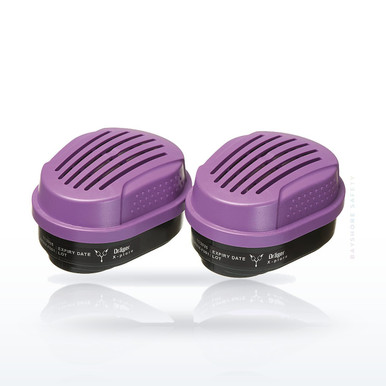
| Combination cartridge + P100 filter | Gases on the label plus particles | CO, low oxygen | Whichever element is used up first |
| Gas mask canister | Higher concentrations of the listed gases | CO (except CO-specific escape canisters), low oxygen | Per the label and the schedule |
N, R and P describe oil resistance: N is not for oil mists, R is oil-resistant for one shift, P is oil-proof. The number is the minimum filtration efficiency at the test size (95, 99 or 99.97 percent). Cartridges carry a NIOSH color band: black for organic vapor, white for acid gas, yellow for both, green for ammonia, olive for multi-gas, magenta for P100 filters. None of these elements adds oxygen, and none is permitted in an IDLH atmosphere.
42 CFR 84 Subparts K and L; NIOSH cartridge and canister color code (ANSI K13.1); 29 CFR 1910.134(d)(2) and (d)(3)(iii).
How do supplied-air respirators and SCBA work?
A supplied-air respirator feeds breathing air through a hose from a compressor with filters and a carbon monoxide alarm, or from a bank of cylinders, to a facepiece, hood or helmet. The air must meet Grade D, the quality OSHA requires for breathing air, and the hose length and pressure are limited by the NIOSH approval. Continuous-flow versions keep air moving all the time; pressure-demand versions use a regulator that holds positive pressure in the facepiece and delivers more when you inhale. An SCBA carries the air in a cylinder on your back, 30, 45 or 60 minutes of it, through a pressure-demand regulator; it is heavier and limited by the cylinder but needs no hose and no compressor, which is why it is the firefighter’s and the rescue team’s respirator and the one OSHA requires, alone or combined with supplied air, for IDLH atmospheres.
29 CFR 1910.134(i) (breathing air quality: Grade D, CGA G-7.1); 1910.134(d)(2)(i) (IDLH: pressure-demand SCBA or pressure-demand SAR with auxiliary SCBA); 42 CFR 84 Subparts H (SCBA) and J (supplied-air).What makes a respirator stop working?
- A broken seal: facial hair, a bad fit, a strap under a hood. Negative-pressure respirators leak inward at every breath.
- The wrong element: a particulate filter against a vapor, an organic vapor cartridge against ammonia, any cartridge against carbon monoxide.
- A used-up cartridge: breakthrough with no warning. Change schedules exist because of this.
- Low oxygen: an air-purifying respirator in a space below 19.5 percent oxygen is a mask with nothing to breathe.
- Concentration above the limit: cartridges and filters are approved up to a maximum use concentration; above it, or in IDLH, only supplied air or SCBA.
- A loaded filter: harder breathing, more leakage around the seal as you pull harder.
Respirators, filters and cartridges
30 items · prices liveEach item is listed by its NIOSH approval type as the manufacturer publishes it; filters and cartridges fit only the facepieces they are approved with. Free shipping on orders over $199.
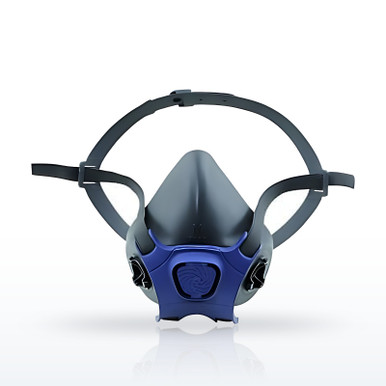
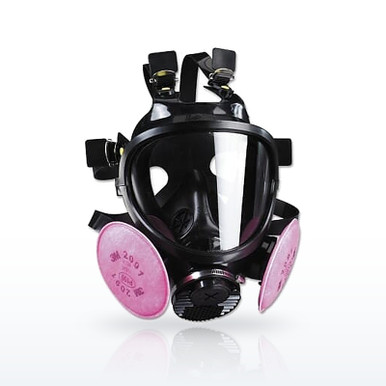
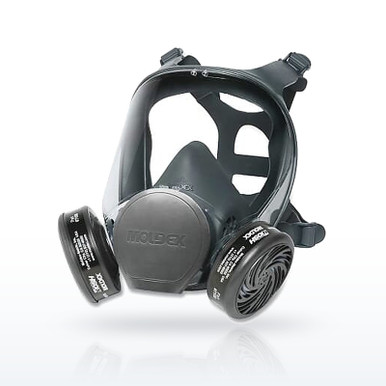







Every facepiece, filter and cartridge we carry, filtered by class and respirator type, is on the respirator finder.
Questions people ask
How does a respirator work?
An air-purifying respirator filters or adsorbs contaminants out of the air you inhale; an atmosphere-supplying respirator gives you clean air from a tank or a hose. Both only protect you if the facepiece seals.
Does a respirator provide oxygen?
Only an atmosphere-supplying respirator (SCBA or supplied air). Filters and cartridges clean the air; they add nothing to it, and they are not allowed in oxygen-deficient atmospheres.
What is the difference between a filter and a cartridge?
A filter traps particles in a fiber mat; a cartridge adsorbs gases and vapors on activated carbon. A combination element does both. A filter does nothing for a vapor, and a cartridge does nothing for dust.
How does an N95 filter such small particles?
By diffusion and electrostatic attraction, not by sieving: the smallest particles bounce around and hit fibers, and charged fibers pull particles in. The hardest size to catch is about 0.3 micron; NIOSH rates at that size.
How do you know when a cartridge is used up?
You cannot, reliably, by smell. OSHA requires a change schedule based on the contaminant, concentration and work rate, or an end-of-service-life indicator. (1910.134(d)(3)(iii)(B).)
What does negative pressure mean on a respirator?
The wearer creates suction with each breath, so the pressure inside the facepiece drops below the outside and a leak in the seal lets contaminated air in. Positive-pressure respirators (PAPR, pressure-demand SAR and SCBA) keep the inside above outside pressure.
Can a respirator protect against carbon monoxide?
Not an air-purifying one; no standard cartridge adsorbs CO. CO exposure above the limit requires supplied air or SCBA. Special CO escape canisters exist for mines and escape only.
What is a PAPR?
A powered air-purifying respirator: a battery blower pulls air through filters or cartridges and feeds it to a hood, helmet or facepiece under positive pressure. Easier breathing, higher protection factor, and the loose-fitting versions work with beards.
Related guides
Respirator vs gas mask vs ventilatorWhat each term meansWhat does N95, N99, N100, R95, P95 and P100 mean?The NIOSH filter classesWhen do you change respirator cartridges?Change schedules and end-of-service-life indicatorsWhat is SCBA, and when does OSHA require it?IDLH atmospheres and rescueStandards and ratings on this page are as published in the documents named and by the manufacturers named. The employer’s hazard assessment and written program decide what applies at a given workplace. Verify a rating on the product and its spec sheet before use.