
DuPont Tychem 4000 Disposable Protective Clothing
5 DuPont Tychem 4000 items we carry (coverall). Manufacturer test data, chemical and barrier results and the standards named on the data sheet.
What DuPont Tychem 4000 is
DuPont Tychem 4000 is The garment shall be constructed of DuPont™ Tychem® 4000 -- a DuPont™ Tyvek® protective fabric laminated with a chemical resistant Dow Saranex™ 23-P film.; Tychem® 4000 is white for high visibility. The manufacturer names these applications: Uses include waste management, hazardous response and nuclear environments. Seams: Seam types on the SafeSPEC pages for this family: Bound, Taped; Serged or sewn*: A seam produced when three threads are interlocked around the raw edges of two pieces of material for a strong, stress-resistant seam. For potential misting exposure of non-hazardous liquids or particle penetration thro. Shelf life per the manufacturer: What is the shelf life of Tychem® 4000 garments? Tychem® garments may be used for 5 years from the date of manufacture as long as all of the following conditions are met: The garment has been stored p.
In the manufacturer's words: "DuPont™ Tychem® 4000 delivers effective protection against a range of chemical environments. Tychem® 4000 utilizes a chemical barrier film laminated to a Tyvek® substrate to provide a rugged and durable fabric that resists abrasion. Tychem® 4000 fabric provides at least 30 minutes of protection against >124 chemical challenges. Typical applications: chemical mixing, hazardous remediation, emergency medical response, paint spraying, and nuclear environments."
Every DuPont Tychem 4000 item we carry
| Part number | Item | Seams | Sizes | Case | Price | ||
|---|---|---|---|---|---|---|---|
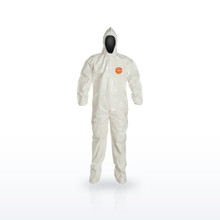 | SL122B | DuPont Tychem Chemical Resistant Clothing, Coverall, Hood and Attached Socks | Bound | L, 3XL, 4XL | 12 per case | $32.86 | Choose size |
 | SL122B | DuPont Tychem SL122B Coveralls | Bound | Large, 2X-Large, 3X-Large, 4X-Large | 12 per case | $339.58 | Choose size |
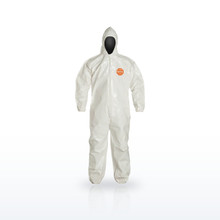 | SL127B | DuPont Tychem SL127BWH5X001200 Chemical Resistant Clothing, Hooded Coverall | Bound | One size | 12 per case | $403.83 | |
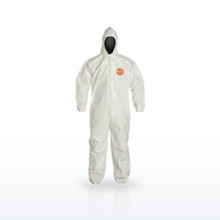 | SL127B | DuPont Tychem Chemical Resistant Clothing, Coverall, Hood | Bound | M, L, XL, 2XL, 3XL | 12 per case | $29.82 | Choose size |
 | SL127B | DuPont Tychem Coveralls, Bound Seams, Attached Hood | Bound | X-Large, 2X-Large, 3X-Large | 12 per case | $308.10 | Choose size |
Prices refresh from the store at the unit shown on the product page. Sized garments open the product page to pick the size.
DuPont Tychem 4000 physical properties (manufacturer test data)
| Test | Method | Result |
|---|---|---|
| Thickness | ASTM D1777 | 12 mils |
| Basis Weight | ASTM D3776 | 3.6 oz/yd^2 |
| Burst Strength - Mullen | ASTM D3786 | 71 psi |
| Breaking Strength - Grab (MD) | ASTM D5034 | 44 lbf |
| Breaking Strength - Grab (CD) | ASTM D5034 | 48 lbf |
| Wearing Apparel Flammability | 16 CFR 1610 | Class 1 |
Source: DuPont published data (dupont-tychem-4000-sl127b-wh.html), copied as published. The employer's hazard assessment under OSHA 29 CFR 1910.132 decides what a job needs; these are the manufacturer's test results, not a fitness statement for any task.
DuPont Tychem 4000: SafeSPEC CHEMICAL RESISTANCE table for Tychem 4000 (as shown on the SL127B product page)
| Hazard / Chemical Name | Cas Number | Phase | Normalized Break Through |
|---|---|---|---|
| 2-(2-Ethoxyethoxy) ethanol | 111-90-0 | Liquid | >480 |
| 2-Methyl-4-isothiazolin-3-one (20%) | 2682-20-4 | Liquid | >480 |
| Acetic acid (>95%) | 64-19-7 | Liquid | >480 |
| Acetic acid 2 ethoxy ethyl ester | 111-15-9 | Liquid | 116*/238 |
| Acetic acid 2 methoxy ethyl ester | 110-49-6 | Liquid | >480 |
| Acetic acid ethenyl ester | 108-05-4 | Liquid | 24 |
| Acetic acid ethyl ester | 141-78-6 | Liquid | imm |
| Acetic anhydride | 108-24-7 | Liquid | 12*/48 |
| Acetic chloride | 75-36-5 | Liquid | 39*/63 |
| Acetone | 67-64-1 | Liquid | 13 |
| Acetonitrile | 75-05-8 | Liquid | 60 |
| Acetyl chloride | 75-36-5 | Liquid | 39*/63 |
| Acroleic acid | 79-10-7 | Liquid | >480 |
| Acrolein (90%) | 107-02-8 | Liquid | 24 |
| Acrylamide (50%) | 79-06-1 | Liquid | >480 |
| Acrylic acid | 79-10-7 | Liquid | >480 |
| Acrylic acid n-butyl ester | 141-32-2 | Liquid | >480 |
| Acrylicamide (50%) | 79-06-1 | Liquid | >480 |
| Acrylonitrile | 107-13-1 | Liquid | 36*/48 |
| Acryloyl Chloride | 814-68-6 | Liquid | imm |
| Allyl alcohol | 107-18-6 | Liquid | >480 |
| Amino 3,4-dichlorobenzene, 1- (70 °C, molten) | 95-76-1 | Liquid | imm |
| Amino benzene | 62-53-3 | Liquid | >480 |
| Amino diphenyl, 4- (1 mg/ml in Methanol) | 92-67-1 | Liquid | >480 |
| Amino ethylethanolamine | 111-41-1 | Liquid | imm |
| Amino ethylethanolamine (60%) | 111-41-1 | Liquid | >480 |
| Amino ethylpiperazine | 140-31-8 | Liquid | >480 |
| Amino pyridine, 2- (sat) | 504-29-0 | Liquid | >480 |
| Ammonia (gaseous) | 7664-41-7 | Vapor | 26 |
| Ammonium hydroxide (2-3% in Householdcleaner) | 1336-21-6 | Liquid | >480 |
| Ammonium hydroxide (32%) | 1336-21-6 | Liquid | 55 |
| Aniline | 62-53-3 | Liquid | >480 |
| Antimony pentachloride | 7647-18-9 | Liquid | >480 |
| Benzenamine | 62-53-3 | Liquid | >480 |
| Benzene | 71-43-2 | Liquid | imm |
| Benzisothiazol 1,2- (20%) | 2634-33-5 | Liquid | >480 |
| Benzyl alcohol | 100-51-6 | Liquid | >480 |
| Bis (4-(2,3-epoxypropoxy)phenyl)propane (80%) | 1675-54-3 | Liquid | >480 |
| Bis phenol A diglycidyl ether (80%) | 1675-54-3 | Liquid | >480 |
| Black Liquor (mix) | mix | Liquid | >480 |
| Bromo methane | 74-83-9 | Vapor | >480 |
| Butadiene, 1,3- (gaseous) | 106-99-0 | Vapor | >480 |
| Butanal, n- | 123-72-8 | Liquid | 41 |
| Butanol, 1- | 71-36-3 | Liquid | >480 |
| Butanol, n- | 71-36-3 | Liquid | >480 |
| Butanone | 78-93-3 | Liquid | 18 |
| Butanone oxime, 2- | 96-29-7 | Liquid | >480 |
| Butenal, 2- | 123-73-9 | Liquid | 34 |
| Butoxy ethanol, 2- | 111-76-2 | Liquid | >480 |
| Butyl acrylate, n- | 141-32-2 | Liquid | >480 |
| Butyl alcohol, n- | 71-36-3 | Liquid | >480 |
| Butyraldehyde, n- | 123-72-8 | Liquid | 41 |
| Carbon disulfide | 75-15-0 | Liquid | imm |
| Carburant n° 2 | 68476-30-2 | Liquid | >480 |
| Caustic ammonia (2-3% in Householdcleaner) | 1336-21-6 | Liquid | >480 |
| Caustic ammonia (32%) | 1336-21-6 | Liquid | 55 |
| Caustic soda (50%) | 1310-73-2 | Liquid | >480 |
| Cellosolve acetate | 110-80-5 | Liquid | >480 |
| Chemguard S-764P14A | mix | Liquid | >480 |
| Chemidize 727 ND (mix) | mix | Liquid | >480 |
| Chlorine (gaseous) | 7782-50-5 | Vapor | >480 |
| Chloro 1-methylbenzene, 2- | 95-49-8 | Liquid | 13 |
| Chloro 2,3-epoxy propane, 1- | 106-89-8 | Liquid | 15 |
| Chloro acetic acid (80%) | 79-11-8 | Liquid | >480 |
| Chloro acetone (95%) | 78-95-5 | Liquid | 258 |
| Chloro acetyl chloride | 79-04-9 | Liquid | 120 |
| Chloro aniline, p- (70 °C, molten) | 106-47-8 | Liquid | imm |
| Chloro benzenamine, 4- (70 °C, molten) | 106-47-8 | Liquid | imm |
| Chloro ethene | 75-01-4 | Vapor | >480 |
| Chloro propan-2-one, 1- (95%) | 78-95-5 | Liquid | 258 |
| Chloro toluene, o- | 95-49-8 | Liquid | 13 |
| Chloroform | 67-66-3 | Liquid | imm |
| Chlorsulfonic acid | 7790-94-5 | Liquid | >480 |
| Chromic acid (CrO3) (44.9%) | 1333-82-0 | Liquid | >480 |
| Cresol o- | 95-48-7 | Liquid | >480 |
| Cresols, mixed isomers | 1319-77-3 | Liquid | 100 |
| Cresylic acid | 1319-77-3 | Liquid | 100 |
| Croton aldehyde | 123-73-9 | Liquid | 34 |
| Crude oil | 8002-05-9 | Liquid | >480 |
| Crude oil, California | 8002-05-9 | Liquid | >480 |
| Cyanoethylene | 107-13-1 | Liquid | 36*/48 |
| Cyanomethane | 75-05-8 | Liquid | 60 |
| Cyclo hexanone | 108-94-1 | Liquid | 136 |
| Cyclo hexyl isocanyte | 3173-53-3 | Liquid | 36*/54 |
| Diaminoethane, 1,2- | 107-15-3 | Liquid | >480 |
| Dichlorbenzen, 1,2- | 95-50-1 | Liquid | 76 |
| Dichlorbenzen, 1,3- | 541-73-1 | Liquid | 45 |
| Dichlorbenzen, 1,4- (50% in Ethanol) | 106-46-7 | Liquid | >480 |
| Dichlorethane, 1.2.- | 107-06-2 | Liquid | imm |
| Dichloro -4,4'-methylenedianiline, 2,2'- (sat in Methanol) | 101-14-4 | Liquid | >480 |
| Dichloro aniline, 3,4- (70 °C, molten) | 95-76-1 | Liquid | imm |
| Dichloro methane | 75-09-2 | Liquid | imm |
| Diesel Fuel Grade D-2 | mix | Liquid | >480 |
| Diethyl amine | 109-89-7 | Liquid | 15 |
| Diethyl aniline crude | 91-66-7 | Liquid | >480 |
| Diethyl benzene (95%) | 25340-17-4 | Liquid | 31 |
| Diethyl ethanamine, N,N- | 121-44-8 | Liquid | 12*/22 |
| Diethyl ether | 60-29-7 | Liquid | imm |
| Diethyl m-toluidine, N,N- | 91-67-8 | Liquid | >480 |
| Diethylene imide oxide | 110-91-8 | Liquid | 158 |
| Diethylene triamine | 111-40-0 | Liquid | imm*/321 |
| Dimethyl Carbonate (DMC) | 616-38-6 | Liquid | 35 |
| Dimethyl acetamide N,N- | 127-19-5 | Liquid | 96 |
| Dimethyl dichlorosilane | 75-78-5 | Liquid | 46 |
| Dimethyl formamide, N,N- | 68-12-2 | Liquid | 90 |
| Dimethyl hydrazine, N,N- | 57-14-7 | Liquid | 13 |
| Dimethyl ketal | 67-64-1 | Liquid | 13 |
| Dimethyl ketone | 67-64-1 | Liquid | 13 |
| Dimethyl maleate | 624-48-6 | Liquid | >480 |
| Dimethyl sulfate | 77-78-1 | Liquid | >480 |
| Diphenyl methane diisocyanate, 4,4'- (50 °C, molten) | 101-68-8 | Liquid | >480 |
| Disodium sulfide (60% (slurry)) | 1313-82-2 | Liquid | >480 |
| Epichlorohydrin | 106-89-8 | Liquid | 15 |
| Epoxy ethane (gaseous) | 75-21-8 | Vapor | imm |
| Ethane 1,2-diol | 107-21-1 | Liquid | >480 |
| Ethane diol dipropanoate, 1,2- | 123-73-9 | Liquid | 34 |
| Ethane nitrile | 75-05-8 | Liquid | 60 |
| Ethane thiol | 75-08-1 | Liquid | imm |
| Ethanol | 64-17-5 | Liquid | >480 |
| Ethanoyl chloride | 75-36-5 | Liquid | 39*/63 |
| Ethoxy ethanol, 2- | 110-80-5 | Liquid | >480 |
| Ethoxy ethylacetat | 111-15-9 | Liquid | 116*/238 |
| Ethyl Cellosolve® | 110-80-5 | Liquid | >480 |
| Ethyl acetate | 141-78-6 | Liquid | imm |
| Ethyl alcohol | 64-17-5 | Liquid | >480 |
| Ethyl benzene | 100-41-4 | Liquid | imm |
| Ethyl ethanamine, N- | 109-89-7 | Liquid | 15 |
| Ethyl ether | 60-29-7 | Liquid | imm |
| Ethyl glycol acetate | 111-15-9 | Liquid | 116*/238 |
| Ethyl mercaptan | 75-08-1 | Liquid | imm |
| Ethyl methyl carbonate (EMC) | 623-53-0 | Liquid | 25 |
| Ethyl nitrile | 75-05-8 | Liquid | 60 |
| Ethylene Carbonate solution (60%) | 96-49-1 | Liquid | >480 |
| Ethylene carboxylic acid | 79-10-7 | Liquid | >480 |
| Ethylene diamine | 107-15-3 | Liquid | >480 |
| Ethylene dichloride | 107-06-2 | Liquid | imm |
| Ethylene glycol | 107-21-1 | Liquid | >480 |
| Ethylene glycol mono ethyl ether acetate | 111-15-9 | Liquid | 116*/238 |
| Ethylene glycol monobutyl ether | 111-76-2 | Liquid | >480 |
| Ethylene glycol monoethyl ether | 110-80-5 | Liquid | >480 |
| Ethylene glycol monomethyl ether | 109-86-4 | Liquid | >480 |
| Ethylene glycol monomethyl ether acetate | 110-49-6 | Liquid | >480 |
| Ethylene oxide (gaseous) | 75-21-8 | Vapor | imm |
| Ethylene tetrachloride | 127-18-4 | Liquid | imm |
| Ethylene trichloride | 79-01-6 | Liquid | imm |
| Ferric (III) chloride (50%) | 7705-08-0 | Liquid | >480 |
| Fluorobenzene | 462-06-6 | Liquid | imm |
| Fluoroboric acid (48-50%) | 16872-11-0 | Liquid | >480 |
| Fluorosilicic acid (33-35%) | 16961-83-4 | Liquid | >480 |
| Formaldehyde (37%) | 50-00-0 | Liquid | >480 |
| Formalin (37% (10-15% Methanol)) | 50-00-0 | Liquid | >480 |
| Formalin (37%) | 50-00-0 | Liquid | >480 |
| Formic acid (88%) | 64-18-6 | Liquid | >480 |
| Fuel-oil no 2 | 68476-30-2 | Liquid | >480 |
| Furaldehyde, 2- | 98-01-1 | Liquid | 198*/227 |
| Furfural | 98-01-1 | Liquid | 198*/227 |
| Gasoline, unleaded | 86290-81-5 | Liquid | imm |
| Gasoline, unleaded E10 (87 Octane) | 308066-70-8 | Liquid | imm |
| Glutaral (50%) | 111-30-8 | Liquid | >480 |
| Glutaraldehyde (50%) | 111-30-8 | Liquid | >480 |
| Glycol alcohol | 107-21-1 | Liquid | >480 |
| Green Liquor (mix) | mix | Liquid | >480 |
| Hexamethyl disilazane | 999-97-3 | Liquid | >480 |
| Hexamethyl disilazane, 1,1,1,3,3,3- | 999-97-3 | Liquid | >480 |
| Hexamethylene diamine (50 °C, molten) | 124-09-4 | Liquid | 80 |
| Hexamethylene diisocyanate | 822-06-0 | Liquid | >480 |
| Hexane, n- | 110-54-3 | Liquid | imm |
| Hexanone | 108-94-1 | Liquid | 136 |
| Hydrazine | 302-01-2 | Liquid | >480 |
| Hydriodic acid (47%) | 10034-85-2 | Liquid | >480 |
| Hydrochloric acid (37%) | 7647-01-0 | Liquid | >480 |
| Hydrofluoric acid (48-51%) | 7664-39-3 | Liquid | >480 |
| Hydrofluoric acid (70%) | 7664-39-3 | Liquid | 143 |
| Hydrogen chloride (gaseous) | 7647-01-0 | Vapor | >480 |
| Hydrogen fluoride (20-27 °C, gaseous) | 7664-39-3 | Vapor | 93*/134 |
| Hydrogen peroxide (30%) | 7722-84-1 | Liquid | >480 |
| Hydroxy 2-nitrobenzene, 1- (70 °C, molten) | 88-75-5 | Liquid | imm |
| Hydroxy toluene | 100-51-6 | Liquid | >480 |
| Hydroxy toluene, o- | 95-48-7 | Liquid | >480 |
| Iodine | 7553-56-2 | Solid | >480 |
| Iodomethane | 74-88-4 | Liquid | imm |
| Isoamyl alcohol | 123-51-3 | Liquid | >480 |
| Isopropanol | 67-63-0 | Liquid | >480 |
| Isopropanol (70%) | 67-63-0 | Liquid | >480 |
| Isopropyl alcohol | 67-63-0 | Liquid | >480 |
| Isopropyl alcohol (70%) | 67-63-0 | Liquid | >480 |
| Isopropylidenediphenol diglycidyl ether, 4,4'- (80%) | 1675-54-3 | Liquid | >480 |
| JP-4 Jet Fuel | 50815-00-4 | Liquid | imm |
| JP-8 Jet Fuel | 94114-58-6 | Liquid | 39*/67 |
| Kerosene | 8008-20-6 | Liquid | 69 |
| Ketone propane | 67-64-1 | Liquid | 13 |
| Lewisite (L), MIL-STD-282 (10 g/m^2) | 541-25-3 | Liquid | >360^8 |
| Lithium Hexafluorophosphate (sat.) | 21324-40-3 | Liquid | >480 |
| MEK | 78-93-3 | Liquid | 18 |
| Maleic anhydride (66 °C, molten) | 108-31-6 | Liquid | 13 |
| Mercuric II chloride (sat) | 7487-94-7 | Liquid | >480 |
| Mercury | 7439-97-6 | Liquid | >480 |
| Methanesulphonic acid (70%) | 75-75-2 | Liquid | >480 |
| Methanol | 67-56-1 | Liquid | >480 |
| Methoxy 2-methylpropane, 2- | 1634-04-4 | Liquid | >480 |
| Methoxy ethanol, 2 | 109-86-4 | Liquid | >480 |
| Methoxy ethylacetate, 2- | 110-49-6 | Liquid | >480 |
| Methyl 2-methyl-2-propenoate | 80-62-6 | Liquid | 23 |
| Methyl 2-pyrrolidone, N- | 872-50-4 | Liquid | 101 |
| Methyl Ethyl Ketone Peroxide (35%) | 1338-23-4 | Liquid | >480 |
| Methyl acetyl | 67-64-1 | Liquid | 13 |
| Methyl acrolein | 123-73-9 | Liquid | 34 |
| Methyl aniline, o- | 95-53-4 | Liquid | >480 |
| Methyl benzol | 108-88-3 | Liquid | imm |
| Methyl bromide | 74-83-9 | Vapor | >480 |
| Methyl butan-1-ol, 3- | 123-51-3 | Liquid | >480 |
| Methyl chloride (-70 °C, liquid) | 74-87-3 | Liquid | >480 |
| Methyl chloride (gaseous) | 74-87-3 | Vapor | >480 |
| Methyl cyanide | 75-05-8 | Liquid | 60 |
| Methyl ethyl ketone | 78-93-3 | Liquid | 18 |
| Methyl ethyl ketoxime | 96-29-7 | Liquid | >480 |
| Methyl iodide | 74-88-4 | Liquid | imm |
| Methyl isocyanate | 624-83-9 | Liquid | imm |
| Methyl ketone | 67-64-1 | Liquid | 13 |
| Methyl methacrylate | 80-62-6 | Liquid | 23 |
| Methyl phenols | 1319-77-3 | Liquid | 100 |
| Methyl salicylate | 119-36-8 | Liquid | >480 |
| Methyl tert-butyl ether | 1634-04-4 | Liquid | >480 |
| Methylen Isocyclohexylamine, 4,4- (50 °C, molten) | 1761-71-3 | Liquid | >480 |
| Methylene bis(2-Chloroaniline), 4,4- (sat in Methanol) | 101-14-4 | Liquid | >480 |
| Methylene chloride | 75-09-2 | Liquid | imm |
| Methylene diphenyl diisocyanate, 4,4'- (50 °C, molten) | 101-68-8 | Liquid | >480 |
| Mineral oil | 8012-95-1 | Liquid | >480 |
| Mineral spirit | 64475-85-0 | Liquid | 190 |
| Morpholine | 110-91-8 | Liquid | 158 |
| Naphthalene (25% in Diethylene glycol dimethylether) | 91-20-3 | Liquid | 79 |
| Nitric acid (70%) | 7697-37-2 | Liquid | >480 |
| Nitro benzene | 98-95-3 | Liquid | 59 |
| Nitro phenol, o- (70 °C, molten) | 88-75-5 | Liquid | imm |
| Nitro toluene, 2- | 88-72-2 | Liquid | 95 |
| Nitrogen dioxide | 10102-44-0 | Liquid | >480 |
| Norflurane | 811-97-2 | Vapor | >480 |
| Oleum (20% free SO3) | 8014-95-7 | Liquid | >480 |
| Oleum (30% free SO3) | 8014-95-7 | Liquid | >480 |
| PCB 1254 (50% in Mineral Oil) | 11097-69-1 | Liquid | >480 |
| PCB 1254 (90%) | 11097-69-1 | Liquid | >480 |
| Pentachloroantimony | 7647-18-9 | Liquid | >480 |
| Pentanedial, 1,5- (50%) | 111-30-8 | Liquid | >480 |
| Peracetic Acid (32%) | 79-21-0 | Liquid | 272 |
| Phenethylene | 100-42-5 | Liquid | 16 |
| Phenol (45 °C, molten) | 108-95-2 | Liquid | 44 |
| Phenol (60 °C, molten) | 108-95-2 | Liquid | imm |
| Phenol (85%) | 108-95-2 | Liquid | >480 |
| Phenyl amine | 62-53-3 | Liquid | >480 |
| Phenyl ethane | 100-41-4 | Liquid | imm |
| Phenyl ethanol, 1- | 98-85-1 | Liquid | >480 |
| Phenyl glycidyl ether | 122-60-1 | Liquid | >480 |
| Phenyl trichlorosilane | 98-13-5 | Liquid | >480 |
| Phosphoric acid (85%) | 7664-38-2 | Liquid | >480 |
| Phosphorus trichloride | 7719-12-2 | Liquid | imm |
| Pimelic ketone | 108-94-1 | Liquid | 136 |
| Polymethylene polyphenyle isocyanate (p-MDI) | 9016-87-9 | Liquid | >480 |
| Potassium acetate (sat) | 127-08-2 | Liquid | >480 |
| Potassium chromate (sat) | 7789-00-6 | Liquid | >480 |
| Potassium hydroxide (45%) | 1310-58-3 | Liquid | >480 |
| Prop-2-en-1-al (90%) | 107-02-8 | Liquid | 24 |
| Propan -2-ol | 67-63-0 | Liquid | >480 |
| Propan -2-ol (70%) | 67-63-0 | Liquid | >480 |
| Propan -2-one | 67-64-1 | Liquid | 13 |
| Propen 1-ol, 2- | 107-18-6 | Liquid | >480 |
| Propenamide (50%) | 79-06-1 | Liquid | >480 |
| Propene acid | 79-10-7 | Liquid | >480 |
| Propenenitrile, 2- | 107-13-1 | Liquid | 36*/48 |
| Propenoic acid butyl ester, 2- | 141-32-2 | Liquid | >480 |
| Propenoic acid nitrile | 107-13-1 | Liquid | 36*/48 |
| Propyl bromide, n- | 106-94-5 | Liquid | 12 |
| Propylene aldehyde | 123-73-9 | Liquid | 34 |
| Pyridine | 110-86-1 | Liquid | 31 |
| Pyroacetic ether | 67-64-1 | Liquid | 13 |
| Sarin (GB), MIL-STD-282 (10 g/m^2) | 107-44-8 | Liquid | >480^8 |
| Silicon tetrachloride | 10026-04-7 | Liquid | 35 |
| Skydrol 4D | mix | Liquid | >480 |
| Skydrol 5 | mix | Liquid | >480 |
| Skydrol PE-5 | mix | Liquid | >480 |
| Sodium bisulphite (38-40%) | 7631-90-5 | Liquid | >480 |
| Sodium cyanide (sat) | 143-33-9 | Liquid | >480 |
| Sodium fluoride (sat) | 7681-49-4 | Liquid | >480 |
| Sodium hydroxide (50%) | 1310-73-2 | Liquid | >480 |
| Sodium hypochlorite (15%) | 7681-52-9 | Liquid | >480 |
| Sodium metabisulphite (38%) | 7681-57-4 | Liquid | >480 |
| Spectracide® (50% Malathion, 44% Aromatic Solvent) | mix | Liquid | >480 |
| Spiritus | 64-17-5 | Liquid | >480 |
| Styrene | 100-42-5 | Liquid | 16 |
| Sulfur Mustard (HD), MIL-STD-282 (10 g/m^2) | 505-60-2 | Liquid | >480^8 |
| Sulfur dioxide | 7446-09-5 | Vapor | >480 |
| Sulfuric acid (>95%) | 7664-93-9 | Liquid | >480 |
| Sulfuric acid dimethyl ester | 77-78-1 | Liquid | >480 |
| Sulfuric acid fuming (20% free SO3) | 8014-95-7 | Liquid | >480 |
| Sulfuric acid fuming (30% free SO3) | 8014-95-7 | Liquid | >480 |
| Tetrachloro ethane, 1,1,2,2,- | 79-34-5 | Liquid | 25 |
| Tetrachloro ethylene, 1,1,2,2- | 127-18-4 | Liquid | imm |
| Tetraethyl ammonium hydroxide (35%) | 77-98-5 | Liquid | >480 |
| Tetraethylene pentamine | 112-57-2 | Liquid | >480 |
| Tetrafluoroethane, 1,1,1,2- | 811-97-2 | Vapor | >480 |
| Tetrahydrofuran | 109-99-9 | Liquid | imm |
| Tetramethyl ammonium hydroxide (25%) | 75-59-2 | Liquid | >480 |
| Thioalkohol | 75-08-1 | Liquid | imm |
| Titan(IV) chloride | 7550-45-0 | Liquid | imm |
| Titanium tetrachloride | 7550-45-0 | Liquid | imm |
| Toluene | 108-88-3 | Liquid | imm |
| Toluene diisocyanate, 2,4- | 584-84-9 | Liquid | >480 |
| Toluene diisocyanate, 2,4- (80%) | 584-84-9 | Liquid | >480 |
| Toluidine, m- | 108-44-1 | Liquid | >480 |
| Toluidine, o- | 95-53-4 | Liquid | >480 |
| Trichlor vinylsilane | 75-94-5 | Liquid | 100 |
| Trichloro benzene, 1,2,4- | 120-82-1 | Liquid | 87 |
| Trichloro ethanol, 2,2,2- | 115-20-8 | Liquid | >480 |
| Trichloro ethylene | 79-01-6 | Liquid | imm |
| Trichloro methane | 67-66-3 | Liquid | imm |
| Trichloro phenylsilane | 98-13-5 | Liquid | >480 |
| Trichloro silane | 10025-78-2 | Liquid | 60 |
| Triethyl amine | 121-44-8 | Liquid | 12*/22 |
| Triethylentetramine (60%) | 112-24-3 | Liquid | >480 |
| Trifluoro acetic acid | 76-05-1 | Liquid | >480 |
| Trifluoro methansulfonic acid | 1493-13-6 | Liquid | >480 |
| Trimethyl phosphite | 121-45-9 | Liquid | 210 |
| VM & P Naphtha | 8030-30-6 | Liquid | imm |
| VX Nerve Agent, MIL-STD-282 (10 g/m^2) | 50782-69-9 | Liquid | >480^8 |
| Vinyl acetate | 108-05-4 | Liquid | 24 |
| Vinyl benzol | 100-42-5 | Liquid | 16 |
| Vinyl carbinol | 107-18-6 | Liquid | >480 |
| Vinyl chloride | 75-01-4 | Vapor | >480 |
| Vinyl cyanide | 107-13-1 | Liquid | 36*/48 |
| Vinyl ethylene (gaseous) | 106-99-0 | Vapor | >480 |
| Vinyl magnesium chloride (15% in Tetrahydrofuran) | 3536-96-7 | Liquid | imm |
| Vinyl pyridine, 4- | 100-43-6 | Liquid | 15 |
| White Liquor | mix | Liquid | >480 |
Source: DuPont published data (dupont-tychem-4000-sl127b-wh.html), copied as published. The employer's hazard assessment under OSHA 29 CFR 1910.132 decides what a job needs; these are the manufacturer's test results, not a fitness statement for any task.
DuPont Tychem 4000: 21 Industrial chemicals ASTM F1001 — Permeation data (catalog p.10), column for Tychem® 4000*
Index of codes: > = greater than, imm. = immediate (<10 minutes), nt = not tested, L = liquid, G = gas. Normalized Breakthrough Time (NBT) shown in minutes. *Serged and/or bound seams are degraded by some hazardous liquid chemicals, such as strong acids, and should not be worn when these chemicals are present. Permeation testing on chemicals is in accordance with ASTM F739, Standard Test Method for Resistance of Protective Clothing Materials to Permeation by Liquids or Gases Under Conditions of Continuous Contact. All tests are conducted at room temperature unless otherwise noted. Reported results are Normalized Breakthrough Times defined by ASTM F739 as the time (in minutes) when the permeation rate reaches 0.1 µg/cm2/min. Note: Numbers reported are averages of samples tested. Sample results vary. All DuPont permeation testing is performed by a third party. Transcribed from the reading-order text of catalog p.10; the chemical-warfare-agent rows were not transcribed (superscript footnote markers are fused to the numbers in the text layer).
| Chemical | CAS # | Physical phase | NBT (minutes) Tychem® 4000* |
|---|---|---|---|
| Acetone (95%) | 67-64-1 | L | 13 |
| Acetonitrile (95%) | 75-05-8 | L | 60 |
| Ammonia (95%) | 7664-41-7 | G | 26 |
| 1, 3-Butadiene (95%) | 106-99-0 | G | >480 |
| Carbon disulfide (95%) | 75-15-0 | L | imm. |
| Chlorine (95%) | 7782-50-5 | G | >480 |
| Dichloromethane (95%) | 75-09-2 | L | imm. |
| Diethylamine (95%) | 109-89-7 | L | 15 |
| N, N-Dimethylformamide (95%) | 68-12-2 | L | 90 |
| Ethyl acetate (95%) | 141-78-6 | L | imm. |
| Ethylene oxide (95%) | 75-21-8 | G | imm. |
| n-Hexane (95%) | 110-54-3 | L | imm. |
| Hydrogen chloride (95%) | 7647-01-0 | G | >480 |
| Methanol (95%) | 67-56-1 | L | >480 |
| Methyl chloride (95%) | 74-87-3 | G | >480 |
| Nitrobenzene (95%) | 98-95-3 | L | 59 |
| Sodium hydroxide (50%) | 1310-73-2 | L | >480 |
| Sulfuric acid (95%) | 7664-93-9 | L | >480 |
| 1, 1, 2, 2-Tetrachloroethylene (95%) | 127-18-4 | L | imm. |
| Tetrahydrofuran (95%) | 109-99-9 | L | imm. |
| Toluene (95%) | 108-88-3 | L | imm. |
Source: DuPont published data (DPP_CI_Catalog_2024_V2.pdf), copied as published. The employer's hazard assessment under OSHA 29 CFR 1910.132 decides what a job needs; these are the manufacturer's test results, not a fitness statement for any task.
DuPont Tychem 4000 barrier tests
| Test | Method | Result |
|---|---|---|
| Passes ASTM F1670 and ASTM F1671 tests, offering bloodborne pathogen protection | ASTM F1670 / ASTM F1671 | (statement) |
Source: DuPont published data (DPP_CI_Catalog_2024_V2.pdf), copied as published. The employer's hazard assessment under OSHA 29 CFR 1910.132 decides what a job needs; these are the manufacturer's test results, not a fitness statement for any task.
Standards named by the manufacturer for DuPont Tychem 4000
| Standard | What the manufacturer states |
|---|---|
| 16 CFR 1610 | Wearing Apparel Flammability: Class 1 |
Source: DuPont published data (dupont-tychem-4000-sl127b-wh.html), copied as published. The employer's hazard assessment under OSHA 29 CFR 1910.132 decides what a job needs; these are the manufacturer's test results, not a fitness statement for any task.
Manufacturer limitations and warnings
- Warning: Most Tychem® garments should not be used around heat, flames, sparks or in potentially flammable or explosive environments.
- These Tychem® 4000 garments have attached socks made of the garment material. These attached socks must be worn inside protective outer footwear and are not suitable as outer footwear. These attached socks do not have adequate durability or slip resistance to be worn as the outer foot covering.
- Please note that Tychem® fabrics have different permeation performance. Please check DuPont™ SafeSPEC™ for permeation data that meets your specific needs.
- *Serged and bound seams are degraded by some hazardous liquid chemicals, such as strong acids, and should not be worn when these chemicals are present.
- *CAUTION: This information is based upon technical data that DuPont believes to be reliable. It is subject to revision as additional knowledge and experience are gained. DuPont makes no guarantee of results and assumes no obligation or liability in connection with this information. It is the user's responsibility to determine the level of toxicity and the proper personal protective equipment needed. The information set forth herein reflects laboratory performance of fabrics, not complete garments, under controlled conditions. It is intended for informational use by persons having technical skill for evaluation under their specific end-use conditions, at their own discretion and risk. Anyone intending to use this information should first verify that the garment selected is suitable for the intended use. In many cases, seams and closures have shorter breakthrough times and higher permeation rates than the fabric. Please contact DuPont for specific data. If fabric becomes torn, abraded or punctured, or if seams or closures fail, or if attached gloves, visors, etc. are damaged, end user should discontinue use of garment to avoid potential exposure to chemical. Since conditions of use are outside our control, we make no warranties, express or implied, including, without limitation, no warranties of merchantability or fitness for a particular use and assume no liability in connection with any use of this information. This information is not intended as a license to operate under or a recommendation to infringe any patent or technical information of DuPont or others covering any material or its use.
- Cellosolve® and Selexol™ are registered trademarks of Dow Chemicals Company. Skydrol® is a registered trademark of Solutia.
- As of January 2023, all DuPont Personal Protection products are manufactured under specifications that exclude components containing natural rubber latex. Tyvek® 500, Tyvek® 600 and Tyvek® 800 styles made before January 2023 contain natural rubber latex, which may cause allergic reactions in some sensitized individuals. Anyone who begins to exhibit an allergic response during the use of DuPont products should immediately cease using these products and should report it to DuPont at +1 (888) 439-2988 so that an investigation can be initiated.
- Wear other appropriate PPE such as, but not limited to, respiratory, eye, head, hand, and foot protection based on the hazard assessment.
- Please read, understand and follow the Tychem® User Manual.
DuPont Tychem 4000 questions
What is DuPont Tychem 4000 made of? The garment shall be constructed of DuPont™ Tychem® 4000 -- a DuPont™ Tyvek® protective fabric laminated with a chemical resistant Dow Saranex™ 23-P film.; Tychem® 4000 is white for high visibility
Which DuPont Tychem 4000 garments does Bayshore Safety carry? SL122B (DuPont Tychem Chemical Resistant Clothing, Coverall, Hood and Attached Socks), SL127B (DuPont Tychem SL127BWH5X001200 Chemical Resistant Clothing, Hooded Coverall), SL122B (DuPont Tychem SL122B Coveralls), SL127B (DuPont Tychem Chemical Resistant Clothing, Coverall, Hood), SL127B (DuPont Tychem Coveralls, Bound Seams, Attached Hood).
What standards does the manufacturer name for DuPont Tychem 4000? 16 CFR 1610. The wording for each is in the standards table above.
Does the manufacturer publish chemical test data for DuPont Tychem 4000? Yes: 2 tables on this page (SafeSPEC CHEMICAL RESISTANCE table for Tychem 4000 (as shown on the SL127B product page); 21 Industrial chemicals ASTM F1001 — Permeation data (catalog p.10), column for Tychem® 4000*), copied from the manufacturer. Penetration and permeation are different tests; the guide on permeation versus penetration explains how to read them.
What does the manufacturer warn about DuPont Tychem 4000? Warning: Most Tychem® garments should not be used around heat, flames, sparks or in potentially flammable or explosive environments. These Tychem® 4000 garments have attached socks made of the garment material. These attached socks must be worn inside protective outer footwear and are not suitable as outer footwear. These attached socks do not have adequate durability or slip resistance to be worn
Is this a statement that the garment is compliant for my job? No. These are the manufacturer's published test results and the standards it names. Under OSHA 29 CFR 1910.132 the employer's hazard assessment decides which protective clothing a task needs.
See also: the disposable coverall fabrics hub, the disposable garment selector and the disposable coverall guides.