
Guides · Fire extinguishers
Fire extinguisher guides
Fourteen guides on fire extinguishers for data centers, electrical rooms and commercial buildings: which type goes where under NFPA 10 (2026), what Halotron BrX and Halotron I are and how they differ, how clean agent units are sized to a room, placed, inspected and replaced at 12 years. Each guide answers the question in its title, cites the NFPA 10 section behind it, and shows the extinguishers that meet it with prices.
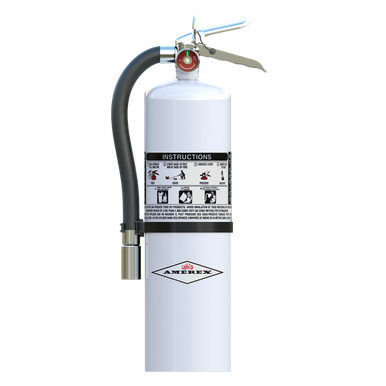 Clean agent fire extinguishersHalotron BrX, Halotron I, CO2 and water mist, with the code behind each
Halotron I vs Halotron BrX: what is the difference, and which one do you buy?Halotron I is HCFC-123, a hydrochlorofluorocarbon blend sold since the 1990s as the Halon 1211 replacement in portable extinguishers; Halotron BrX is stabilized 2-BTP (2-bromo-3,3,3-trifluoropropene), the newer agent Ame…NFPA 10 (2026) sections as cited; Amerex HT Series clean agent sheet; Halotron BrX informaWhich fire extinguisher does a data center need? What NFPA 10 (2026) says about clean agent extinguishers for data halls, server rooms and electrical roomsNFPA 10 (2026) answers it in two sections. 5.5.4.6.1: extinguishers protecting delicate electronic equipment are selected from types listed and labeled for Class C. 5.5.4.6.2: dry chemical extinguishers are not installed…NFPA 10 (2026) 5.3.2.6.1, 5.5.4.6, 5.5.5, 6.2, 6.3, 6.4, 7.3.6.3; Amerex HT Series sheet; What is a Class C fire extinguisher, what is it used for, and which type should you use on energized electrical equipment?Class C is not a kind of fire so much as a condition: a Class A or Class B fire that involves energized electrical equipment. A Class C rating on an extinguisher means the agent has been tested as non-conductive, so the…NFPA 10 (2026) 5.3.2.3, 5.5.4.6, 6.4; UL 711What is a clean agent fire extinguisher, how does it work, and when does NFPA 10 (2026) point to one?NFPA 10 (2026) 3.3.5 defines a clean agent as an electrically non-conducting, volatile or gaseous fire extinguishant that does not leave a residue upon evaporation. In portable extinguishers that means the halogenated (c…NFPA 10 (2026) 3.3.3, 3.3.5, 3.3.18, 5.3.2.6, 5.5.4.6, Tables 7.3.3.1 and 8.3.1, 7.3.6.3What replaced Halon 1211 and 1301 fire extinguishers, and can you still use a halon extinguisher?Halon 1211 (bromochlorodifluoromethane) and Halon 1301 (bromotrifluoromethane) are ozone-depleting agents whose production ended under the Montreal Protocol; new halon has not been made in the United States since the mid…NFPA 10 (2026) 3.3.18.2, 4.1.2.2, 5.3.2.6, 7.2.3.3, 7.3.6.2, 8.4.1.3; Amerex Halon 1211 maWhat is the minimum room volume on a clean agent fire extinguisher, and how do you check a room against it?Every halogenated agent extinguisher carries a warning on its nameplate: do not use in confined spaces smaller than a stated volume. The number comes from the agent's listing and exists because a halocarbon discharged in…NFPA 10 (2026) 5.3.2.6.1; Amerex HT Series clean agent sheet; Amerex Halotron BrX maintenaIs there a fire extinguisher for lithium-ion battery fires? What NFPA 10 (2026) says, and what the manufacturers do and do not claimNFPA 10 (2026) classifies fires as A, B, C, D and K. There is no class for lithium-ion battery fires, and none of the portable clean agent, CO2 or dry chemical units on this site is listed for one. A lithium-ion cell in…NFPA 10 (2026) 5.2, 5.3.2.6.1, 6.4.1; NFPA 855; UL 9540A; Amerex HT Series sheetNFPA 10 fire extinguisher requirements explained: selection, placement, mounting height, inspection and testing (2026 edition)NFPA 10, Standard for Portable Fire Extinguishers, is the document OSHA (29 CFR 1910.157) and the fire codes adopt for how extinguishers are chosen, placed and kept. The current edition is 2026 and NFPA lets anyone read…NFPA 10 (2026) Chapters 5, 6, 7 and 8, sections as cited; OSHA 29 CFR 1910.157How high should a fire extinguisher be mounted, and where does it go? NFPA 10 (2026) mounting height, travel distance and cabinet rulesNFPA 10 (2026) 6.1.3.9 sets the height by weight: an extinguisher with a gross weight up to 40 lb is hung so its top is no more than 5 ft (1.53 m) above the floor; one over 40 lb, other than wheeled units, so its top is…NFPA 10 (2026) 6.1.3, 6.1.3.9, 6.1.3.11, 6.2, 6.3, 6.6; OSHA 29 CFR 1910.157Fire extinguisher inspection, maintenance and hydrostatic testing: the monthly, annual, 6-year and 12-year intervals under NFPA 10 (2026)NFPA 10 (2026) runs four clocks on a portable extinguisher. Inspection (7.2) is the quick monthly check the owner does: in place, unobstructed, instructions out, seal intact, full by weight or heft, no damage, indicator…NFPA 10 (2026) 7.2, 7.3, Table 7.3.3.1, 7.3.6, 7.3.6.3, Chapter 8, Table 8.3.1, 8.4.2Do fire extinguishers expire? How long a fire extinguisher is good for under NFPA 10 (2026)There is no expiration date on a rechargeable fire extinguisher. It stays in service as long as it passes the monthly inspection (7.2), the annual maintenance (7.3.1.1), the internal examination on its interval (Table 7.…NFPA 10 (2026) 3.4.2, 3.4.5, 7.2, 7.3.1.1, Table 7.3.3.1, 7.3.6.3, Table 8.3.1, 8.4.2What does NFPA 10 (2026) require for a nonrechargeable fire extinguisher? Inspection, maintenance and the 12-year ruleA nonrechargeable (nonrefillable) extinguisher under NFPA 10 (2026) 3.4.2 is intended for one use and is not capable of being recharged and returned to service. The standard asks four things of it. Inspect it when placed…NFPA 10 (2026) 3.4.2, 7.1.3, 7.2, 7.2.3, 7.3.1.1, 7.3.2, 7.3.3.6, 7.3.6.3, 8.4.1; Amerex HFire extinguisher types explained: Class A, B, C, D and K, and the agents that carry each ratingNFPA 10 (2026) classifies fires by what burns: Class A ordinary combustibles (wood, paper, cloth, plastics), Class B flammable and combustible liquids and gases, Class C fires that involve energized electrical equipment,…NFPA 10 (2026) 5.2, 5.3, 5.5.4.6, 6.6, Annex B; UL 711What does 2A:10B:C mean? Fire extinguisher ratings explainedA rating like 2A:10B:C is three test results on one label. The number before A is the Class A rating: UL 711 fire tests on wood cribs and panels, where 1-A is roughly the fire a 1.25 gallon water extinguisher handles and…NFPA 10 (2026) 5.3, 5.5.1, Table 6.2.1.1, Table 6.3.1.1, Annex G; UL 711