
DuPont Tyvek 400 Disposable Protective Clothing
24 DuPont Tyvek 400 items we carry (apron, boot cover, coverall, frock / lab coat, hood, lab coat, pants, shirt, shoe / boot cover, shoe cover, sleeve). Manufacturer test data, chemical and barrier results and the standards named on the data sheet.
What DuPont Tyvek 400 is
DuPont Tyvek 400 is The garment shall be constructed of DuPont™ Tyvek® 400-- a patented flash-spun polyethylene fabric.; Tyvek® 400 is white; Level of protection (catalog p.4 brand crossover chart): Tyvek® 400 sits under "Hazardous particles" in the DuPont™ Tyvek® garments column; Tyvek® 400 D under "Non-hazardous particles". The manufacturer names these applications: One garment for many applications: General maintenance/operations; Microcrystalline silica; Lead abatement; Environmental cleanup; Agriculture; Asbestos abatement; Food processing; Mold remediation; Spray painting; Crime scene investigation; Wind turbine manufacturing; Well suited for workers who are involved in a variety of strenuous activities that can lead to heat stress. Seams: Seam types on the SafeSPEC pages for this family: Bound, Serged; Serged or sewn*: A seam produced when three threads are interlocked around the raw edges of two pieces of material for a strong, stress-resistant seam. For potential misting exposure of non-hazardous liquids or particle penetration thr. Shelf life per the manufacturer: What is the shelf life of TYVEK® 400 garments? DuPont suggests that Tyvek® garments be used within 5 years of receipt, provided they are properly stored and pass a full visual inspection. High tempera.
In the manufacturer's words: "Tyvek® 400 garments are composed of flash spun high density polyethylene which creates a unique, nonwoven material available only from DuPont. Tyvek® 400 provides an ideal balance of protection, durability and comfort of any limited use fabric technology. Tyvek® 400 fabric offers an inherent barrier against particles (down to 1.0 micron in size). Protection is built into the fabric itself; there are no films or laminates to abrade or wear away. Tyvek® 400 fabric's durability advantage over mic"
Every DuPont Tyvek 400 item we carry


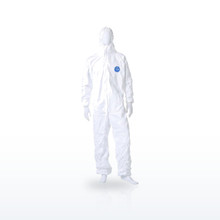
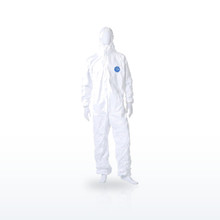


Prices refresh from the store at the unit shown on the product page. Sized garments open the product page to pick the size.
DuPont Tyvek 400 physical properties (manufacturer test data)
| Test | Method | Result |
|---|---|---|
| Thickness | ASTM D1777 | 5.9 mils |
| Basis Weight | ASTM D3776 | 1.2 oz/yd2 |
| Burst Strength - Mullen | ASTM D774 | 50 psi |
| Seam Strength | ASTM D1683 | > 19 lbf |
| Breaking Strength - Grab (MD) | ASTM D5034 | 18 lbf /in |
| Breaking Strength - Grab (CD) | ASTM D5034 | 22 lbf /in |
| Hydrostatic Head | AATCC 127 | 45 inches H^2O |
| Surface Resistivity (23°C / 25% RH) | EN 1149-1 | <2.5 x 10^9 ohms |
| Wearing Apparel Flammability | 16 CFR 1610 | Class 1 |
Source: DuPont published data (dupont-tyvek-400-ty122s-wh.html), copied as published. The employer's hazard assessment under OSHA 29 CFR 1910.132 decides what a job needs; these are the manufacturer's test results, not a fitness statement for any task.
DuPont Tyvek 400 barrier tests
| Test | Method | Result |
|---|---|---|
| Hydrostatic Head | AATCC 127 | 45 inches H^2O |
Source: DuPont published data (dupont-tyvek-400-ty122s-wh.html), copied as published. The employer's hazard assessment under OSHA 29 CFR 1910.132 decides what a job needs; these are the manufacturer's test results, not a fitness statement for any task.
Standards named by the manufacturer for DuPont Tyvek 400
| Standard | What the manufacturer states |
|---|---|
| USMCA/TAA | Only NF option codes are USMCA/TAA compliant. |
| EN 14126 | Catalog "Product line by hazard" (p.12) footnote: Biohazards have a variety of classification methods. These products (garments or fabrics) have been tested to the following standards, including but not limited to AATCC 127 (Tyvek® 400), EN 14126 (Tyvek® 500 HV, Tyvek® 500, Tyvek® 600, Tyvek® 800), ASTM F1670 (ProShield® 60, ProShield® 70) and ASTM F1671 (ProShield® 70). Visit our website for specific testing data. |
| EN 1149-1 | Surface Resistivity (23°C / 25% RH): <2.5 x 10^9 ohms |
| 16 CFR 1610 | Wearing Apparel Flammability: Class 1 |
Source: DuPont published data (DPP_CI_Catalog_2024_V2.pdf, dupont-tyvek-400-ty122s-wh.html), copied as published. The employer's hazard assessment under OSHA 29 CFR 1910.132 decides what a job needs; these are the manufacturer's test results, not a fitness statement for any task.
Manufacturer limitations and warnings
- Warning: Tyvek® should not be used around heat, flames, sparks or in potentially flammable or explosive environments. Garments made of Tyvek® fabrics should have slip-resistant or anti-slip materials on the outer surface of boots, shoe covers, or other garment surfaces in conditions where slipping could occur.
- Seams and closures have less barrier than fabric.
- Serged and/or bound seams are degraded by some hazardous liquid chemicals, such as strong acids, and should not be worn when these chemicals are present.
- *Serged and bound seams are degraded by some hazardous liquid chemicals, such as strong acids, and should not be worn when these chemicals are present.
- *Liquid barrier performance varies based on the amount of liquid that may get on the garment, the length of time the liquid is on the garment, applied pressure and certain physical properties of the liquid. Tyvek®400, Tyvek® 400 D, ProShield®, ProShield® 10, ProShield® 60, Tyvek® 400 FC, and ProShield® 70 garments are not appropriate if during use they are getting wet (liquid is dripping or running, or it is wet to the touch) or if spotting is observed on skin or garments worn under the protective garment. Tyvek® 500 and Tyvek® 600 offer improved liquid barrier, but may not be appropriate if spotting is observed on the skin or garments worn under the protective garment. In applications where a higher liquid barrier is needed, consider Tychem® 2000 and Tychem® 4000 garments with taped seams.
- Tyvek® 600 and Tyvek® 500 fabric have different fabric physical properties and improved chemical resistance properties than standard Tyvek® 400 garments.
- **Garments made using Tyvek® 400, Tyvek® 500, Tyvek® 600 and Tyvek® 800 fabrics will burn and possibly melt. None of these garments should be worn near heat, open flames, sparks or any other possible ignition source nor should they be worn in potentially explosive or flammable environments. If these garments do burn or melt while being worn, it may increase the severity of burn injuries even when worn over garments which are flame resistant, including, but not limited to, Nomex® IIIA or Nomex® Comfort garments.
- *CAUTION: This information is based upon technical data that DuPont believes to be reliable. It is subject to revision as additional knowledge and experience are gained. DuPont makes no guarantee of results and assumes no obligation or liability in connection with this information. It is the user's responsibility to determine the level of toxicity and the proper personal protective equipment needed. The information set forth herein reflects laboratory performance of fabrics, not complete garments, under controlled conditions. It is intended for informational use by persons having technical skill for evaluation under their specific end-use conditions, at their own discretion and risk. Anyone intending to use this information should first verify that the garment selected is suitable for the intended use. In many cases, seams and closures have shorter breakthrough times and higher permeation rates than the fabric. Please contact DuPont for specific data. If fabric becomes torn, abraded or punctured, or if seams or closures fail, or if attached gloves, visors, etc. are damaged, end user should discontinue use of garment to avoid potential exposure to chemical. Since conditions of use are outside our control, we make no warranties, express or implied, including, without limitation, no warranties of merchantability or fitness for a particular use and assume no liability in connection with any use of this information. This information is not intended as a license to operate under or a recommendation to infringe any patent or technical information of DuPont or others covering any material or its use.
- Cellosolve® and Selexol™ are registered trademarks of Dow Chemicals Company. Skydrol® is a registered trademark of Solutia.
- Tyvek® friction-coated shoe covers or Tyvek® garments with attached friction-coated skid-resistant shoe covers might contain silicone in the shoe-cover. This includes styles TY122, TY121, FC450 and FC454. End users who are consuming these styles and who have concerns about silicone contamination should conduct their own testing to ensure they are suitable for their application(s).
- As of January 2023, all DuPont Personal Protection products are manufactured under specifications that exclude components containing natural rubber latex. Tyvek® 500, Tyvek® 600 and Tyvek® 800 styles made before January 2023 contain natural rubber latex, which may cause allergic reactions in some sensitized individuals. Anyone who begins to exhibit an allergic response during the use of DuPont products should immediately cease using these products and should report it to DuPont at +1 (888) 439-2988 so that an investigation can be initiated.
- Wear other appropriate PPE such as, but not limited to, respiratory, eye, head, hand, and foot protection based on the hazard assessment.
DuPont Tyvek 400 questions
What is DuPont Tyvek 400 made of? The garment shall be constructed of DuPont™ Tyvek® 400-- a patented flash-spun polyethylene fabric.; Tyvek® 400 is white; Level of protection (catalog p.4 brand crossover chart): Tyvek® 400 sits under "Hazardous particles" in the DuPont™ Tyvek® garments column; Tyvek® 400 D under "Non-hazardous particles"
Which DuPont Tyvek 400 garments does Bayshore Safety carry? TY120S, TY125S (DuPont Tyvek 400 Disposable Coverall, Collar), TY120S, TY122S, TY125S, TY127S (DuPont Tyvek 400 Disposable Coveralls, Case of 25), TY500S (DuPont Tyvek D13397569 Sleeves & Bibs, 400 Disposable Sleeve, 18 in), TY127S (DuPont Tyvek D15221737 400 Disposable Hooded Coverall), TY273B (DuPont Tyvek D13398751 400 Disposable Bib Apron, 28 x 36 in), TY350S (DuPont Tyvek Work Pants & Shorts, 400 Pants), TY450S (DuPont Tyvek D14135748 Shoe & Boot Covers, 400 Disposable Shoe Cover, 8.25 in), TY127S (DuPont Tyvek 400 Disposable Coverall, Hood), TY210S (DuPont Tyvek TY210S Coats & Jackets, 400 Frocks No Pockets), TY454S (DuPont Tyvek TY454S-LG Overboots, Tyvek Boot Cover, Large), and 14 more.
What standards does the manufacturer name for DuPont Tyvek 400? USMCA/TAA; EN 14126; EN 1149-1; 16 CFR 1610. The wording for each is in the standards table above.
Does the manufacturer publish chemical permeation data for DuPont Tyvek 400? No. The published data for DuPont Tyvek 400 covers physical properties and barrier tests; no chemical permeation table is published for it.
What does the manufacturer warn about DuPont Tyvek 400? Warning: Tyvek® should not be used around heat, flames, sparks or in potentially flammable or explosive environments. Garments made of Tyvek® fabrics should have slip-resistant or anti-slip materials on the outer surface of boots, shoe covers, or other garment surfaces in conditions where slipping could occur. Seams and closures have less barrier than fabric. Serged and/or bound seams are degraded
Is this a statement that the garment is compliant for my job? No. These are the manufacturer's published test results and the standards it names. Under OSHA 29 CFR 1910.132 the employer's hazard assessment decides which protective clothing a task needs.
See also: the disposable coverall fabrics hub, the disposable garment selector and the disposable coverall guides.