
Emergency showers: what ANSI Z358.1 requires for flow, height and temperature
An emergency shower (drench shower) must deliver at least 20 gallons of tepid water per minute for 15 minutes. The shower head sits 82 to 96 inches above the floor, the spray must be at least 20 inches across measured 60 inches up, and the center of the spray at least 16 inches from any wall or obstruction. The valve turns on in 1 second or less, stays on without hands, and its handle is no higher than 69 inches. Water is tepid, between 60 and 100°F. The shower is within 10 seconds of the hazard, on the same level, with a clear path, in a lit spot with a sign. It is run every week and fully inspected every year. OSHA 1910.151(c) is the rule that requires it; Z358.1 is the measure OSHA uses for what suitable means.
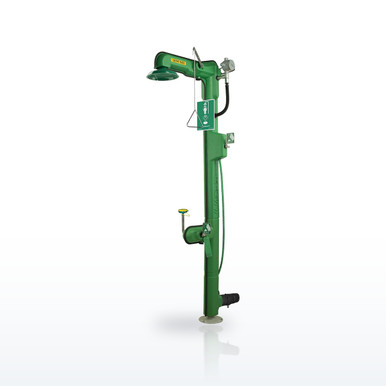
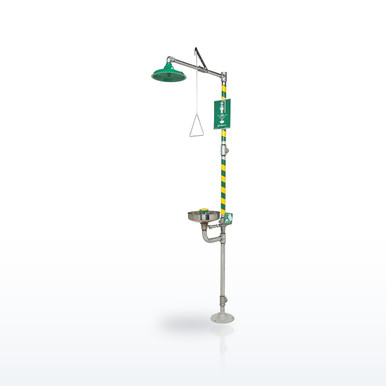 Haws AXION MSR combination shower and eye/face washDrench shower and eye/face wash on one stand, usable at the same time
Why 20 gallons a minute? A shower is for a splash that hits more than the face: an acid line that lets go, a drum that tips, a caustic that soaks a sleeve. The job is to flood the whole body fast enough that the chemical is diluted and washed off before it burns through skin, and to keep doing it for 15 minutes while clothing comes off. An ordinary bathroom shower runs about 2 gallons a minute. The 20-gallon figure, the 20-inch spray pattern and the 82-to-96-inch head height together describe a column of water a person can stand under fully dressed and be drenched head to foot.
What are the Z358.1 numbers for a drench shower?
Each figure, with where it comes from. A plumbed shower and a self-contained (tank) shower must both meet all of them.
How is tepid water delivered?
This is the figure most plumbed showers fail. Cold-water lines in an unheated building run well under 60°F for much of the year, and a roof-fed line in summer can run over 100. The usual fix is a thermostatic mixing valve sized for 20 gallons per minute that blends hot and cold to a set point and fails to cold if the hot supply is lost, with a scald-protection bleed valve on the line. Where there is no hot water, a tank-type (self-contained) shower in a heated jacket, or a tankless heater on the feed, does the same job. Outdoor units in freezing climates use freeze-protected valves and heat trace or an insulated enclosure.
ANSI/ISEA Z358.1-2014 section 4.5.6 (tepid flushing fluid), Appendix B (tepid water guidance); manufacturer installation data for the tempering valves and freeze-protected units in the band.OSHA’s own letter names water temperature as one of the conditions the employer is responsible for assessing, since 1910.151(c) does not give an installation specification. A shower that delivers 45°F water for 15 minutes is a shower nobody can stay under, and an inspector may treat it as unsuitable.
OSHA letter of interpretation, April 18, 2002 (employer responsibility to assess conditions, water temperature given as the example).What is a combination unit, and when is it the right choice?
A combination unit puts a drench shower and an eyewash or eye/face wash on one supply and one stand. The standard requires that each part meets its own section (20 gallons per minute for the shower, 0.4 or 3 gallons per minute for the eye or eye/face wash) and that the parts can be used at the same time by one person: a splash to the face and chest is flushed at both at once. Where the chemical can reach eyes and body, which is most splash hazards, the combination unit is what the standard describes. An eyewash alone covers the eyes; a shower alone is hard to use for the eyes because the flow is too heavy.
ANSI/ISEA Z358.1-2014 section 7 (combination units), 7.4.4 (components usable simultaneously), 7.5.2 and 7.5.5 (weekly activation, annual inspection).The eye/face wash figures: 3.0 gallons per minute for 15 minutes, nozzles 33 to 53 inches above the floor and 6 inches from the wall, hands-free, tepid. The eyewash figures (0.4 gallons per minute) are in the eyewash requirements guide.
ANSI/ISEA Z358.1-2014 sections 6.1.6, 6.4.4, 6.2, 6.4.6.How often is a shower tested, and what about the water on the floor?
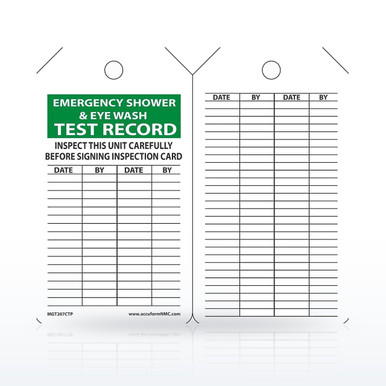
- Weekly: activate a plumbed shower long enough to confirm it flows and to clear stagnant water from the branch line. Visually check a self-contained shower’s fluid weekly. Record the date on a tag at the unit.
- Yearly: inspect every requirement, including the 20 gallons per minute (a test bucket or flow gauge), the pattern at 60 inches, the head height, the actuator height, the temperature and the path.
- Drainage is not required by the standard, but 20 gallons a minute for a weekly test is 20 gallons on the floor. A floor drain, a test cart with a bucket and a drain hose, or a shower tester funnel that catches the water keeps the weekly test from being skipped, which is the most common reason showers are found not working.
- Training: everyone who may be exposed must be told where the shower is and shown how to use it, including how to help someone under it and when to remove contaminated clothing.
Does OSHA require a shower, or just an eyewash?
The rule says eyes or body. Where the material can reach the body, quick drenching of the body is required, and a shower is the facility that does it. Where the only credible exposure is to the eyes (a small bottle of reagent at a bench, a battery-watering job in a tight bay), an eyewash may be enough. The employer decides from the quantity, the pressure, the way it is handled and the SDS. Construction has the same sentence at 1926.50(g).
29 CFR 1910.151(c) and 1926.50(g); OSHA letter of interpretation, June 1, 2009 (employer determines whether and how employees can be exposed).Drench showers, combination units and shower valves
9 items · prices liveType is as labeled by the manufacturer. Flow, head height and the ANSI Z358.1 edition each unit is built to are on the spec sheet linked from the product page. Showers ship freight; call for a quote on more than one. Contractor Direct orders ship free; freight items excepted.
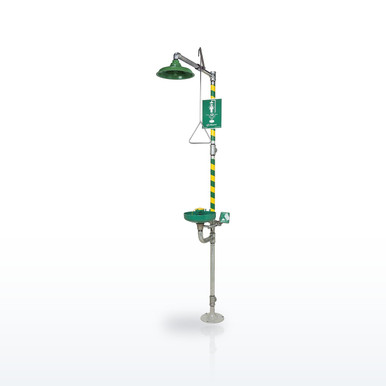
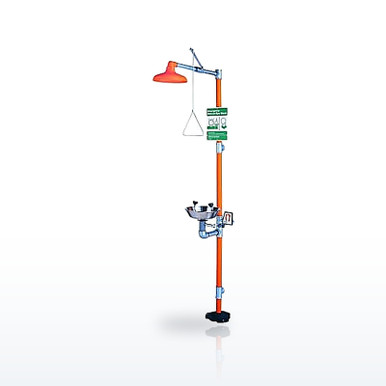
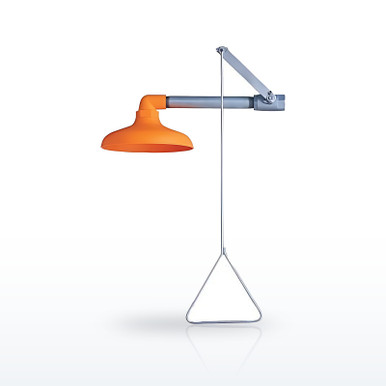
Portable and tank-type eyewash stations are in the eyewash requirements guide below. Mobile heated shower trailers are quoted on request: call (925) 215-7337.
Questions people ask
What is the flow rate for an emergency shower?
At least 20 gallons per minute (75.7 liters) for at least 15 minutes, under ANSI/ISEA Z358.1-2014 section 4.
How high should an emergency shower head be?
Between 82 and 96 inches above the surface the user stands on, with a spray at least 20 inches across measured at 60 inches up.
What temperature should safety shower water be?
Tepid: above 60°F (16°C) and below 100°F (38°C). A thermostatic mixing valve rated for 20 gallons per minute is the usual way to get there on a plumbed unit.
How far can a safety shower be from the hazard?
Within 10 seconds, which the standard’s appendix puts at about 55 feet, on the same level with nothing in the path.
How often should an emergency shower be tested?
Activated weekly on a plumbed unit (fluid checked weekly on a tank unit), and fully inspected once a year. Keep the dates on a tag at the unit.
Does an emergency shower need a drain?
The standard does not require one. A drain, a test cart or a tester funnel makes the weekly test practical, and a shower that is never tested is the common failure.
Does OSHA require an emergency shower?
1910.151(c) requires suitable facilities for quick drenching of the eyes and body where injurious corrosives can reach them. A shower is what drenches the body; OSHA judges suitable against Z358.1.
What is a combination unit?
A drench shower and an eyewash or eye/face wash on one stand and supply, built so one person can use both at the same time. Each part meets its own section of the standard.
Standards and ratings on this page are as published in the documents named and by the manufacturers named. The employer’s hazard assessment and written program decide what applies at a given workplace. Verify a rating on the product and its spec sheet before use.