
Fingertip and knuckle bandages: how to apply them
A fingertip bandage is an hourglass or butterfly shape that wraps over the end of a finger: the pad covers the tip and the two wings fold down the sides and overlap on the nail and the pad, so the cut is covered from both directions without a bulky knot. A knuckle bandage is an H shape: the pad sits over the joint and the four arms wrap around the finger above and below it, so the joint bends without the bandage lifting. Both work the same way: stop the bleeding with pressure, clean the cut, dry the skin, apply without touching the pad, press the wings in the right order, and change it when it is wet or dirty. Anything deep, gaping, still bleeding after 10 minutes of pressure, or from a dirty or crushed injury needs more than a bandage.
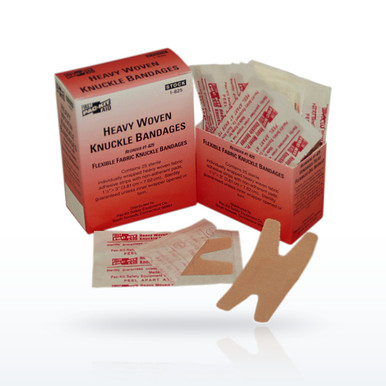
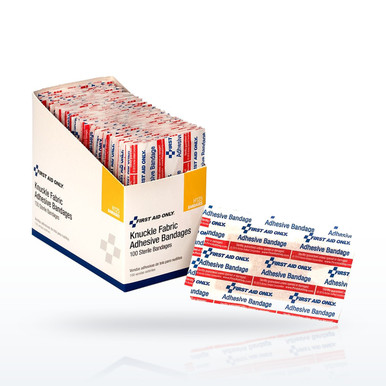 First Aid Only H125 heavy woven knuckle bandagesFabric H-shape bandage for a cut over the joint
Why not just use a strip? A 1 x 3 inch strip is flat and a finger is round and moves. On a fingertip the strip has nothing to grip and slides off the first time the hand goes in a glove; on a knuckle it either bunches when the finger bends or tears away. The two shapes exist because the fingers are where most jobsite cuts happen and the standard strip does not stay on them. A bandage that falls off in an hour is a cut that stays open all shift, and in a food plant a lost bandage is a product recall.
How do you put on a fingertip bandage?
Hourglass or butterfly shape; the pad goes over the tip of the finger.
How do you put on a knuckle bandage?
- Stop the bleeding and clean the cut as above. Dry the skin on both sides of the joint.
- Bend the finger slightly to the position it will spend most of the day in, usually a loose curl. A knuckle bandage applied on a straight finger tightens and lifts the first time the finger closes.
- Hold it by the backing tabs and expose the pad without touching it. Center the pad over the cut on the knuckle.
- Wrap the two arms on one side of the H around the finger above the joint, one in each direction, so they overlap on the underside.
- Wrap the two arms on the other side around the finger below the joint the same way. Each pair circles the finger; the pad bridges the joint between them.
- Press and flex Press the arms down for 10 seconds and work the finger. The pad should flex over the knuckle with the arms anchored on either side. If it pulls, it is on too tight or the finger was straight when you applied it.
The same H shape covers a cut on the heel of the hand, the back of the wrist or the elbow: the pad over the cut and the arms wrapped above and below the joint.
When is a bandage not enough?
- Bleeding that does not stop after 10 minutes of firm, continuous pressure, or that spurts. That is pressure, a trauma pad and a call for help, not a bandage.
- A cut that gapes open, or is deeper than the skin: a flap, visible fat or tendon. It needs closing by a clinician within hours.
- A puncture or a cut from something dirty, rusty or from an animal. It needs cleaning and a tetanus check.
- Numbness, or a finger that will not bend or straighten. A tendon or nerve may be cut.
- A crush or an amputated fingertip. Pressure, elevation, keep the part cool and dry in a bag, and go.
- Any wound that is red, swollen, hot or draining a day or two later.
Fabric, plastic or blue metal-detectable: which bandage for which job?
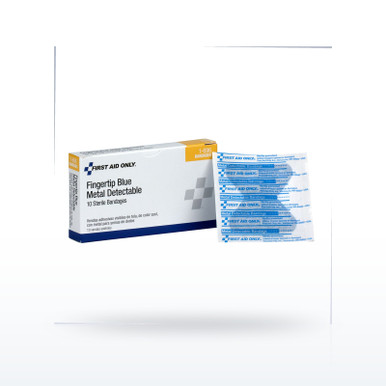
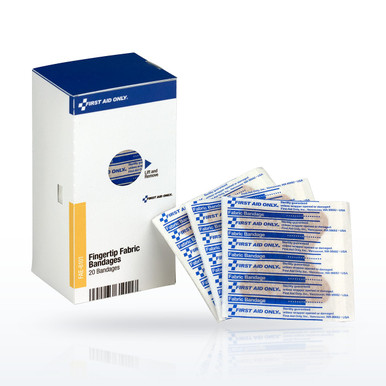
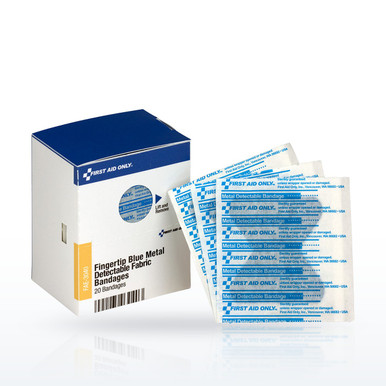
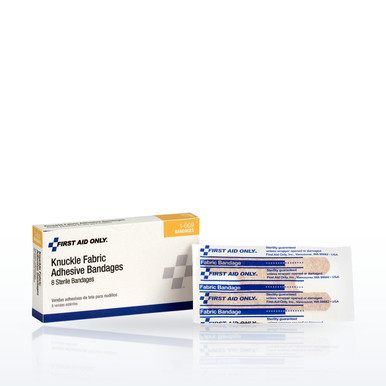
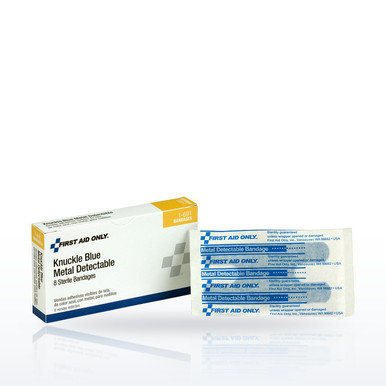
Fabric (woven) bandages stretch with the skin and hold through sweat and glove friction, which is why the workplace kits carry them; heavy woven is a thicker fabric for the same reason. Plastic strips are cheaper and stay cleaner but do not stretch, so they come off fingers first. Blue metal-detectable bandages are fabric bandages with a blue color no food is and a metallic thread that trips the detector on a food or pharmaceutical line; they are the only kind allowed in many plants. All of the bandages in the band are listed by the manufacturer as not made with natural rubber latex, which matters for a crew where anyone has a latex allergy.
Manufacturer product data for the bandages in the band (First Aid Only: flexible fabric, ventilated, not made with natural rubber latex; blue metal-detectable for food and pharmaceutical processing).ANSI Z308.1 counts bandages by the 1 x 3 inch strip: 16 in a Class A kit and 50 in a Class B kit. Fingertip and knuckle bandages are not a required item; they are the supplementary supply the standard tells the employer to add where the hazard calls for it, and for any crew that works with its hands, it does. A box of each in the kit, and a refill cartridge in the cabinet where the kit uses one.
ANSI/ISEA Z308.1-2021 Table 1 (adhesive bandages, 1 x 3 in, 16 and 50) and supplementary supplies guidance.Fingertip and knuckle bandages
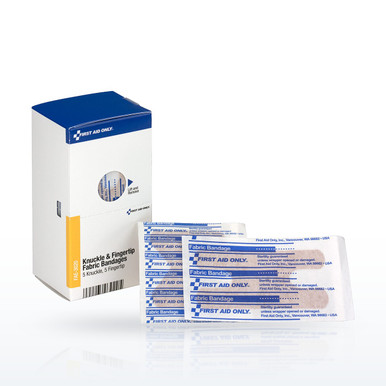
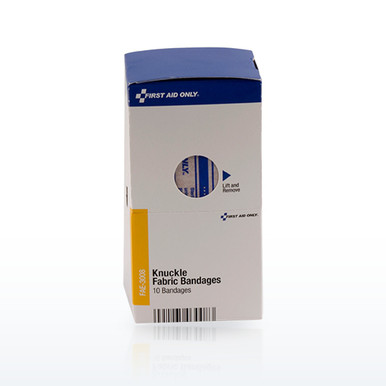
15 items · prices liveShape and material are as labeled by the manufacturer. Count per box and cabinet-refill fit are on each product page. Contractor Direct orders ship free.
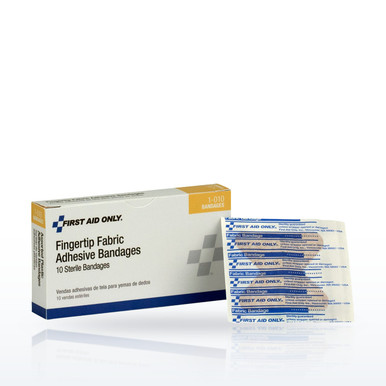
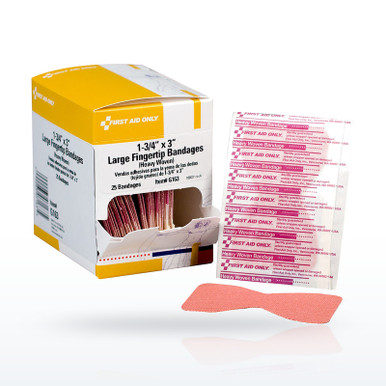
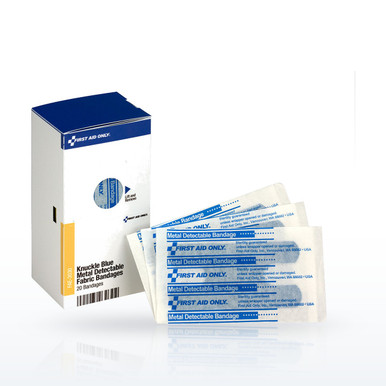
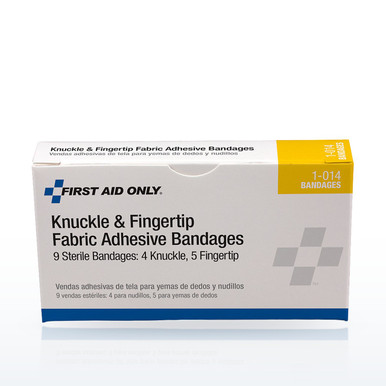
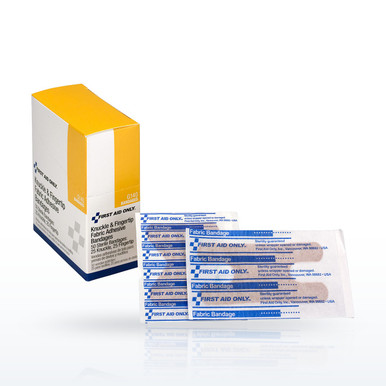
Standard 1 x 3 strips, trauma pads and the rest of the Z308.1 fill are in the first aid finder.
Questions people ask
How do you put a fingertip bandage on?
Clean and dry the finger, center the pad on the tip, fold one wing down the nail side, fold the other over it on the pad side, and press for 10 seconds. The overlap holds it.
How do you put a knuckle bandage on?
Bend the finger slightly, center the pad on the joint, wrap the two arms on one side around the finger above the knuckle and the two on the other side below it, then press and flex.
Why does my bandage keep falling off my finger?
Wet or oily skin, a flat strip on a round finger, or applying a knuckle bandage with the finger straight. Dry the skin, use the shaped bandage, and apply with the finger in its working position.
What is a knuckle bandage?
An H-shaped adhesive bandage. The crossbar pad covers the cut on the joint and the four arms wrap the finger above and below it, so the joint bends without lifting the pad.
What is a fingertip bandage?
A butterfly or hourglass-shaped bandage whose wings fold over the end of the finger from both sides, covering a cut on the tip or the pad.
What are blue metal-detectable bandages for?
Food and pharmaceutical plants. The blue shows against food, and a metal strip in the bandage sets off the line’s metal detector if one is lost into the product.
Does ANSI Z308.1 require fingertip or knuckle bandages?
No. It requires 1 x 3 inch strips (16 Class A, 50 Class B). Shaped bandages are a supplementary item the standard tells the employer to add for the site’s hazards.
When does a cut need stitches?
When it gapes, is deeper than the skin, will not stop bleeding after 10 minutes of pressure, or is on a joint and keeps opening. Go within a few hours; cuts are closed sooner rather than later.
Standards and ratings on this page are as published in the documents named and by the manufacturers named. The employer’s hazard assessment and written program decide what applies at a given workplace. Verify a rating on the product and its spec sheet before use.