Home › Guides › Roofing tools › Reading a tape measure
Guide · Measuring tools · Tape measures, reel tapes and measuring wheels

How do you read a tape measure? Inches, the 1/16 marks, 3/8 and the other fractions, the 16 and 19.2 inch marks, decimals to fractions, accuracy and Type 1 and Type 2 tapes, metric tapes, and how a measuring wheel works

A standard US tape measure is divided into inches, and each inch into sixteenths: the longest line is the inch, the next longest the half (8/16), then the quarters (4/16 and 12/16), the eighths and the shortest lines the sixteenths. To find 3/8, count three of the eighth-inch lines past the inch mark, which is the same as six sixteenths. The large numbers are inches; the small red numbers every 16 inches and the black diamonds every 19.2 inches are stud and joist spacings. A pocket tape is normally accurate to about 1/16 inch over its length; a 100 ft reel tape and a measuring wheel are for long runs where that tolerance does not matter.
Bayshore Safety. Industrial safety, roofing tools and jobsite supplies since 2017. · Current as of November 2026 · the C&R Rock Solid and Keson tape measure product data on this site (RST-260, RSTP-25, TPW-25, TPME-25, TPAL-25, ORT-100N, ORTP-100, ABSTP-100, 12WHL, 4SWHL); Keson product pages (keson.com, fetched Nov 10 2026); the markings printed on the blades themselves (16 inch stud marks, 19.2 inch black diamonds); NIST Handbook 44 and the Type 1 / Type 2 accuracy classes as published for retail tapes
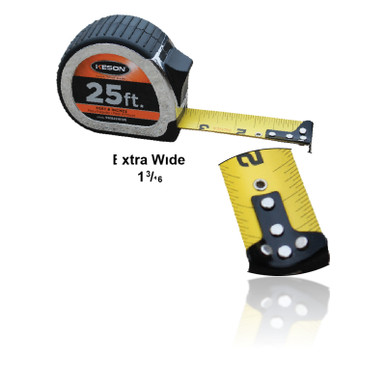
Keson TPW-25 Tape Measure, 25 ft, Extra WideKeson TPW-25 Tape Measure, 25 ft, Extra WideKeson lists the TPW-25 as an extra wide 25 ft tape with a non-slip grip; the wide blade stands out farther before it folds

Why the question is asked 1,500 ways. A tape measure is the one tool every trade uses and almost nobody is taught to read. The marks are all there on the blade: a roofer laying out courses, a framer marking studs at 16 on center, a tile setter checking a 3-4-5 triangle and a homeowner reading 3.9 inches off a drawing all need the same three things explained once: what each line length means, how to turn a fraction into a mark and a decimal into a fraction, and how far to trust the number. This page does that in the order the questions come up, then covers the long tapes and the measuring wheel that take over when a 25 ft blade runs out.

Reading the blade, mark by mark

The marks below are the US standard layout printed on every tape we carry; a metric tape is covered further down.

How many inches are in a tape, and what are the large numbers?The large numbers are whole inches, running from 1 at the hook to the length of the blade: 300 on a 25 ft tape, 312 on a 26 ft tape, 1,200 on a 100 ft reel. Most pocket tapes also print feet in a second color (1F, 2F) with the inches restarting after each foot, so a mark can read either as "38" or as "3F 2". Both mean the same place on the blade.
What are all the lines on a tape measure?Between any two inch numbers there are fifteen lines of four lengths. The one long line in the middle is the half inch. The two next-longest are the quarters (1/4 and 3/4). The four after that are the eighths (1/8, 3/8, 5/8, 7/8). The eight shortest are the sixteenths (1/16, 3/16, 5/16, 7/16, 9/16, 11/16, 13/16, 15/16). Some tapes mark the first foot in thirty-seconds, which adds one more set of still shorter lines; past the first foot almost every tape stops at sixteenths.
How do I find 3/8 on a tape measure?Start at the inch mark and count the eighth-inch lines: the first is 1/8, the second is 1/4 (printed as a longer quarter line), the third is 3/8. In sixteenths it is the sixth short line. The quick way is to find the quarter mark and step back one eighth: 3/8 is one eighth short of the half, and 5/8 is one eighth past it.
What does 1/4 inch mean, and where is .25?One quarter inch is the second-longest line in each inch, the first of the two quarter marks. In decimals 1/4 is 0.25, so ".25 on a tape" is the quarter line. The same logic gives .5 for the half line and .75 for the third quarter (12/16). A decimal that is not a clean quarter has to be converted, which the next card covers.
How do I convert a decimal to a fraction on a tape measure?Multiply the decimal part by 16 and round to the nearest whole number; that number is the count in sixteenths. 0.6 inch x 16 = 9.6, so 0.6 inch is about 10/16, which is 5/8. 2.75 inches is 2 and 12/16, which is 2-3/4. 3.94 inches x 16 = 15.04, so it is 3-15/16, one sixteenth short of 4. 3.9 inches is 3 and 14.4 sixteenths, so a hair past 3-7/8. 11/32 is between 5/16 and 3/8; on a sixteenths tape you read it as halfway between the fifth and sixth short lines.
What are 11/16, 27/32, 31/32 and 5/32 on a tape?11/16 is the eleventh short line past the inch, three sixteenths past the half. 27/32 is between 13/16 and 7/8 (half a sixteenth past 13/16). 31/32 is a thirty-second short of the next inch. 5/32 is halfway between 1/8 and 3/16. Thirty-seconds exist only on the first foot of some tapes; past that, read them as half-steps between sixteenths. For work that needs thirty-seconds everywhere, a steel rule or a machinist scale is the tool, not a tape.
What is the 16 inch mark, and what is 19.2?Every 16 inches the inch number is printed in red or boxed (16, 32, 48, 64, 80, 96) because studs, joists and rafters are laid out 16 inches on center and 96 inches is 8 feet, the sheet length. The small black diamonds every 19.2 inches (19.2, 38.4, 57.6, 76.8, 96) are the five-per-sheet layout: five joists at 19.2 inches also land on 96. Roofers meet the 16 inch marks when nailing roof brackets to rafters and the 19.2 diamonds on trusses set at that spacing.
How accurate is a measuring tape?Tapes sold for trade use carry an accuracy class. A Type 1 (Class I) tape is held to about 1/32 inch over 10 feet; Type 2 (Class II) to about 1/16 inch over 10 feet, and most pocket tapes meet Type 2 or are unclassed, which in practice means about 1/16 inch over the blade. The hook is riveted loose on purpose: it slides by its own thickness so an inside (push) measurement and an outside (hook) measurement both read true. A bent hook, a kinked blade or a tape read from the wrong side of the hook each add more error than the class allows, so a crew checks its tapes against one another at the start of a job.
What sizes do measuring tapes come in?Pocket tapes run 12, 16, 25, 26, 30 and 35 feet, with 25 ft the trade standard and 26 ft the same tape with one more foot for 26 ft rafter runs. Blade widths run 3/4 inch to 1-1/4 inch; a wider blade stands out farther before it buckles (Keson lists its TPW-25 as an extra wide blade; the Rock Solid RSTP-25 data lists a 7 ft standout). Reel tapes run 50, 100, 200 and 300 feet in steel or fiberglass; fiberglass does not rust or conduct, steel does not stretch. We carry the 100 ft open and closed reels in both.
Are there metric tapes, and how do I read inches and centimeters on one tape?Yes. A metric tape is divided into centimeters with ten millimeter lines each; a dual tape prints inches along one edge and centimeters along the other. To read both, pick the edge that matches the drawing and ignore the other. There is no clean conversion between sixteenths and millimeters (1/16 inch is 1.5875 mm), so a dual tape is read in one system or the other, never mixed on the same mark.
Can I use my phone as a tape measure?Phone measuring apps estimate distance from the camera and are fine for a rough room size. They are not a substitute for a tape on anything that gets cut: the error is inches, not sixteenths, and it grows with distance and poor light. Use the phone to estimate how much material to order and the tape to cut it.
How to wrap a tape measure, and what the parts are calledThe blade is the steel strip; the hook (or tang) is the riveted end piece; the case holds the spring; the lock button holds the blade out; the belt clip hangs it. To rewind a tape that has fed out fully, guide the blade with a gloved hand so the hook does not slam the case, which is what snaps hooks and cracks cases. On a reel tape, fold the handle out and crank; wipe a muddy blade as it goes in so grit does not score the markings.
What is the measuring wheel called, how does it work, and how accurate is it?A measuring wheel (also called a distance wheel, surveyor’s wheel or clickwheel) counts the turns of a wheel of known circumference. Our 12 in wheel has a 36 inch circumference, so each turn is one yard and the counter reads in feet and inches; the compact 4 in wheel does the same on a smaller wheel for indoor runs. Accuracy is about 1 percent on a hard, flat surface and worse on gravel or grass where the wheel slips or bounces, so a wheel is the tool for pacing a roof perimeter, a parking lot or a fence line, not for anything that gets cut to length. Which size you need depends on the surface: the large wheel rolls over rough ground, the small one is for smooth floors.

The tape measure in plain words

  • Long line in the middle of the inch: half. Two medium lines: quarters. Four shorter: eighths. Eight shortest: sixteenths.
  • 3/8 is three eighth-lines past the inch, or six sixteenths; it sits one eighth short of the half.
  • Decimal to fraction: multiply the decimal by 16 and round. 0.6 inch is 10/16, which is 5/8.
  • Red or boxed numbers every 16 inches are stud spacing; black diamonds every 19.2 inches are the five-per-sheet joist layout.
  • The hook slides on its rivets by its own thickness so inside and outside measurements both read true. Do not tighten it.
  • A pocket tape is good to about 1/16 inch over its length; a Type 1 tape is held to 1/32 inch over 10 feet.
  • 25 ft is the trade standard pocket tape; 100 ft reels take over for long runs; a measuring wheel paces a perimeter to about 1 percent.
  • A metric tape reads in centimeters and millimeters; a dual tape is read on one edge at a time.

Questions people ask

How many inches are in a tape measure?

As many as its length in feet times 12: a 25 ft tape has 300 inches, a 26 ft tape 312 and a 100 ft reel 1,200. The large numbers on the blade are the inches, and most pocket tapes also print the feet in a second color.

How do I find 3/8 on a tape measure?

Count three of the eighth-inch lines past the inch mark; it is also the sixth sixteenth line, one eighth short of the long half-inch line.

How accurate is a measuring tape?

A trade pocket tape is accurate to about 1/16 inch over its length; a Type 1 tape is held to 1/32 inch over 10 feet. A bent hook or kinked blade adds more error than the class allows.

What are the large numbers on a tape measure?

Whole inches. The red or boxed numbers every 16 inches mark stud spacing and the black diamonds every 19.2 inches mark the five-joists-per-sheet layout.

What does 2.75 inches look like on a tape measure?

Two inches plus the third quarter line, which is 2-3/4, or 2 and 12/16.

What is 3.94 inches on a tape measure?

Three inches plus 15/16, one short line before the 4 inch mark; 0.94 x 16 is 15.

What is .75 on a ruler?

Three quarters of an inch, the second of the two medium-length quarter lines in the inch.

Can I use my phone as a tape measure?

For a rough room size, yes; for anything that gets cut, no. Camera measuring apps are off by inches and the error grows with distance.

Are there metric tape measures?

Yes, in centimeters and millimeters, and dual tapes carry inches on one edge and centimeters on the other. Read one edge at a time.

What sizes do measuring tapes come in?

Pocket tapes 12 to 35 ft with 25 ft the trade standard; reel tapes 50 to 300 ft in steel or fiberglass; blade widths from 3/4 to 1-1/4 inch.

How does a measuring wheel work, and how accurate is it?

It counts turns of a wheel of known circumference (our 12 in wheel is 36 inches around, one yard per turn) and reads in feet and inches on a counter. Accuracy is about 1 percent on flat ground and worse on gravel or grass.

What is the measuring wheel called?

A measuring wheel, distance wheel, surveyor’s wheel, trundle wheel or clickwheel; they are all the same tool.

The ratings, test results and standards shown here are the manufacturers' published values, reproduced as published. Nothing on this page is a recommendation by Bayshore Safety that any product is suitable for a particular task, hazard or workplace. Selecting safety products and protective equipment is the responsibility of the end user and the employer, based on their own hazard assessment and the regulations that apply to their work. Confirm every value on the manufacturer's own documentation before use.

Setting up a roofing crew or a shop?Call (925) 215-7337 or email us the trades, the crew size and the quantities and we will quote tools and supplies by the case, with the part numbers listed. We sell nationwide.
All roofing tools
How to buyCard, purchase order or invoice terms; quotes on request; agencies and institutions welcome.
Live Service & SupportReal people who know the products, Monday to Friday 7:30am to 4pm Pacific. 925-215-7337
We DeliverWe ship nationwide. Parcel and LTL freight to job sites and businesses across the U.S.