
What does a 4/12 pitch look like on a speed square, and how does it differ from a framing square? Reading pitch and rafter angles, combination squares, L-squares and the 3-4-5 check, torpedo levels, magnetic levels, and the sizes of each
A 4/12 pitch rises 4 inches for every 12 inches of run, which is 18.4 degrees; on a speed square it is the 4 on the common-rafter scale along the long edge: pivot the square on its corner against the board edge until the 4 lines up with the edge and the hypotenuse marks the cut. A speed square (rafter square) is a 7 or 12 inch aluminum triangle with a lipped fence, a 45 degree edge, a degree scale and rafter scales; a framing square (L-square, carpenter’s square) is a flat 24 by 16 inch L with rafter tables stamped on it, for laying out stair stringers, rafters and checking large work square. A combination square is a 12 or 16 inch rule in a sliding head with 90 and 45 degree faces and a bubble, for marking, depth and short squareness. A torpedo level is a 9 inch level with a magnetic base for pipe, conduit and metal.
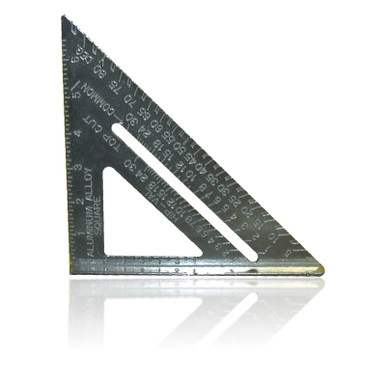 C&R M-004 Aluminum Alloy Square, 7 inThe product data lists the M-004 as a 7 in aluminum alloy square
Pitch, in one line. Roof pitch is rise over 12 inches of run: 4/12, 6/12, 12/12. The speed square carries that number on its common scale so the angle never has to be converted to degrees, and the framing square carries the rafter tables so the rafter length per foot of run can be read off. The cards below answer what 4/12 looks like on the square, how to find a roof angle with it, the difference between the squares, what an L-square and a combination square are for and their sizes, the 3-4-5 check, whether a framing square has a 45, how to adjust one, what a torpedo level does, and what size it comes in. The magnetic level is here because it is the level roofers and gutter crews use on metal.
Squares and levels, question by question
Sizes are from the product data on this site; the pitch angles are geometry, and the scales are the ones printed on every rafter square.
Squares and levels in plain words
- Pitch is rise over 12 inches of run. 4/12 is 18.4 degrees, 6/12 is 26.6, 12/12 is 45.
- On a speed square, pivot on the corner and line the pitch number on the common scale with the board edge; the long edge is the cut.
- Speed square: 7 or 12 inch triangle with a fence; marks 90, 45, any degree and rafter cuts; saw guide.
- Framing square: 24 x 16 inch flat L; stairs, rafters, big squareness; 45 by equal numbers on both legs.
- Combination square: sliding rule for square, 45, depth and scribing parallel lines; tighten the nut and check it.
- 3-4-5 checks square over any distance.
- Torpedo level: 9 inches, level, plumb and 45 vials; magnetic base for pipe, conduit, gutter and metal.
- A dropped square is out of true; check by mark, flip, mark.
Questions people ask
What does a 4x12 pitch look like on a speed square?
The long edge set at the 4 on the common scale, 18.4 degrees off the fence.
What is the difference between a speed square and a framing square?
The speed square is a 7 or 12 inch fenced triangle for marking cuts and rafter angles; the framing square is a 24 x 16 inch flat L for stairs, rafters and large squareness.
What is the most accurate square for woodworking?
We do not rank; a machinist’s combination square carries the tightest published tolerance, a carpenter’s square about 1/32 inch over 24 inches.
What is an L-square used for?
Squaring corners and sheets, laying out stairs and rafters, marking square cuts across wide boards, and as a straightedge.
What is the 3/4/5 rule for squares?
Measure 3 and 4 along the legs from the corner; a 5 diagonal means the corner is square, at any multiple.
What is a drawback of the combination square?
The rule slips if the thumb nut is loose, and a cheap head may not be square; check it by mark, flip, mark.
Who invented the speed square?
Albert J. Swanson, a carpenter, patented it in 1925.
How to adjust a framing square?
Check it against a straightedge by mark, flip, mark; a light center-punch tap near the inside corner opens it, near the outside corner closes it.
What size is a torpedo level?
6 to 12 inches, with 9 inches the common size.
What is a combination square?
A 12 or 16 inch rule in a sliding head with 90 and 45 degree faces, a bubble and a scriber.
What is the size of an L-square ruler?
24 x 16 inches for the carpenter’s framing square; smaller try squares and a 48 inch drywall T-square also exist.
Does a framing square have a 45 degree angle?
Not as a face; set equal numbers on both legs against an edge to get 45.
What does a torpedo level do?
Checks level, plumb and 45 on short work: pipe, conduit, gutters, drip edge, shims.
What is another name for a speed square?
Rafter square, triangle square or quick square.
What is the difference between a rafter square and a speed square?
None; speed square is the trade name that became generic for the rafter square.
How do you find a roof angle with a speed square?
Lay the square on the roof with a torpedo level on its fence and read where the roof line crosses the common scale, or measure the rise over 12 inches of run with a level.
What size combination square should I get?
12 inch for the pouch, 16 inch for layout.
What is the torpedo level for pipefitters?
A 9 inch level with a magnetic base and a V-groove that sits on pipe and holds itself there.
Related guides
Chalk lines and marking chalkColors, permanence and lumber crayonsHow do you read a tape measure?Fractions, the 16 and 19.2 inch marks, accuracy and measuring wheelsRoof brackets, roof jacks and ladder accessoriesAngles, planks, hooks and stabilizersMagnet sweepersNail cleanup after a roof jobSaw blades and TPIHacksaw, circular and reciprocating bladesThe ratings, test results and standards shown here are the manufacturers' published values, reproduced as published. Nothing on this page is a recommendation by Bayshore Safety that any product is suitable for a particular task, hazard or workplace. Selecting safety products and protective equipment is the responsibility of the end user and the employer, based on their own hazard assessment and the regulations that apply to their work. Confirm every value on the manufacturer's own documentation before use.