
Machine guarding signs and tags: what OSHA requires, and what a sign cannot replace
OSHA’s machine guarding rule requires a physical guard, not a sign. One or more guarding methods must protect the operator and others from the point of operation, nip points, rotating parts, and flying chips and sparks, and a sign does not count as one. Signs and tags come in around the guard. A tag goes on a machine when it is out of the ordinary: out of service, missing a guard, under repair, or locked out. A Danger sign marks an immediate hazard and a Caution sign a possible one, in the colors 1910.145 fixes. Lockout tags under 1910.147 must warn that the machine may not be operated and name the person who applied them.
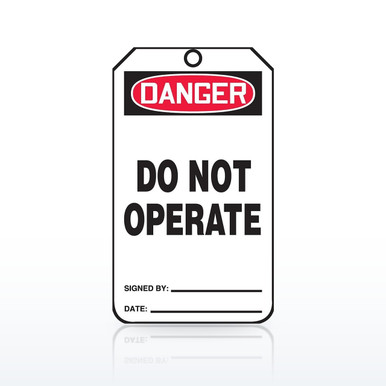
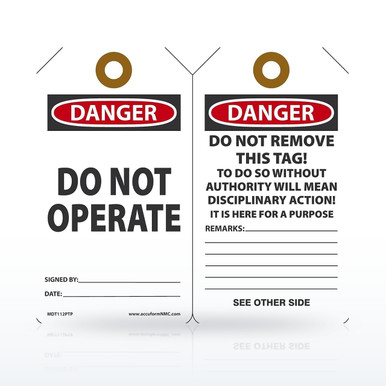
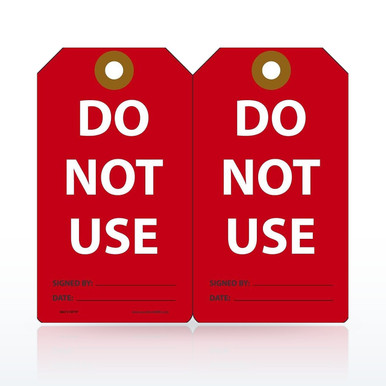 Accuform Do Not Use equipment status tag, pack of 25Hangs on a machine that is out of service; 5-3/4 x 3-1/4 in with a reinforced grommet
Why does OSHA separate guards from signs? A guard stops a hand from reaching the blade whether or not anyone reads anything. A sign only works on a person who sees it, reads it, understands it and obeys it, every time. OSHA wrote the machine rule around the guard because the point of operation does not forgive one lapse. The sign and tag rules exist for the conditions a guard cannot cover: the machine that is broken, the guard that is off for repair, the setup where someone has to be told not to start it.
What does 1910.212 require?
The general machine guarding rule. None of it is satisfied by a sign.
When does a machine get a tag?
The accident prevention tag rule applies to hazardous conditions that are out of the ordinary, unexpected or not readily apparent: a machine with a guard removed, a broken interlock, a press waiting on a part. The tag stays on until the hazard is eliminated or the hazardous operation is completed. Tags are not required where signs, guarding or other positive means of protection are in place, which is the rule’s own statement that a tag is the fallback, not the protection.
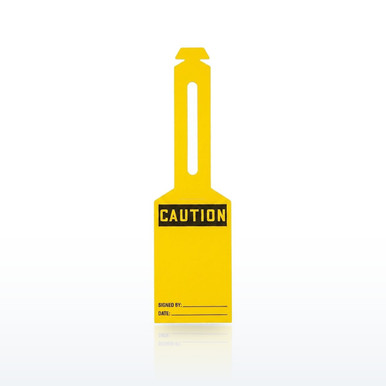
1910.145(f)(3).Every required tag carries a signal word and a major message. The signal word is Danger, Caution, Biological Hazard or BIOHAZARD, readable from at least 5 feet. The major message states the condition or the instruction: Do Not Start, Do Not Use, Close Clearance, High Voltage. Danger tags are for major hazard situations where an immediate hazard threatens death or serious injury, and only those; Caution tags for minor hazards with a lesser threat, and only those; Warning may be used between the two. The tag is attached as close as safely possible to the hazard by string, wire or adhesive that prevents its loss, and every employee is told what the tags mean.
1910.145(f)(4)(i) through (vi); (f)(5), (f)(6) and (f)(7); (f)(2) definition of major message.What is different about a lockout tag?
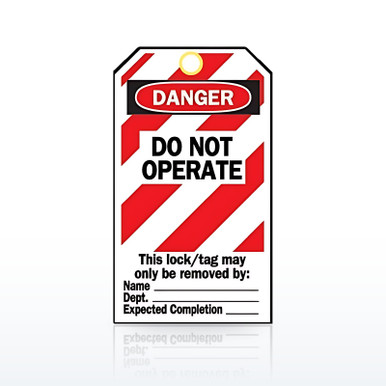
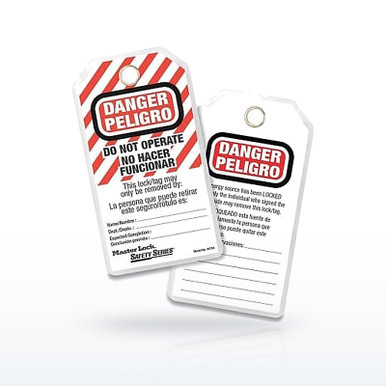
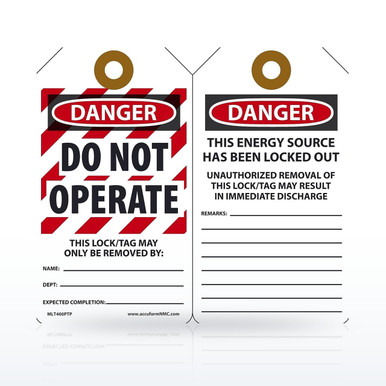
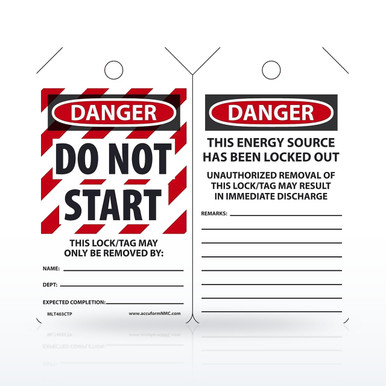
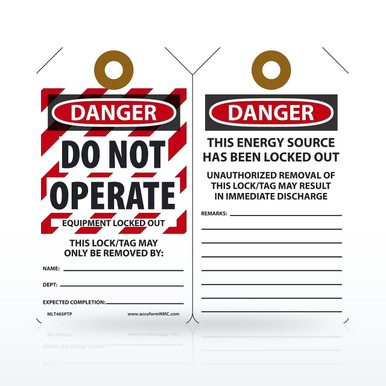
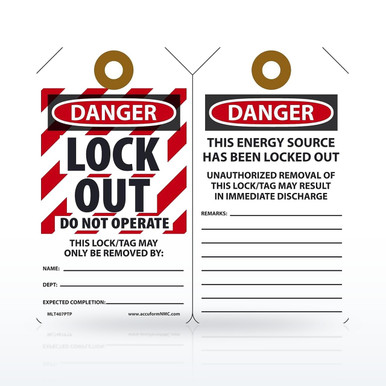
A tag used in lockout/tagout is a tagout device under 1910.147 and has its own rules on top of 1910.145. It must warn against hazardous conditions if the machine is energized, with a legend such as Do Not Start, Do Not Open, Do Not Close, Do Not Energize or Do Not Operate. It must identify the employee who applied it. It must be durable enough for weather, wet and corrosive areas without fading, standardized in print and format across the facility, and attached with a non-reusable, self-locking, hand-attachable tie that holds at least 50 pounds, equivalent to a one-piece nylon cable tie. And it is a warning only: it provides none of the physical restraint of a lock, and a tag alone is permitted only where the isolating device cannot be locked or where the employer shows equivalent protection.
1910.147(c)(5)(ii)(A) through (D) and (c)(5)(iii); (c)(2)(i) and (ii); (c)(7)(ii)(A).Which signs go on or near machines?
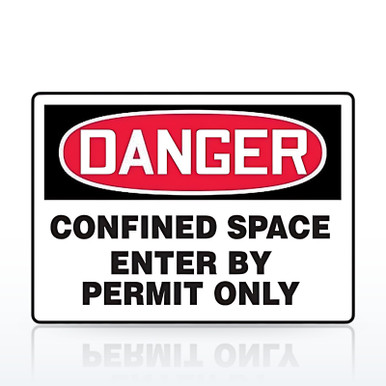
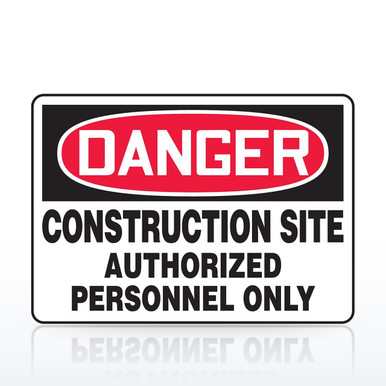
- Danger signs for an immediate hazard, in red, black and white: employees are instructed that danger means immediate danger and special precautions. Used where a guard opening, a hot surface or a pinch point remains after guarding and can cause death or serious injury.
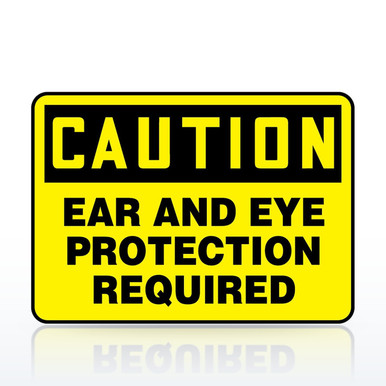
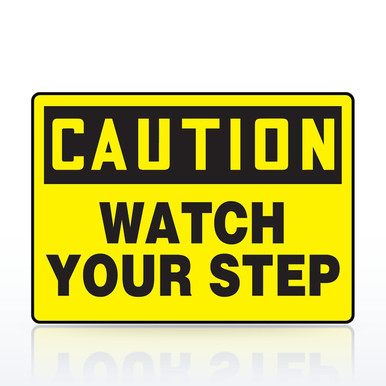
- Caution signs for a potential hazard or an unsafe practice, yellow background with a black panel: employees are instructed that caution means a possible hazard against which proper precaution should be taken. Pinch points, moving parts, PPE required at the machine.
- Safety instruction signs, white with a green panel, for instructions such as the location of the emergency stop or a cleaning procedure.
- Emergency stops themselves are red: emergency stop bars on hazardous machines and stop buttons used for emergency stopping are red by rule.
- ANSI Z535 format, with a signal word header, the safety alert symbol and a pictogram, is what manufacturers build to and what OSHA accepts; Warning, in orange, fills the gap between Caution and Danger that OSHA’s sign classes leave open.
Can a sign excuse a missing guard?
No. The guarding rule has no exception for a warning, and the tag rule says tags are not needed where guarding is in place, not the reverse. A sign that says Keep Hands Clear on an unguarded nip point documents the hazard without controlling it. Where a guard has to come off for servicing, the servicing is done under lockout, with the tag and lock on the isolating device, and the guard goes back before the machine returns to production.
1910.212(a)(1) and (a)(3)(ii); 1910.145(f)(3); 1910.147(a)(2)(ii)(A): removing or bypassing a guard during production brings the work under the lockout standard.Tags and signs for machines
22 items · prices liveSignal words, legends and colors are as published by each manufacturer. The signal word that applies to a given machine condition is set by the employer’s assessment under 1910.145, not by this page. Free shipping on orders over $199.
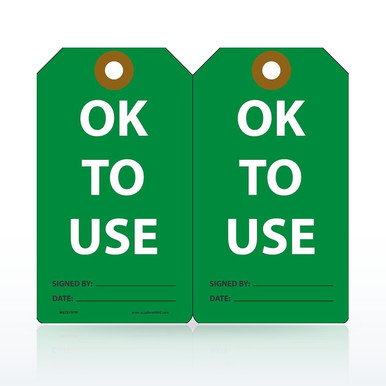
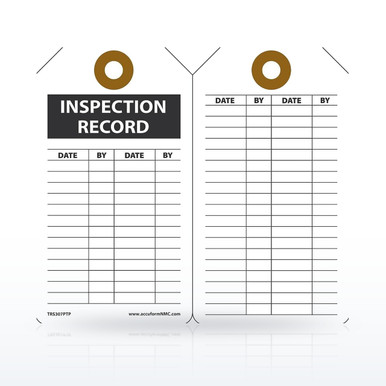
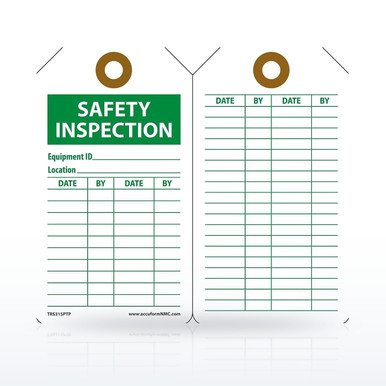




Custom legends and sizes are quoted on request: call (925) 215-7337.
Questions people ask
Does OSHA require signs on machines?
Not in the machine guarding rule. 1910.212 requires guards. Signs and tags are required by 1910.145 where a hazard is out of the ordinary or not readily apparent, and by 1910.147 when a machine is locked or tagged out.
Can a warning sign replace a machine guard?
No. The guarding requirement has no exception for a sign, and 1910.145(f)(3) says tags are not needed where guarding is in place, not that a tag replaces it. (1910.212(a)(1).)
When is a tag required on a machine?
When employees are exposed to a hazardous condition that is out of the ordinary, unexpected or not readily apparent, until the hazard is eliminated or the operation completed. (1910.145(f)(3).)
What must be on an accident prevention tag?
A signal word, Danger, Caution or Biological Hazard, readable from 5 feet, and a major message stating the condition or instruction. (1910.145(f)(4).)
What is the difference between a Danger tag and a Caution tag?
Danger is for an immediate hazard threatening death or serious injury, and only that. Caution is for a non-immediate or potential hazard with a lesser threat, and only that. (1910.145(f)(5) and (f)(6).)
What has to be on a lockout tag?
A warning that the machine may not be operated (Do Not Start, Do Not Operate or similar), the identity of the employee who applied it, durable material, and a self-locking tie that holds 50 pounds. (1910.147(c)(5)(ii) and (iii).)
What color is an emergency stop?
Red. Emergency stop bars and stop buttons used for emergency stopping of machinery are red. (1910.144(a)(1)(iii).)
Which machines need point-of-operation guards?
Any whose point of operation exposes an employee to injury. OSHA lists guillotine cutters, shears, power presses, milling machines, power saws, jointers, portable power tools, forming rolls and calenders as machines that usually do. (1910.212(a)(3)(ii) and (iv).)
Standards and ratings on this page are as published in the documents named and by the manufacturers named. The employer’s hazard assessment and written program decide what applies at a given workplace. Verify a rating on the product and its spec sheet before use.