
OSHA first aid kit requirements: what 1910.151 and ANSI Z308.1 require
OSHA’s rule, 1910.151, says three things: a workplace must have people trained to give first aid unless a clinic or hospital is close enough to the job, first aid supplies must be readily available, and eyewash must be provided where corrosives are used. It does not list what goes in the kit. For that, OSHA points to ANSI/ISEA Z308.1, which sets two fills: Class A for ordinary workplaces (adhesive bandages, gauze, tape, antiseptic, burn treatment, gloves, CPR barrier, eye wash and more, in set quantities) and Class B, larger and broader, for higher-risk or larger sites. Buying a kit marked ANSI Z308.1-2021 Class A or B is how most employers meet the rule.
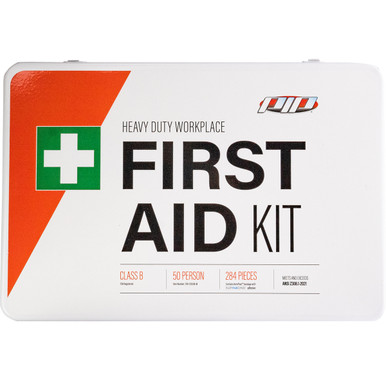
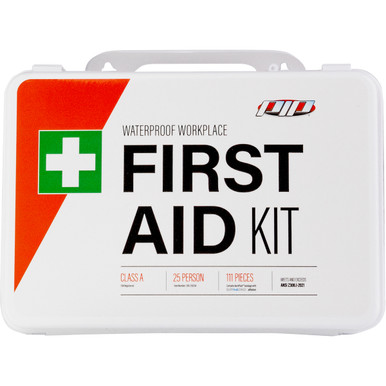 PIP 299-21025A ANSI Class A kit, 25 personZ308.1-2021 Class A fill in a waterproof case
Why does the standard not list the contents? Because OSHA wrote 1910.151 to be performance-based: supplies must be adequate for the hazards of the workplace, and a welding shop, an office and a logging crew do not need the same box. OSHA then told inspectors, in an appendix and in interpretation letters, that a kit meeting ANSI Z308.1 is adequate for a typical workplace, and that the employer should add to it for specific hazards. So the ANSI classes became the de facto minimum, and the hazard assessment adds the rest.
What does OSHA 1910.151 require?
Three paragraphs. The ANSI standard fills in the kit.
ANSI/ISEA Z308.1-2021 Class A and Class B minimum contents
| Item | Class A (quantity) | Class B (quantity) |
|---|---|---|
| Adhesive bandages, 1 x 3 in | 16 | 50 |
| Adhesive tape | 1 (2.5 yd) | 2 (2.5 yd) |
| Antibiotic application, 1/57 oz | 10 | 25 |
| Antiseptic, 1/57 oz | 10 | 50 |
| Breathing barrier (CPR) | 1 | 1 |
| Burn dressing, gel-soaked, 4 x 4 in | 1 | 2 |
| Burn treatment, 1/32 oz | 10 | 25 |
| Cold pack, 4 x 5 in | 1 | 2 |
| Eye covering, with means of attachment | 2 | 2 |
| Eye/skin wash | 1 fl oz | 4 fl oz |
| First aid guide | 1 | 1 |
| Hand sanitizer, 1/32 oz | 10 | 20 |
| Medical exam gloves, pairs | 2 | 4 |
| Roller bandage, 2 in x 4 yd | 1 | 2 |
| Roller bandage, 4 in x 4 yd | 0 | 1 |
| Scissors | 1 | 1 |
| Splint, 4 x 24 in | 0 | 1 |
| Sterile pads, 3 x 3 in | 2 | 4 |
| Tourniquet | Not required (optional supplement) | 1 |
| Trauma pads, 5 x 9 in | 2 | 4 |
| Triangular bandage, 40 x 40 x 56 in | 1 | 2 |
| Foil blanket, 52 x 84 in | 1 (added in 2021) | 1 |
Quantities are the standard’s minimums; manufacturers may exceed them. The 2021 edition added a foil blanket to Class A, raised the hand sanitizer count in both classes, and kept the tourniquet as a Class B item; Class A kits may add one as a supplement, and bleeding-control kits are covered in the standard’s guidance on supplemental supplies. Class B is for workplaces with more employees, higher risk, or more complex hazards; the standard leaves the choice to the employer’s assessment. Kits are also typed by container: Type I (indoor, fixed mount), Type II (indoor, portable), Type III (portable, mountable, water-resistant, for mobile and outdoor use), Type IV (portable, mountable, waterproof, for rough conditions and vehicles).
ANSI/ISEA Z308.1-2021 Table 1 (minimum required supplies) and section 4 (kit types), as published in manufacturer and distributor summaries of the 2021 edition; changes from the 2015 edition per the same summaries.
How many kits, and where?
The standards do not give a count per employee; the kit sizes sold as 10-person, 25-person or 50-person are manufacturers’ sizing of the same Class A or B fill with more of each item. The rule is readily available: a kit a worker can reach in the time an injury allows, on every floor or area, near the hazards, in every vehicle that carries a crew, and not locked in a supervisor’s office. OSHA’s construction rule adds that a weatherproof kit must be at the worksite and checked weekly. Restock after every use and check the whole kit on a schedule; a kit short of its fill is not an adequate kit.
29 CFR 1910.151(b) (readily available); 29 CFR 1926.50(d)(1) and (2) (weatherproof container, checked at least weekly); ANSI/ISEA Z308.1-2021 section 6 (inspection and restocking per the employer’s hazard assessment).What does construction require?
- Medical personnel available for advice, and a trained first-aid person on site unless a clinic or hospital is reasonably accessible in time and distance.
- First aid supplies easily accessible, in a weatherproof container with individually sealed packages for each type of item, checked by the employer before being sent to each job and at least weekly.
- Transport to a physician or hospital arranged in advance, with telephone numbers posted where there is no 911 service.
- Eyewash and drenching facilities where corrosives are used.
What should be added for specific hazards?
The ANSI fill is a floor. Add what the hazard assessment says: bleeding control kits with additional tourniquets and hemostatic dressings for saw, blade and heavy-equipment work; burn dressings and larger burn kits for welding and hot work; eyewash stations (not just the kit bottle) for chemicals; insect-sting and poison-plant supplies for outdoor crews; a splint set and larger dressings for remote sites far from care; an AED where sudden cardiac arrest is a recognized risk and response time is long. OSHA says the same in Appendix A: assess, then supplement.
29 CFR 1910.151 Appendix A; ANSI/ISEA Z308.1-2021 section 5.3 (supplemental supplies).Who has to be trained?
If no clinic or hospital is near enough, at least one person on each shift and at each location must be trained in first aid, and OSHA expects CPR training as well where the hazards warrant it. The training is from a recognized provider (Red Cross, American Heart Association, National Safety Council or equivalent) and is kept current, usually every two years. Where the workplace involves blood exposure as part of the job, the bloodborne pathogens standard applies to the responders.
29 CFR 1910.151(b); OSHA Best Practices Guide: Fundamentals of a Workplace First-Aid Program (3317); 29 CFR 1910.1030.ANSI Z308.1 Class A and Class B first aid kits
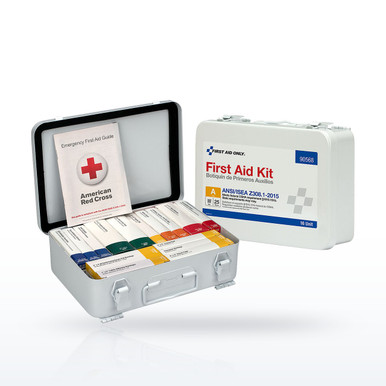
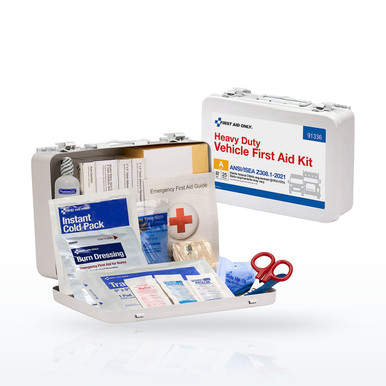
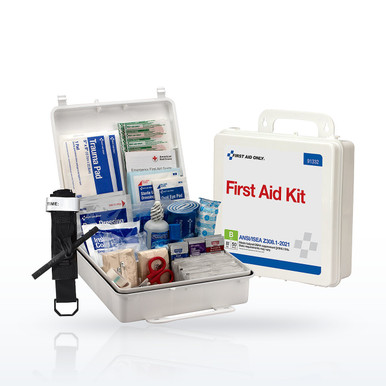
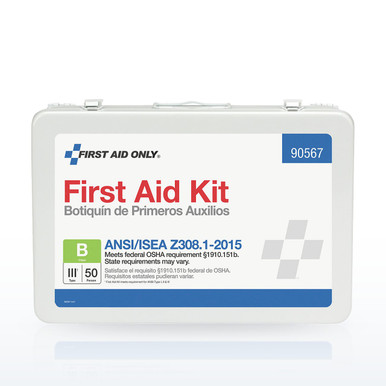
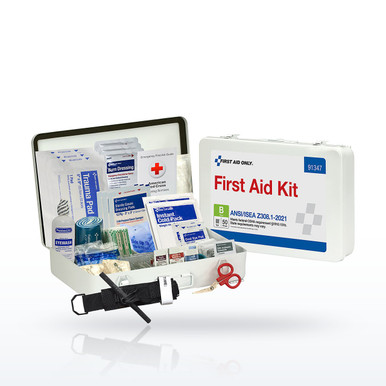
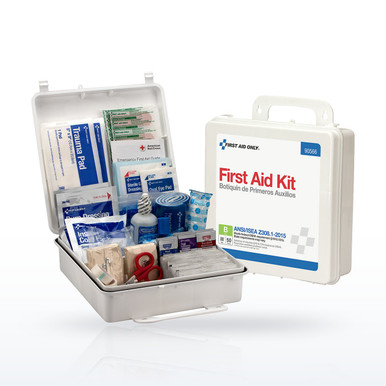
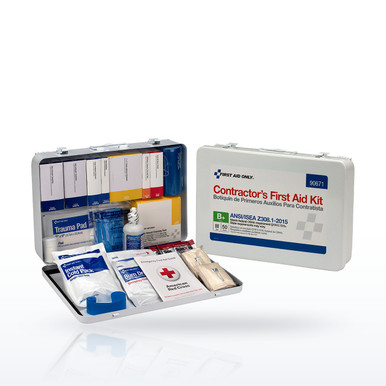
23 items · prices liveKits are listed by the ANSI class and the person count their manufacturer publishes; the product page lists the contents. Free shipping on orders over $199.
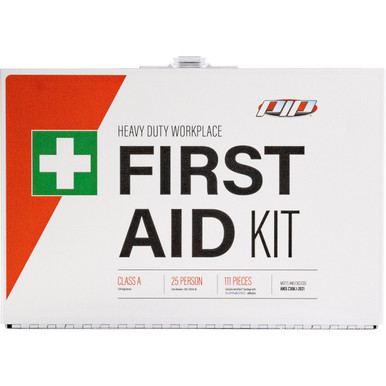
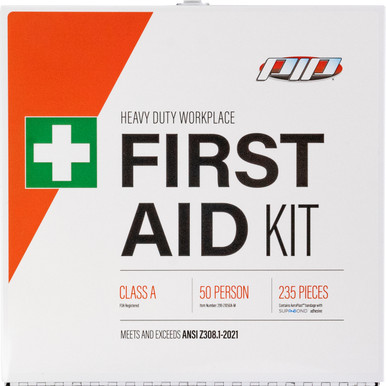
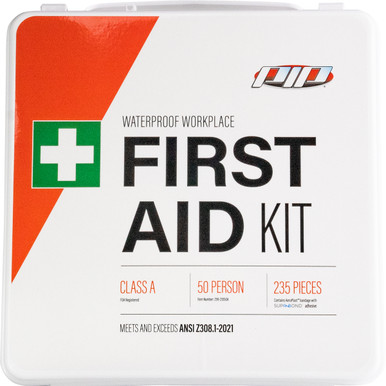
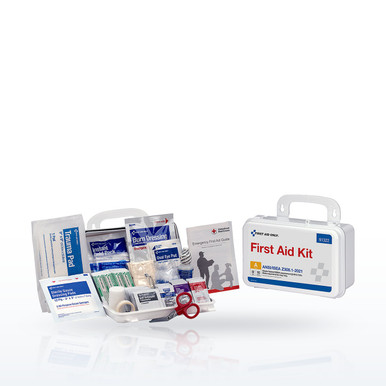
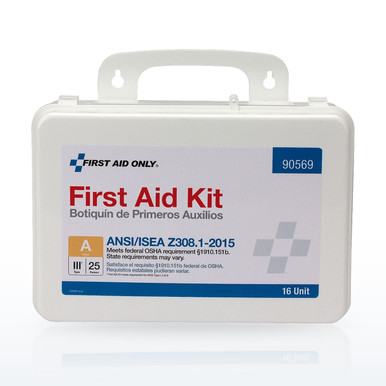
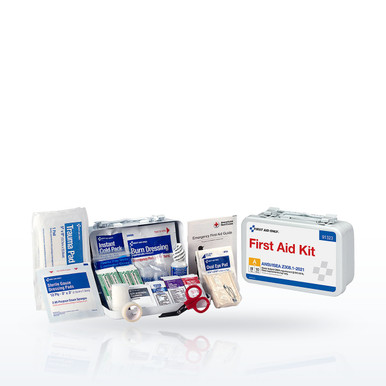
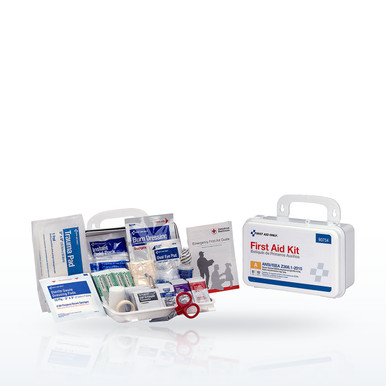
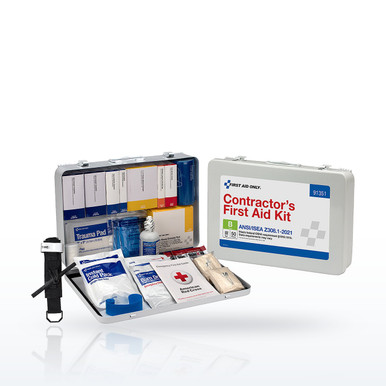
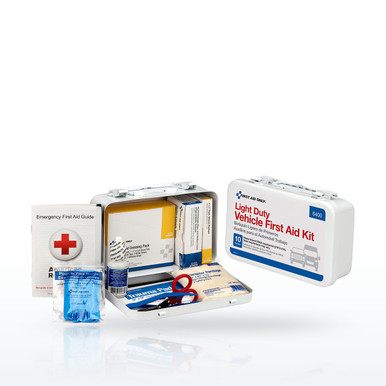
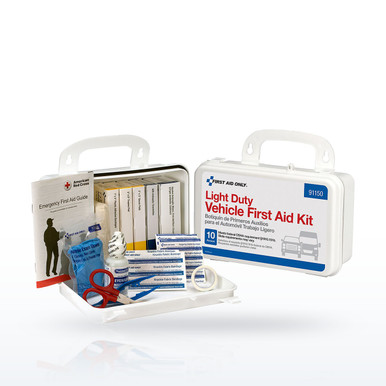
Refills, cabinets, bleeding control kits and vehicle kits are on the first aid finder.
Questions people ask
Does OSHA require a first aid kit?
OSHA requires adequate first aid supplies readily available, and trained responders unless a clinic or hospital is in near proximity. It does not list contents; ANSI Z308.1 is the accepted definition of adequate. (1910.151(b) and Appendix A.)
What should be in a workplace first aid kit?
At minimum the ANSI Z308.1-2021 Class A fill in the table above: bandages, gauze, tape, antiseptic, burn treatment, cold pack, eye wash, gloves, CPR barrier, foil blanket and a guide. Class B has more of each plus a tourniquet, a splint and a 4-inch roller bandage.
What is the difference between Class A and Class B first aid kits?
Class B holds more of every item and adds a splint and a larger roller bandage; it is meant for larger, higher-risk or more complex workplaces. Class A is the baseline for a typical workplace.
How many first aid kits does a workplace need?
Enough that one is readily available wherever people work, including each floor, each remote area and each crew vehicle. The 10/25/50-person sizes are the manufacturer’s scaling of the same fill.
Does OSHA require first aid training?
Yes, unless a clinic or hospital is close enough; OSHA reads that as a few minutes for serious hazards. Training is from a recognized provider and kept current. (1910.151(b).)
What does the construction standard require?
A trained first-aid person unless care is reasonably accessible, a weatherproof kit with sealed items checked weekly, transport arranged, and eyewash where corrosives are used. (1926.50.)
Does a first aid kit need an eyewash?
The ANSI fill includes at least 1 ounce (Class A) or 4 ounces (Class B) of eye wash. Where corrosives are used, OSHA separately requires a flushing station in the work area; the kit bottle does not satisfy that.
Do first aid kit supplies expire?
Many do: antiseptics, ointments, eye wash, burn gel and sterile dressings carry dates. Check and restock on a schedule and after every use.
Standards and ratings on this page are as published in the documents named and by the manufacturers named. The employer’s hazard assessment and written program decide what applies at a given workplace. Verify a rating on the product and its spec sheet before use.