
OSHA safety harness requirements: what 1926.502(d) says
OSHA does not approve harnesses. It sets performance rules in 1926.502(d), and the harness has to be part of a system that meets them. A full-body harness is required for fall arrest; body belts have been prohibited for that since 1998. The system must limit the force on the body to 1,800 pounds and keep free fall to 6 feet or less. The attachment point is the D-ring in the center of the back near shoulder level, or above the head. Webbing must be synthetic, D-rings must hold 5,000 pounds and pass a 3,600-pound proof test, the harness is inspected before each use, and anything that has caught a fall comes out of service until a competent person clears it. ANSI/ASSP Z359.11 is the industry standard manufacturers build and label harnesses to.
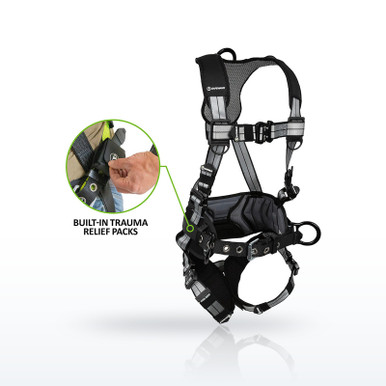
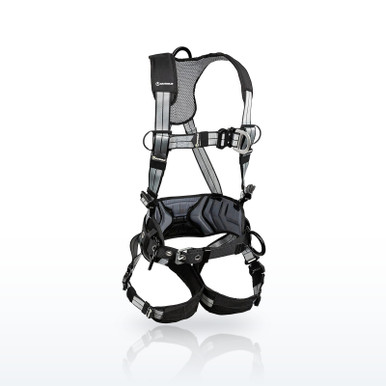
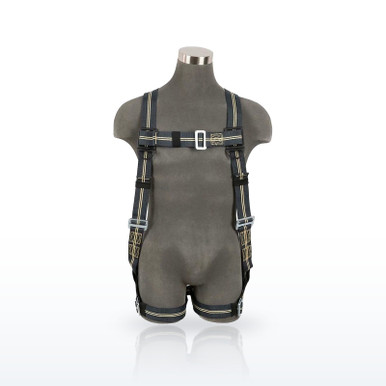
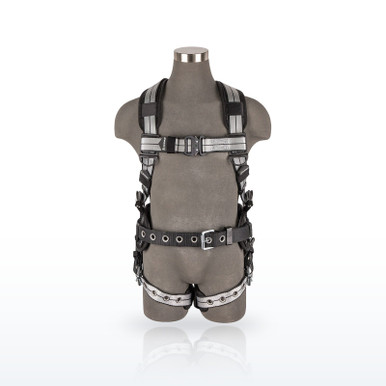 Safewaze PRO+ Slate construction harnessANSI Z359.11, dorsal D-ring plus side positioning D-rings
Why a full-body harness and not a belt? A belt concentrates the whole arresting force on the abdomen and can fold a falling worker in half or let them slip out. A full-body harness spreads the force over the thighs, pelvis, chest and shoulders and keeps the worker upright afterward. OSHA wrote the 1,800-pound force limit around the harness and the 900-pound limit around the belt, then prohibited the belt for fall arrest altogether from January 1, 1998. Everything else in the rule follows from one idea: the harness must hold a falling person without hurting them, and it must still be in one piece when it does.
What does 1926.502(d) require of a harness?
The paragraphs that apply to the harness itself and to how it is worn.
What does the whole system have to do?
The harness is one part. 1926.502(d)(16) is written about the system: it must limit arresting force to 1,800 pounds with a harness, be rigged so the worker can neither free fall more than 6 feet nor contact any lower level, bring the worker to a complete stop within 3.5 feet of deceleration distance, and have the strength to withstand twice the potential impact energy of a 6-foot free fall. A note to the paragraph says a system that meets Appendix C to Subpart M is considered compliant for a combined worker-and-tool weight under 310 pounds; above 310 pounds the employer must modify the criteria. That is where the 310-pound ANSI capacity on most harness labels comes from, and why manufacturers publish a separate OSHA capacity, usually up to 420 pounds, for harnesses they have tested heavier.
29 CFR 1926.502(d)(16)(ii) through (v) and the note following (d)(16); 1926 Subpart M Appendix C; manufacturer capacity statements on the harnesses listed below.The anchorage must hold 5,000 pounds per worker or be engineered at a safety factor of 2, the lanyard or lifeline must have a 5,000-pound breaking strength, and the employer must provide for prompt rescue after a fall or make sure workers can rescue themselves. The harness does not meet any of these on its own.
29 CFR 1926.502(d)(9), (d)(15) and (d)(20).What does ANSI Z359.11 add?
OSHA gives the performance floor; ANSI/ASSP Z359.11 is the design and test standard manufacturers certify harnesses to, and it is what the Z359.11 mark on the label means. The 2021 edition requires every harness to carry a visual indicator that deploys in a fall arrest and is placed where it can be inspected, a pictogram showing the approved use of each D-ring (fall arrest, positioning, restraint, climbing, rescue), and a warning on any integrated D-ring extender. Its dynamic test drops a 220-pound torso from a 6-foot height, including a headfirst test, with a required peak load on the harness of at least 3,600 pounds. OSHA does not adopt Z359.11 by reference, but the standard is how a harness shows it will do what 1926.502(d) demands.
ANSI/ASSP Z359.11-2021, effective May 1, 2022: visual indicator, D-ring pictogram, D-ring extender warning and dynamic test, as summarized by 3M Fall Protection; 29 CFR 1926.502(d)(16).The side D-rings on a construction harness are for positioning only. The front D-ring on a climbing or rescue harness is for ladder climbing systems, rescue and, in general industry, fall arrest with free fall limited to 2 feet. Shoulder D-rings are for retrieval and rescue. The pictogram on the label is the quick way to confirm which is which; the dorsal D-ring is the only one OSHA names for fall arrest in construction.
ANSI/ASSP Z359.11-2021 attachment element pictograms; 29 CFR 1926.502(d)(17); 1910.140(c)(22).What else does OSHA require around the harness?
- Training. Each employee who might be exposed to fall hazards is trained by a competent person to recognize the hazards and in the procedures for erecting, inspecting, using and disassembling the fall protection systems they will use, with a written certification record.
- Compatibility. Snap hooks must be sized to the member they connect to, and in general industry ropes, belts, lanyards and harnesses must be compatible with all connectors used.
- Protection of the webbing. Lifelines are protected against being cut or abraded; general industry extends that to belts, lanyards and harnesses being protected from cuts, abrasion, melting and other damage.
- Fit. The system must sustain the employee without the straps contacting the neck and chin area, which is a general industry performance requirement that only a properly adjusted harness meets.
- Rescue. Prompt rescue after a fall is the employer’s duty, and a worker hanging in a harness is on a clock; see the suspension trauma guide.
Full-body harnesses built to ANSI Z359.11
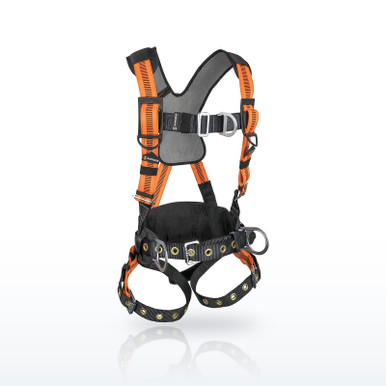
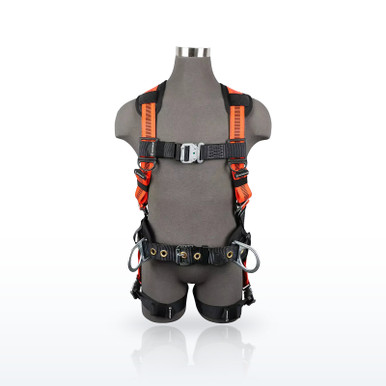
22 items · prices liveEach harness shown is listed by its manufacturer as meeting ANSI/ASSP Z359.11; the edition, D-ring configuration and capacity are on the product page and spec sheet. Contractor Direct orders ship free.
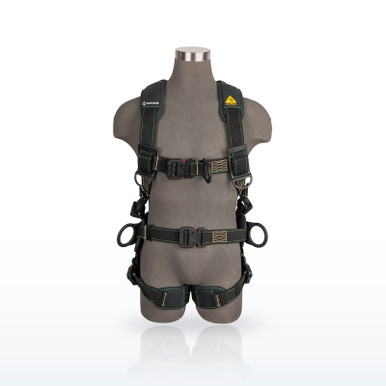
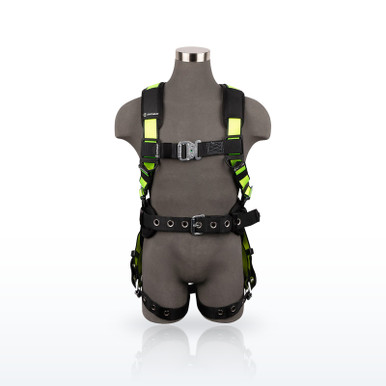
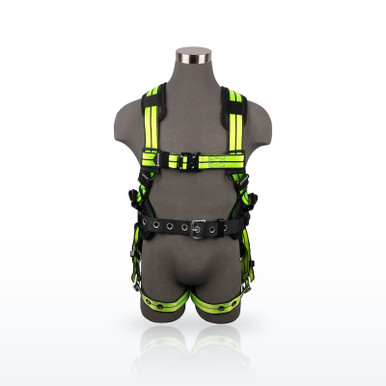
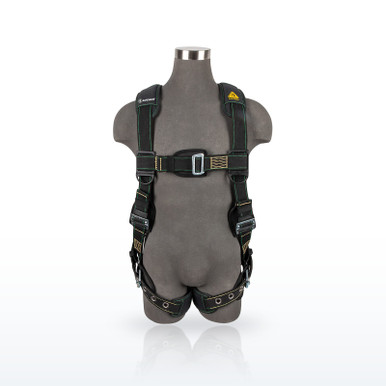
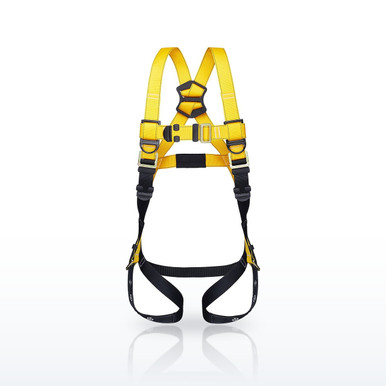
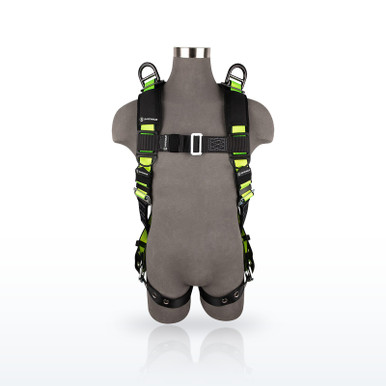
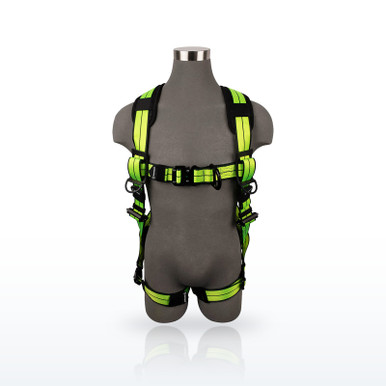
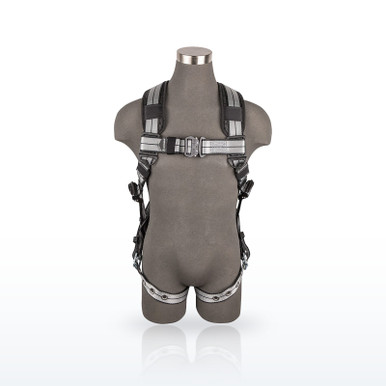
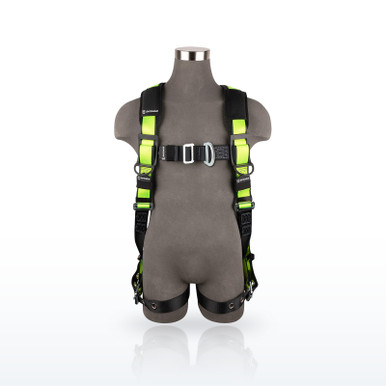
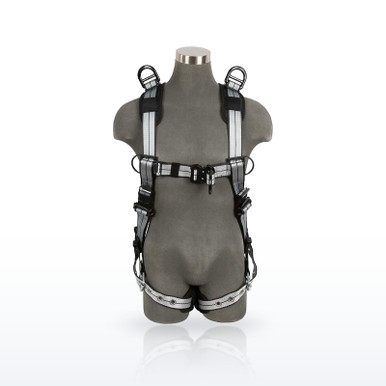
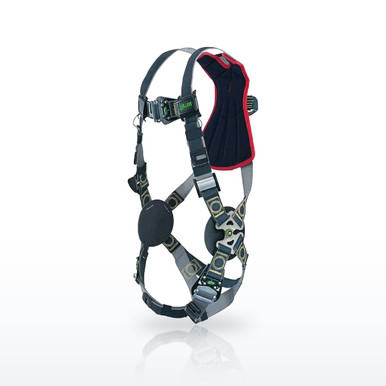
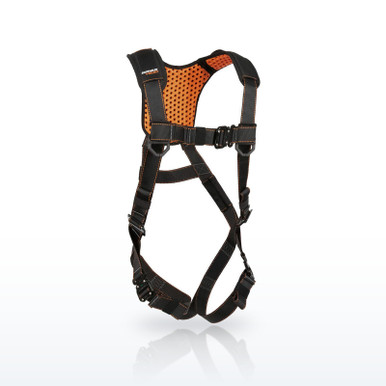
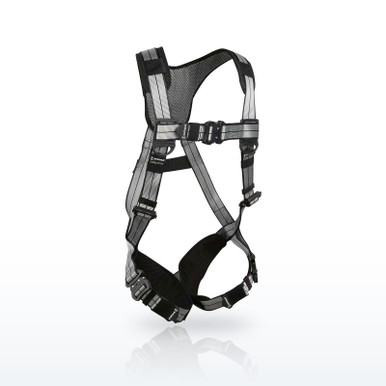
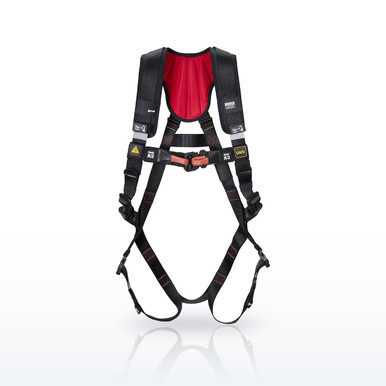
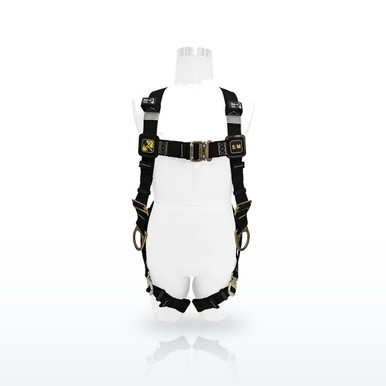
Harnesses from Miller, DBI-SALA, MSA and Protecta, listed with the standards their manufacturers publish, are on the fall protection finder.
Questions people ask
Does OSHA require a full-body harness?
For fall arrest, yes. Body belts have been prohibited as part of a personal fall arrest system since January 1, 1998. (1926.500(b); 1910.140(d)(3).)
What is the OSHA standard for safety harnesses?
29 CFR 1926.502(d) in construction and 1910.140 in general industry. OSHA does not certify harnesses; ANSI/ASSP Z359.11 is the design standard manufacturers test and label to.
Where does the lanyard attach on a harness?
The D-ring in the center of the back near shoulder level, or above the head. In general industry a chest D-ring may be used when free fall is limited to 2 feet. (1926.502(d)(17); 1910.140(c)(22).)
What is the maximum arresting force OSHA allows?
1,800 pounds on the body with a full-body harness. (1926.502(d)(16)(ii).)
How much weight is a harness rated for?
ANSI Z359.11 harnesses are tested for a 130-to-310-pound user. OSHA’s note to 1926.502(d)(16) requires the employer to modify the system for combined worker and tool weights of 310 pounds or more, and many manufacturers publish an OSHA capacity up to 420 pounds for harnesses tested at that weight. Check the label.
Does a harness expire?
OSHA sets no life. The manufacturer’s instructions and the inspection decide: a harness that fails inspection or has arrested a fall is removed from service regardless of age. (1926.502(d)(19) and (d)(21).)
Can I use the side D-rings for fall arrest?
No. Side D-rings are positioning attachments. The Z359.11 pictogram on the label shows what each D-ring is approved for.
Does OSHA require harness training?
Yes. 1926.503 requires training by a competent person in the hazards and in using and inspecting the system, with a written certification record.
Standards and ratings on this page are as published in the documents named and by the manufacturers named. The employer’s hazard assessment and written program decide what applies at a given workplace. Verify a rating on the product and its spec sheet before use.