
3M Versaflo TR-300+ vs TR-600 vs TR-800: filters, batteries and intrinsic safety from the 3M comparison
The three Versaflo belt-mounted PAPR blowers share the same S-Series hoods, M-Series headtops and breathing tubes; the 3M comparison sheet separates them by what they can filter and by the battery. The TR-300+ (blower TR-302N+) takes only the TR-3712N HE particulate filter and the TR-332 battery (8 to 12 hours). The TR-600 (TR-602N) takes the TR-6000 Series: TR-6710N HE plus the OV/HE, OV/AG/HE, multi-gas/HE and other gas and vapor cartridges, with the TR-630 (4 to 13 hours) and TR-632 (8 to 19 hours) batteries, and is NIOSH approved with 3M half and full facepieces as well as headtops. The TR-800 (TR-802N) is the intrinsically safe version (UL/IEC 60079) with the same TR-6000 filters and its own TR-830 battery (4 to 8 hours). The APF depends on the headtop: 25 for the loose-fitting S-100 headcovers and M-100/200/300, 1,000 for the S-400 to S-800 hoods and the M-400 helmets, 50 with a half mask and 1,000 with a full facepiece (3M headtop sheets quoting OSHA Table 1).
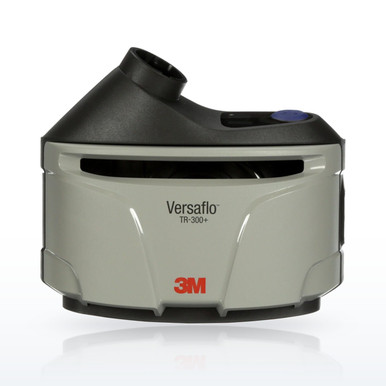 3M PAPR & Supplied Air Respirators, Versaflo TR-302N+ PAPR UnitTR-302N+ blower, HE filter only, TR-332 battery (3M comparison)
Why the filter list is the dividing line. A PAPR is an air-purifying respirator, so it protects only against what its filter or cartridge is approved for. The 3M Cartridge and Filter Summary lists the TR-3712N as the TR-300+ filter with HE as its only class, and the TR-6000 Series for the TR-600 and TR-800 with HE, OV/HE (TR-6510N), OV/AG/HE (TR-6530N), multi-gas/HE (TR-6590N) and the TR-6320N, TR-6360N and TR-6350N cartridges; that is why the TR-300+ appears on the particulate hazard pages only. The comparison rows: blower TR-302N+ / TR-602N / TR-802N; battery run time TR-332 8-12 h / TR-630 4-13 h; TR-632 8-19 h / TR-830 4-8 h; intrinsically safe UL/IEC 60079 (PAPRCMP) for the TR-800 only (3M PAPR comparison). The NIOSH CEL lists the TR-600 and TR-800 systems with the 7800S, 6000 full, FF-400, 6000/7500 half and 6500 facepieces (TC-21C-1330 to 1339); the TR-300+ lines are with hoods, helmets and loose-fitting headgear.
Side by side, from the 3M documents
What the Adflo adds
The fourth column of the 3M comparison:
- The Adflo is the welding-helmet PAPR: about 205 l/min, 10 to 12 hours with the HE filter, 5.5 hours with the OV/AG cartridge (3M data sheet and user instructions).
- Its 15-0299-99 HE filter and 15-0499-99 OV/AG cartridge are Adflo parts, not TR-6000 parts; 3M states the OV/AG cartridge is always used with the HE filter, pre-filter and spark arrestor.
- 3M states the Adflo must not be used in flammable or explosive environments; the TR-800 is the Versaflo unit with the intrinsic-safety listing.
Questions people ask
Which Versaflo takes gas and vapor cartridges?
The TR-600 and TR-800 (TR-6000 Series); the TR-300+ takes only the TR-3712N HE filter (3M Cartridge and Filter Summary).
Which Versaflo is intrinsically safe?
The TR-800, listed to UL/IEC 60079 in the 3M comparison, with its own TR-830 battery.
How long do the batteries run?
TR-332 8 to 12 hours (TR-300+); TR-630 4 to 13 and TR-632 8 to 19 hours (TR-600); TR-830 4 to 8 hours (TR-800) (3M PAPR comparison).
Can a TR-600 be used with a half mask?
The CEL lists TR-600 and TR-800 systems with the 6000/7500 half masks, the 6500 and the 3M full facepieces (TC-21C-1330 to 1339); the TR-300+ lines are with hoods and helmets.
Do the three share headtops?
Yes; the S-Series, M-Series, H-Series, 9100 MP and G5-01 appear in the CEL system approvals for all three blowers.
What is the APF of a Versaflo hood?
By headtop per 3M: 25 for the S-103/S-133 headcovers and M-100/200/300, 1,000 for the S-400 to S-800 hoods and M-400 helmets, quoting OSHA Table 1.
The ratings, test results and standards shown here are the manufacturers' published values, reproduced as published. Nothing on this page is a recommendation by Bayshore Safety that any product is suitable for a particular task, hazard or workplace. Selecting safety products and protective equipment is the responsibility of the end user and the employer, based on their own hazard assessment and the regulations that apply to their work. Confirm every value on the manufacturer's own documentation before use.