
Is a dust mop better than a broom, and how do you clean one? Dust mop sizes and frames, cotton vs microfiber vs synthetic heads, washing and drying a mop head, wet mops and mop head adapters, when a mop beats a broom, and how long a head lasts
A dust mop is a long, flat head of cotton or synthetic yarn on a swivel frame and a 60 inch handle, pushed in a continuous path so it picks up dust and fine debris on smooth floors instead of throwing it into the air the way a broom does; on a sealed warehouse, gym, shop or hallway floor it is faster and cleaner than a broom, and on rough concrete, decks or anything with chunks the broom wins. Heads come 18 to 72 inches wide (36 is the standard), in cotton (treated with a dust-attracting oil), synthetic blends and microfiber. To clean a cotton or blend head: shake it outside, then machine-wash it warm with detergent, no bleach, no fabric softener, and dry it on low or air-dry; re-treat cotton heads with dust-mop treatment when they stop holding dust. A wet mop is a different tool: a looped- or cut-end string head in a bucket of water on a clamp, screw or pin adapter.
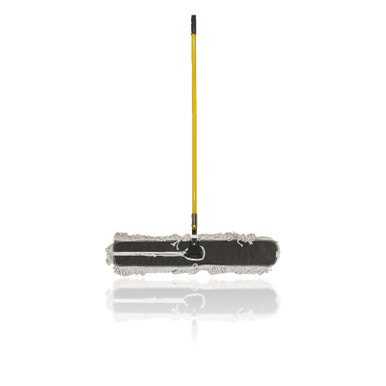 C&R M-3060-36 Dust Mop, 36 inThe product data lists the M-3060-36 as a 36 in dust mop with handle and frame
Where mops fit on a jobsite. After the drywall is sanded and before the floors go down, after a tenant improvement, in the shop every evening: the dust mop is the tool that gets the fine dust up without raising it. The consumer mop brands and spin mops that fill the search results are not what we sell; what is here is the commercial dust mop and wet mop, the heads, the frames and the adapters that fit a threaded handle, and the answers to the questions that apply to them: dust mop vs broom, how to clean a head, whether it goes in the washing machine or the dryer, which soap, how to get the head off, whether dust mops really work and whether they are worth it.
Dust mops and mop heads, question by question
Sizes and adapters are from the product data on this site; the washing guidance is the one printed on treated heads and used in custodial training.
Dust mops in plain words
- A dust mop picks dust up on a smooth floor; a broom pushes it. Sweep debris first, then dust mop, then damp mop.
- 36 inch head on a 60 inch handle is the standard; 18 to 72 inch exist.
- Wash cotton and blend heads warm with detergent, no bleach, no softener; dry low or air; re-treat cotton.
- Microfiber heads: wash with microfiber only, no softener, low heat.
- Keep the head on the floor; S-path or overlapping lanes; shake out after use; rotate the head.
- Wet mop heads mount on screw, pin or compression adapters on a threaded handle; consumer spin and twist mops have their own fittings.
- A head lasts twenty to fifty washes; retire it when it sheds, mats or shrinks.
- Neutral floor cleaner in the bucket, not dish soap.
Questions people ask
How do you clean a dust mop?
Shake it out, machine-wash the head warm with detergent, no bleach or softener, dry low or air-dry, and re-treat a cotton head.
Is a dust mop better than a broom?
On smooth sealed floors, yes; a broom for rough concrete, decks and debris.
How do I clean an industrial mop head?
Wash it warm with detergent, no bleach or softener, separately from dust heads and rags; dry low.
Can you put a mop head in a washing machine?
Cotton, blend and microfiber heads, yes; consumer spin-mop heads depend on the brand and are not what we sell.
What soap do you use with a mop?
A neutral floor cleaner in the bucket; plain detergent in the wash; dish soap leaves a film.
Can you dry a mop head in the dryer?
On low only; high heat shrinks cotton and melts synthetic yarn. Air-drying is better.
Do dust mops really work?
Yes on smooth floors: the yarn holds fine dust by static and treatment instead of throwing it into the air.
What wash cycle for a mop head?
Normal or heavy, warm water, extra rinse.
How do you remove a dust mop head?
Open the snaps, ties or pocket on the frame and slide the frame out.
What is the way to mop dusty floors?
Dust mop first, then a damp mop with a neutral cleaner in sections.
How do I replace a wet mop head?
Loosen the screw, pin or compression adapter, pull the old band out, slide the new one in and tighten.
How to sweep with a dust mop?
Keep the head down, push in overlapping lanes or an S-path, swivel at the walls, collect the dust line at the end of each lane.
Are dust mops worth it?
For any smooth-floored shop or warehouse, yes; heads wash dozens of times and the frame lasts years.
Can I dry a mop head in the dryer?
Low heat only.
What are the different types of mops?
Dust mops (cotton, blend, microfiber), wet string mops (cut-end, looped-end), flat microfiber mops, sponge mops, and consumer spin and twist mops.
What do professional cleaners mop with?
A dust mop followed by a looped-end wet mop and wringer bucket with a neutral cleaner, or a flat microfiber system.
What is a dust mop made of?
Treated cotton yarn, cotton-polyester or acrylic blends, or microfiber, on a swivel frame.
What are the disadvantages of spin mops?
Small heads, a wringer that wears, and fittings that take only their own brand’s heads; commercial mops do more floor per hour.
Are steam mops better than traditional mops?
They are a consumer tool for sealed tile and vinyl, not for job-site floors or wood.
How to wash a mop head in the washing machine?
Warm, detergent, no bleach, no softener, extra rinse, low dry, separate from rags and dust heads.
Related guides
Push brooms, handles and extension polesBristles, braces and telescoping polesMicrofiber cloths and shop ragsWhat not to clean with microfiber, and washingWhere roofers and contractors buy tools and suppliesSupply houses, distributors and buying by the caseSqueegeesRubber vs silicone, notched and floor squeegeesThe ratings, test results and standards shown here are the manufacturers' published values, reproduced as published. Nothing on this page is a recommendation by Bayshore Safety that any product is suitable for a particular task, hazard or workplace. Selecting safety products and protective equipment is the responsibility of the end user and the employer, based on their own hazard assessment and the regulations that apply to their work. Confirm every value on the manufacturer's own documentation before use.