Home › Guides › Roofing tools › Squeegees
Guide · Coating application · Floor, roof and notched squeegees

Rubber or silicone, straight or notched: which squeegee do you use? Floor squeegees for roofs and concrete, notched squeegees for coatings and epoxy, 24 and 36 inch blades, replacement rubber, what professionals use and what to use when you have none

There are three squeegees and they do three jobs. A floor squeegee (straight or curved rubber blade, 18 to 36 inches, on a threaded handle) pushes water, slurry and debris off a roof, a slab or a deck. A notched or serrated squeegee (a blade with teeth cut 3/16 or 1/4 inch deep) spreads roof coating, epoxy, primer and self-leveling compound at a controlled thickness, after which the coating is back-rolled. A window squeegee is a thin, sharp rubber or silicone channel blade on a short handle for glass. Rubber vs silicone matters only on the window tool: silicone stays sharp and flexible longer and costs more. On roofs and floors the question is straight vs curved and notched vs plain, not the rubber.
Bayshore Safety. Industrial safety, roofing tools and jobsite supplies since 2017. · Current as of November 2026 · the C&R squeegee product data on this site (straight squeegees 18, 24, 30 and 36 in; curved squeegees 24, 30 and 36 in; serrated squeegees 18, 24 and 36 in with 3/16 and 1/4 in serrations; 24 in wood notched squeegee with threaded hole); the coating manufacturers’ published method for self-leveling coatings and epoxy (spread with a notched squeegee to a set wet mil, then back-roll); the trade distinction between floor, window and coating squeegees
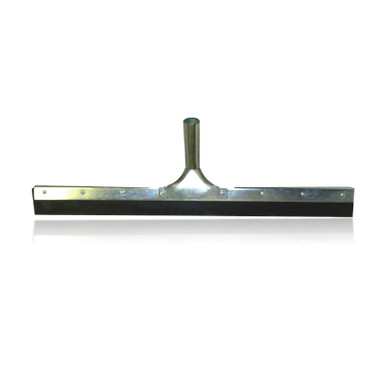
C&R FS118 Straight Squeegee, 18 inC&R FS118 Straight Squeegee, 18 inThe product data lists the 36SC-316 as a 36 in serrated squeegee with 3/16 in serrations for spreading coatings

Why a roofer owns three squeegees. Before a roof coating goes on, the roof is washed and the water is pushed to the drains with a 30 or 36 inch curved squeegee; the coating is then poured out and spread with a serrated squeegee whose notch depth sets the wet thickness, and back-rolled with the long-nap cover from the roller guide. The same two tools lay epoxy on a shop floor, push slurry off a slab and clear standing water from a low-slope roof before a repair. The questions below — rubber or silicone, what the professionals use, does a squeegee work on concrete, which size, what notch for epoxy, replacement rubber, what to use instead — are answered tool by tool.

Squeegees, question by question

Blade lengths and notch sizes are from the product data on this site; the spread-and-back-roll method is the one the coating manufacturers publish.

What is better for a squeegee, rubber or silicone?On a window squeegee, silicone: it holds a sharp edge longer, stays flexible in cold, resists ozone cracking and is replaced less often; natural rubber is cheaper, grips the glass a little more and is what most channel blades are. On a floor or roof squeegee the blade is a thick natural or synthetic rubber (neoprene, EPDM, or a foam rubber for rough floors) chosen for abrasion and chemical resistance, not sharpness; silicone is not used there. For coatings, the serrated blade is a stiff rubber or urethane cut with teeth; the material is set by the solvent in the coating (urethane blades for solvent-based, rubber for water-based).
What squeegee do professionals use?Roofers: a 36 inch curved floor squeegee for water and slurry and a 24 or 36 inch serrated squeegee for coating. Floor coating crews: an 18 or 24 inch notched squeegee for epoxy and self-leveler, 3/16 inch notches for thin builds and 1/4 inch for thicker, followed by a spiked roller or back-roll. Janitorial and concrete crews: a 24 to 36 inch straight or curved rubber floor squeegee, with a foam blade on rough concrete. Window cleaners: a 12 to 18 inch brass or stainless channel with a silicone or rubber blade. The handle is a standard threaded broom handle or a telescoping pole; the squeegee heads we stock take a threaded handle.
Do squeegees work on concrete?Yes; pushing water, wash slurry and spills off concrete is what a floor squeegee is for. A straight blade on smooth, troweled concrete; a curved blade on large areas because it gathers water toward the center; a foam rubber blade on broom-finished or rough concrete where a solid blade skips over the high spots. On a garage or warehouse floor a 36 inch head moves the most water per pass; 24 inch fits between racks and doors.
What is the right size squeegee?By area and access: 18 inch for small rooms, stairwells and tight spots; 24 inch for shop floors, walk-in coolers and detail work on a roof; 30 and 36 inch for open roofs, parking decks, warehouses and pools. A longer blade moves more water per pass but needs a stiffer frame and more muscle; 36 inch is the practical limit for one person. For coatings, the notched blade width sets the pass width and 24 inch is the common production size with 36 inch for large open roofs.
What size notched squeegee for epoxy or roof coating?The notch depth meters the wet film: 3/16 inch notches (our 18SS-316, 24SC-316, 36SC-316) for thinner coats around 15 to 25 wet mils, 1/4 inch (18SS-25, 24SC-25) for heavier builds. The coating data sheet states the wet mils and often the notch; spread with the squeegee held at about 45 degrees, pulling the coating out from the pour, then back-roll with the nap the data sheet calls for to even the ridges. A wood notched squeegee with a threaded hole (NS-24) is the traditional tool for asphalt emulsion and cold-process adhesives. The notch does not replace measuring: a wet-film gauge checks the thickness every few hundred square feet.
Where can I find replacement window squeegee rubber, and can floor blades be replaced?Window blade rubber is sold by the channel length and in rubber or silicone by the window-tool manufacturers; it slides into the channel and is held by the end clips. Floor squeegee blades on many heads are replaceable (the blade bolts or clips into the frame); on molded heads the whole head is replaced. The serrated coating blades wear fastest because the coating abrades the teeth; buy them by the case as a consumable, which is how our product data lists them.
What can I use as a makeshift squeegee, and how do you clean windows without one?For water on a floor: a stiff push broom moves it, slower and leaving a film. For spreading coating: a notched trowel on small areas, or a flat squeegee followed by a heavier back-roll (the thickness is then set by the roller, less accurately). For glass: a microfiber cloth and a dry lint-free cloth do a window without a squeegee; it takes longer and streaks in sun. None of these is a reason to skip the right tool on a job where the coating thickness is specified.
How do you squeegee a roof before coating?Pressure-wash or scrub, then work the standing water and slurry toward the drains and scuppers with a 36 inch curved squeegee in long overlapping pulls, never pushing debris into the drain. Let the roof dry completely (the coating manufacturer states the moisture limit; a plastic sheet taped down for an hour shows condensation if the deck is still wet). Low spots that hold water are marked for the repair crew; coating applied into a pond fails. Fall protection applies on any roof without a parapet; see the OSHA roof rules linked below.
Straight or curved blade, and what is a notched squeegee for besides coating?A straight blade clears along a wall or to a straight drain line and gets into corners; a curved blade gathers water to the center of the pass and is faster in the open. Notched squeegees also spread tile mortar on floors where a trowel would be too slow, lay adhesive for roofing fabric in cold-process built-up work, and level self-leveling underlayment before it sets.
What is the window cleaner that goes with a squeegee?A few drops of dish detergent in a bucket of water is what professional window cleaners use; it lubricates the blade and lifts dirt without streaking. Commercial glass cleaners work too. The technique matters more than the solution: wet the glass with the scrubber, pull the squeegee in overlapping strokes, wipe the blade between strokes, and detail the edges with a dry cloth.

Squeegees in plain words

  • Floor squeegee: thick rubber, straight or curved, 18 to 36 inches, pushes water and slurry. Straight for edges, curved for open areas.
  • Serrated (notched) squeegee: teeth 3/16 or 1/4 inch deep spread coating or epoxy to a set wet thickness; then back-roll.
  • Window squeegee: thin channel blade; silicone lasts longer than rubber. That is the only place rubber vs silicone matters.
  • 24 inch is the production size for coatings; 36 inch for open roofs and floors; 18 inch for tight spots.
  • Squeegees work on concrete; use a foam blade on rough finishes.
  • Serrated blades are consumables; buy them by the case.
  • Check wet film with a gauge; the notch meters, it does not measure.
  • Dry the roof completely after squeegeeing before any coating goes on.

Questions people ask

What is better for a squeegee, rubber or silicone?

On a window squeegee, silicone lasts longer and stays sharper; floor and coating squeegees use thick rubber or urethane and silicone is not used there.

What squeegee do professionals use?

A 36 inch curved floor squeegee for water, a 24 or 36 inch serrated squeegee for coatings, and a channel squeegee with a silicone blade for glass.

Do squeegees work on concrete?

Yes; a straight blade on smooth concrete, curved on large areas and a foam blade on rough broom finishes.

What is the right size squeegee?

18 inch for tight spots, 24 inch for shop floors and coating production, 30 to 36 inch for open roofs and warehouses.

What size notched squeegee for epoxy floor?

3/16 inch notches for thinner builds and 1/4 inch for heavier; the coating data sheet states the wet mils, and a wet-film gauge checks them.

Where can I find replacement window squeegee rubber?

From the window-tool manufacturers by channel length, in rubber or silicone; it slides into the channel under the end clips.

What can I use as a makeshift squeegee?

A push broom for water, a notched trowel for small coating areas, a microfiber cloth for glass; none sets coating thickness the way a notched blade does.

How do you wash windows without a squeegee?

Wet the glass, scrub, and dry with a lint-free cloth; it works, streaks in sun and takes longer.

What is the window cleaner to use with a squeegee?

A few drops of dish detergent in water, or a commercial glass cleaner; technique matters more than the solution.

What kind of squeegee do roofers use?

A curved floor squeegee to clear wash water and a serrated squeegee to spread coating, both on threaded handles or poles.

The ratings, test results and standards shown here are the manufacturers' published values, reproduced as published. Nothing on this page is a recommendation by Bayshore Safety that any product is suitable for a particular task, hazard or workplace. Selecting safety products and protective equipment is the responsibility of the end user and the employer, based on their own hazard assessment and the regulations that apply to their work. Confirm every value on the manufacturer's own documentation before use.

Setting up a roofing crew or a shop?Call (925) 215-7337 or email us the trades, the crew size and the quantities and we will quote tools and supplies by the case, with the part numbers listed. We sell nationwide.
All roofing tools
How to buyCard, purchase order or invoice terms; quotes on request; agencies and institutions welcome.
Live Service & SupportReal people who know the products, Monday to Friday 7:30am to 4pm Pacific. 925-215-7337
We DeliverWe ship nationwide. Parcel and LTL freight to job sites and businesses across the U.S.