Home › Guides › Roofing tools › Ratchet straps and bungees
Guide · Hauling · Ratchet straps, tie-downs, winch straps and bungee cords

How do you use and release a ratchet strap, and how much can one hold? Working load limit vs break strength, S, J and flat hooks, why a ratchet jams and how to free it, winch and endless straps, the DOT tie-down rules, and bungee cords

A ratchet strap is rated two ways: break strength (the load at which the assembly fails in a test) and working load limit (WLL), which is one third of break strength and is the only number to plan a load with. A 1 inch strap is typically 2,400 lb break / 800 lb WLL (our 101G is listed that way), 2 inch straps run 10,000 lb break / 3,333 lb WLL, and 4 inch winch straps 16,200 lb break / 5,400 lb WLL. To release a ratchet, pull and hold the release lever on the handle, open the handle flat (180 degrees) and the spool frees so the webbing pulls out; a strap that will not release has been over-wound until the webbing jammed the spool or the pawl is loaded against the lever. Bungee cords are not tie-downs: they hold a tarp or a light load from shifting, stretch about twice their length, and the rubber ones with hooks are the EPDM or natural-rubber jobsite cords sold by length.
Bayshore Safety. Industrial safety, roofing tools and jobsite supplies since 2017. · Current as of November 2026 · the C&R tie-down product data on this site (101G 1 in x 10 ft ratchet strap listed with a 2,400 lb rated capacity and 800 lb working load limit; 105G 1-1/2 in x 15 ft, 351G and 513G 2 in x 27 ft and 43010RS-FH 4 in x 30 ft tie-down straps with J and flat hooks; 430FH 4 in x 30 ft winch strap; BC-10 to BC-41 bungee cords 10 to 41 in); the WSTDA (Web Sling and Tie Down Association) definition of working load limit as one third of break strength, which the strap labels follow; 49 CFR 393.102–393.110 cargo securement aggregate WLL rules for commercial vehicles
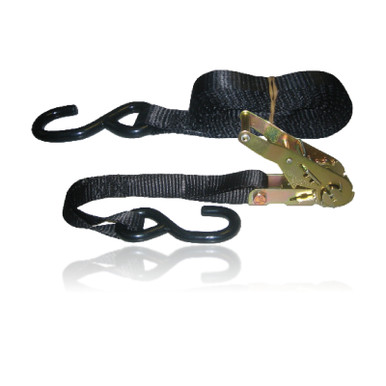
C&R 101G Ratchet Strap, 1 in x 10 ftC&R 101G Ratchet Strap, 1 in x 10 ftThe product data lists the 351G as a 2 in x 27 ft tie-down strap with J hooks

The number on the label. Every strap sold for cargo carries a tag with its WLL, and the DOT rules for commercial vehicles (49 CFR 393.102 to 393.110) require the aggregate WLL of the tie-downs to be at least half the weight of the cargo, with a minimum number of tie-downs by length. Roofers hauling a trailer of tear-off, a pallet of shingles or ladders on a rack are inside those rules the moment the truck is on the road. The cards below cover the vocabulary people ask about (what Americans call them, the metal ones, S vs J hooks, endless straps), the two things everybody struggles with (releasing a ratchet and un-jamming one), what the strap holds and how long it lasts, and then bungee cords, which people ask about as often and which are a different tool.

Straps and bungees, question by question

WLL and break figures are the ones printed on strap labels and in our product data; the one-third rule is the WSTDA convention those labels follow.

What do Americans call ratchet straps, and what are the metal ratchet straps called?Ratchet straps, ratchet tie-downs or tie-down straps; in the UK, ratchet lashings. A strap with a ratchet mechanism is a ratchet strap; a strap with a cam buckle you pull tight by hand is a cam strap or cam buckle tie-down; a strap pulled tight by a winch mounted on a trailer is a winch strap (our 430FH 4 in x 30 ft). The "metal" ones people mean are usually either the winch straps (webbing with a flat hook, tensioned by the trailer winch) or chain binders (lever or ratchet binders that tension a chain for machinery). All of them carry a WLL tag.
How does a ratchet release, which way is loosen, and how do you release one that is stuck?Pull the small release lever (the spring tab on the handle) toward you and hold it, then swing the handle all the way open, past vertical, until it lies flat against the strap; in that position both pawls are lifted off the spool and the webbing pulls free. Loosen is "handle fully open"; tighten is pumping the handle between about 45 and 90 degrees. Stuck: the spool is so full that the webbing has wedged against the frame, or the load is pulling the pawl hard into the teeth. Take the load off (lift, shift, cut a bungee), pump the handle one click to unload the pawl, then hold the release and open it. If the spool is over-wound, unwind it by pulling the strap back out through the slot while the handle is flat. Never cut a loaded strap.
Why do ratchet straps get stuck, and how do you unpinch or untangle one?Three causes: too much webbing wound on the spool (run the slack through by hand before ratcheting; only two or three wraps belong on the spool), webbing twisted as it fed through the mandrel slot, and dirt or rust in the pawls. To unpinch webbing caught between spool and frame: open the handle flat, push the webbing back toward the spool to slacken it, then pull it out. To fix a twisted or tangled strap: pull all the webbing out, lay it flat, feed the free end through the slot from below and take up slack by hand with the webbing flat on the spool. Store straps rolled, not knotted.
How do you tie down with a ratchet strap, and how to put the strap through the ratchet?Open the handle, feed the free end of the webbing up through the slot in the center of the spool (the mandrel), pull it through until the strap is snug by hand with no twists, then pump the handle until the load is tight and the handle closes flat and locks. Hook both ends to rated anchor points (not the trailer rail lip, not a bumper), run the strap over the load, keep the webbing away from sharp edges with corner protectors, and tie off the loose tail. The DOT minimum is one tie-down for cargo up to 5 feet long and under 1,100 lb, two for cargo 5 to 10 feet or over 1,100 lb, and one more for every additional 10 feet; aggregate WLL at least half the cargo weight.
How much weight can a ratchet strap hold, and what is the maximum load?The working load limit on the tag, which is one third of the break strength: 1 inch strap about 800 lb WLL (ours is listed 2,400 lb rated / 800 lb WLL); 1-1/2 inch about 1,000 to 1,500 lb; 2 inch 3,333 lb (10,000 lb break); 3 inch 5,000 lb; 4 inch winch strap 5,400 lb (16,200 lb break). The strap assembly is rated by its weakest part, so a 2 inch strap with light wire hooks is rated by the hooks. "Maximum" in the DOT sense is the aggregate WLL of all tie-downs, which must be at least half the cargo weight; the strap is never run to its break strength.
What are the differences between S hook, J hook and flat hook ratchet straps?S hooks are small double-ended hooks on light 1 inch straps for lawn equipment and bikes. J hooks (wire hooks) are the common 2 inch strap end: they hook into a trailer D-ring, stake pocket or rail. Flat hooks are stamped steel plates that hook over a flatbed rub rail or into a stake pocket and lie flat under load (our 513G 2 inch and 430FH winch strap carry flat hooks). Snap hooks have a spring gate for anchor points that bounce. Chain anchors give a length of chain for odd anchors. E-track fittings lock into van E-track. Pick the hook for the anchor on the trailer, and the WLL of the hook has to match the strap.
What is the easiest tie-down strap to use, and what can I use in place of ratchet straps?Cam buckle straps are the simplest: feed, pull tight, done; they hold a few hundred pounds and cannot over-tension a light load (kayaks, ladders on a rack, a tarp). Ratchet straps are for loads that need real tension. In place of a ratchet strap: a cam strap for light loads, rope with a trucker’s hitch (slower, and rope WLL is lower), chain and binders for machinery, a winch strap on a flatbed. Bungee cords are not a substitute for any of them on the road.
What are endless ratchet straps, and can you use ratchet straps for towing?An endless strap has no hooks: the webbing runs in a loop through the ratchet so the strap wraps the load and itself, for bundling pipe, lumber, ladders and pallet loads. Towing: no. Tie-down straps are rated for static cargo loads, not the shock load of towing a vehicle, and a strap that lets go under tow is a projectile. Tow straps and recovery straps are a different product with their own ratings.
How long do ratchet straps last, and when do you retire one?With care, years; inspect before every use and retire a strap with cuts, frayed edges, burns, melted spots, broken stitching, knots, chemical damage, UV fading that has made the webbing stiff or faded, or a ratchet that does not lock. Store out of the sun and dry; polyester webbing loses strength to UV faster than to anything else. A strap that has held a load through a hard stop or a shift has been shock loaded and gets a closer look.
What are rubber bungee cords called, what are the ones with hooks called, and who makes a good one?Rubber bungee cords are called rubber tie-downs, EPDM tarp straps or tarp straps: a solid natural-rubber or EPDM strap with an S hook crimped into each end, sold by length (our BC-10 to BC-41 run 10 to 41 inches). Braided bungee cords are a rubber core in a woven jacket with plastic-coated hooks. Rubber straps outlast braided cords in sun and cold and are what tarps on trucks and trailers are held with. We do not rank other manufacturers’ cords; the data points that matter are the rubber (EPDM for UV and cold), the hook (steel, crimped, not molded plastic), and the length.
How many pounds can a bungee cord hold, and how do you size one?A bungee cord holds tension, not weight: a typical rubber tarp strap pulls with 20 to 50 pounds at full stretch, a heavy braided cord somewhat more, and the hook or the rubber lets go above that. That is enough to keep a tarp down or a toolbox lid shut and not enough to secure anything on the road. Size a cord so it is stretched about 50 to 100 percent of its relaxed length: a 10 inch cord for a 15 to 20 inch span, a 21 inch cord for a 30 to 40 inch span, a 41 inch cord for a 5 to 7 foot span. A cord stretched past about twice its length is at its limit and snaps back hard.
Do bungee cords lose elasticity or go bad, and what is better than a bungee cord?Yes. Rubber degrades in sun, ozone and heat: a cord that has gone stiff, cracked at the hook, stays stretched or has a jacket with the core showing is done; braided cords also lose their hooks when the plastic coating cracks. In Bay Area sun a braided cord on a truck lasts a season or two, a black EPDM strap several. Better than a bungee for holding a load: a cam strap or a ratchet strap. Better for a tarp: more bungees spaced closer, or rope through the grommets to a batten. To fasten or adjust one, hook one end to a fixed point, stretch to the second point and hook with the hook opening away from your face; adjustable cords have a slider or a ball-and-loop that lets the length be set without stretching.

Straps and bungees in plain words

  • WLL is one third of break strength and is the only number to plan a load with. A 2 inch strap is about 3,333 lb WLL.
  • Release: hold the release tab, open the handle flat past vertical, pull the webbing out. Tighten: pump between 45 and 90 degrees.
  • Stuck ratchet: too much webbing on the spool, a twist, or load on the pawl. Unload, click once, hold the release, open flat.
  • Only two or three wraps belong on the spool; take up slack by hand first.
  • J hooks for D-rings and pockets, flat hooks for flatbed rub rails, S hooks on light straps; the hook WLL must match the strap.
  • DOT: aggregate WLL at least half the cargo weight; one tie-down to 5 ft and 1,100 lb, two to 10 ft, one more per 10 ft after that.
  • Bungees hold tarps and lids, not cargo; they pull 20 to 50 pounds and stretch about double. Replace them when stiff or cracked.
  • Never tow with tie-down straps.

Questions people ask

Do bungee cords lose elasticity?

Yes; sun, ozone and heat stiffen and crack the rubber. Replace a cord that stays stretched, cracks at the hook or shows its core.

What are rubber bungee cords called?

Rubber tie-downs, EPDM tarp straps or tarp straps: a solid rubber strap with a crimped S hook at each end, sold by length.

What is better than bungee cords?

For securing a load, a cam strap or ratchet strap; for a tarp, more cords closer together or rope to a batten.

What do Americans call ratchet straps?

Ratchet straps, ratchet tie-downs or tie-down straps; cam straps and winch straps are the hand-tensioned and trailer-winch versions.

Why do ratchet straps get stuck?

Too much webbing on the spool, a twist through the mandrel slot, dirt in the pawls, or load holding the pawl against the lever.

How many pounds can a bungee cord hold?

About 20 to 50 pounds of tension at full stretch; enough for a tarp, never for cargo on the road.

What is the easiest tie-down strap to use?

A cam buckle strap: feed, pull tight, done, for light loads like ladders and kayaks.

How does a ratchet release?

Hold the release tab on the handle and swing the handle flat past vertical; both pawls lift and the webbing pulls free.

Do bungee cords go bad?

Yes, in a season or two of sun for braided cords and several for EPDM straps.

How do you fasten a bungee cord?

Hook one end to a fixed point, stretch to the other and hook it with the opening away from your face, at 50 to 100 percent stretch.

What can be used in place of ratchet straps?

Cam straps for light loads, rope with a trucker’s hitch, chain and binders for machinery, winch straps on a flatbed.

How do you adjust bungee cords?

Pick a length that stretches 50 to 100 percent, or use adjustable cords with a slider or ball-and-loop.

What is the difference between S hook and J hook ratchet straps?

S hooks are small double hooks on light straps; J hooks are the heavier wire hooks on 2 inch straps that fit D-rings and stake pockets.

How do you determine what size bungee cord you need?

Measure the span and pick a cord 50 to 65 percent of it, so it stretches about half to double its length.

Which way is loosen on a ratchet strap?

Handle fully open, lying flat, with the release tab held; pumping the handle tightens.

How much weight can ratchet straps hold?

Their working load limit: about 800 lb for 1 inch, 3,333 lb for 2 inch, 5,400 lb for a 4 inch winch strap, each one third of break strength.

Can you use ratchet straps for towing?

No; they are rated for static cargo, not shock loads, and a failed strap becomes a projectile.

What is the maximum load a ratchet strap can hold?

Its WLL; the DOT rule is that all tie-downs together must have a WLL of at least half the cargo weight.

How long do ratchet straps last?

Years when stored dry and out of the sun; retire any strap with cuts, fraying, burns, broken stitching, UV stiffness or a ratchet that does not lock.

What are endless ratchet straps?

Straps with no hooks that loop through the ratchet to bundle pipe, lumber and ladders.

What are the bungee cords with hooks called?

Rubber tarp straps or tie-downs when solid rubber with S hooks; braided bungee cords when a rubber core in a woven jacket.

The ratings, test results and standards shown here are the manufacturers' published values, reproduced as published. Nothing on this page is a recommendation by Bayshore Safety that any product is suitable for a particular task, hazard or workplace. Selecting safety products and protective equipment is the responsibility of the end user and the employer, based on their own hazard assessment and the regulations that apply to their work. Confirm every value on the manufacturer's own documentation before use.

Setting up a roofing crew or a shop?Call (925) 215-7337 or email us the trades, the crew size and the quantities and we will quote tools and supplies by the case, with the part numbers listed. We sell nationwide.
All roofing tools
How to buyCard, purchase order or invoice terms; quotes on request; agencies and institutions welcome.
Live Service & SupportReal people who know the products, Monday to Friday 7:30am to 4pm Pacific. 925-215-7337
We DeliverWe ship nationwide. Parcel and LTL freight to job sites and businesses across the U.S.