
Poly, sisal, manila or nylon: which rope do you use, and how strong is it? Breaking strength by size, working load, the standard rope sizes in inches and mm, polypropylene vs polyethylene, sisal vs jute vs manila, and what each rope is for
Four ropes cover jobsite work. Polypropylene (yellow poly) floats, does not absorb water, is cheap and light, and is the rope for tag lines, tarp ties, layout and anything that gets wet; its weaknesses are UV (it chalks and weakens in a season or two of sun), low melting point and a slick surface that does not hold knots well. Manila is the traditional natural-fiber rope: it grips well, does not stretch much and is the rope for hand lines and hoisting light loads, but it rots when stored wet and loses strength over time. Sisal is the cheaper natural fiber, about 80 percent of manila’s strength, for bundling and tying off, not for lifting. Nylon is the strongest and stretchiest, for shock loads and towing. Breaking strengths for 1/2 inch three-strand: polypropylene about 3,800 lb, manila about 2,400 lb, nylon about 5,700 lb; the working load is a fifth to a tenth of that.
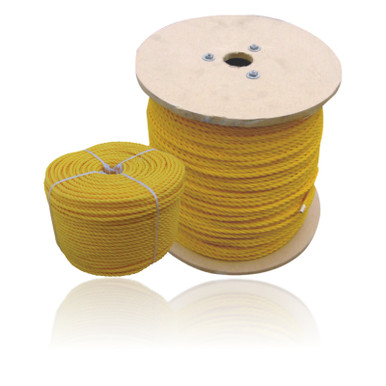 C&R Rope-1/4Poly Poly Rope, 1/4 in x 1200 ft and 1/4 in x 600 ft, YellowThe product data lists the C&R manila as 3-strand rope in 3/4 in x 60 ft, 1/2 in x 100 ft and 3/4 in x 100 ft
Rope is sold by diameter and fiber, and rated by break strength. Diameter is in inches (1/4, 3/8, 1/2, 5/8, 3/4, 1 inch) or millimeters (6, 10, 12, 16, 19, 25 mm; 13 mm is a 1/2 inch rope); the fiber and the construction (3-strand twisted, diamond or solid braid, kernmantle) set the strength; and the label strength is a break figure that is divided by a safety factor of 5 to 10 to get the load the rope should carry. Rope that holds a person is not in this guide: lifelines and lanyards are rated under ANSI Z359 and are covered in the fall protection guides linked below. The questions here are the general-rope ones: which fiber, how strong, what the sizes are, the disadvantages of each, and the pet-rope questions that come up because sisal is sold for scratching posts.
Rope, question by question
Break strengths are Cordage Institute average figures for new 3-strand rope; the rope manufacturer’s own label governs for any specific rope.
Rope in plain words
- Poly: floats, cheap, rotproof, dies in sun, slick knots. Tag lines, tarps, layout.
- Manila: grips, low stretch, does not melt; rots wet, shrinks wet. Hand lines and light hoisting.
- Sisal: 80 percent of manila, cheap, sheds. Bundling and tying off, scratching posts.
- Nylon: strongest common rope, stretches; polyester same strength with low stretch and better UV.
- Break strength on the label; working load is one fifth to one tenth of it; a knot takes up to half.
- 1/2 inch is 12–13 mm; 3/8 is 10 mm; 3/4 is 19 mm.
- 3-strand splices; braid runs smoother; kernmantle is the climbing and lifeline construction.
- No general-purpose rope holds a person; lifelines are rated under ANSI Z359.
Questions people ask
Is sisal rope safe?
As an untreated natural fiber for crafts, pets and bundling, yes; as a load rope it is weak, rots wet and never carries a person.
What is a major disadvantage of polypropylene rope?
UV: unstabilized poly loses much of its strength after a year in sun; it also melts at about 330°F and knots slip on it.
Is manila rope the same as jute rope?
No. Manila is abaca and strong; jute is a soft twine fiber and the weakest of the natural ropes.
What rope is stronger than nylon?
Polyester matches it with less stretch; UHMWPE (Dyneema, Spectra) and aramid are several times stronger.
What are the standard rope sizes?
1/4, 5/16, 3/8, 1/2, 5/8, 3/4 and 1 inch (6 to 25 mm), in 50 to 1,200 ft hanks and 600 ft coils.
Is sisal rope durable?
Fair when kept dry, poor when wet; it rots, mildews and sheds.
What is the breaking strength of 5/8 inch polypropylene rope?
About 5,600 lb for new 3-strand; working load 560 to 1,100 lb.
What is the difference between jute rope and sisal rope?
Sisal (agave) is stiffer and stronger; jute (a bast fiber) is softer, frays and is used for twine and burlap.
What is the difference between polyethylene and polypropylene rope?
Both are cheap floating yellow ropes; polypropylene is lighter and a little stronger, polyethylene is softer and holds knots slightly better.
What is the breaking strength of nylon rope?
About 1,500 lb at 1/4 inch, 5,700 lb at 1/2 inch and 12,800 lb at 3/4 inch for 3-strand.
What are the different types of rope?
By fiber: manila, sisal, jute, cotton, polypropylene, polyethylene, nylon, polyester, UHMWPE. By construction: 3-strand, diamond braid, solid braid, double braid, kernmantle.
What size rope is 13 mm?
Half inch.
What is the disadvantage of manila rope?
It absorbs water, rots if stored wet, shrinks when wet and varies in strength from coil to coil.
What is polypropylene rope?
A plastic-fiber rope that floats, absorbs no water and resists chemicals; the common yellow jobsite rope.
Which is better for cats, sisal or jute rope?
Sisal; it stands up to claws and is untreated. Keep synthetic rope away from cats.
How long do sisal scratching posts last?
A year or more with one cat when the rope is wrapped tight.
What is sisal rope made of?
The leaf fiber of the agave (sisal) plant.
Related guides
Ratchet straps and bungee cordsUse, release, working load and when to replaceTarps: mil, sizes, poly vs vinylAnd how to tarp a roofRoof brackets, roof jacks and ladder accessoriesAngles, planks, hooks and stabilizersHow do you tie off on a roof?Anchor, lifeline, rope grab and SRLWhat does fall protection cost?Harness, lanyard, lifeline, anchor and bagThe ratings, test results and standards shown here are the manufacturers' published values, reproduced as published. Nothing on this page is a recommendation by Bayshore Safety that any product is suitable for a particular task, hazard or workplace. Selecting safety products and protective equipment is the responsibility of the end user and the employer, based on their own hazard assessment and the regulations that apply to their work. Confirm every value on the manufacturer's own documentation before use.