
How do you tie off on a roof? Setting the anchor, running the rope lifeline and rope grab, choosing an SRL, and what the roofing kits include, step by step from the manufacturers’ instructions
Tying off on a roof is four steps: fasten a roof anchor to the structure, at the ridge or in the field over a rafter or truss, with the nails or screws the manufacturer specifies; clip a vertical lifeline to the anchor and let it hang down the slope with a counterweight on the end; put a rope grab on the lifeline with its arrow pointing up toward the anchor and connect its short energy-absorbing lanyard to the dorsal D-ring of your harness; then work below the anchor, within 30 degrees of it, moving the grab as you go so the slack stays short. OSHA requires fall protection on a residential roof at 6 feet (1926.501(b)(13)), and the system must keep free fall to 6 feet or less, limit the force on you to 1,800 pounds and anchor to something that holds 5,000 pounds (1926.502(d)). The roof kits on this site package the four parts, harness, lifeline with grab, lanyard and anchor, in a bucket or bag.
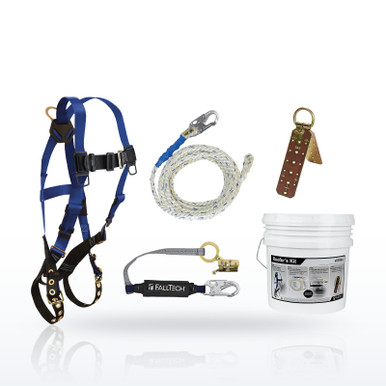 FallTech 8596A Roofer's KitFallTech 8596A roofer’s kit: 7016 harness, 50 ft vertical lifeline, anti-panic fall arrester with 3 ft lanyard, 7410 hinged reusable anchor
This site already has the rule pages (when fall protection is required on a roof, the residential rule, the Cal/OSHA height) and the anchor pages (which anchor fits which roof, whether an anchor can stay). This page is the how-to: hooking up the harness on a roof, setting the anchor where the manufacturer says, rigging the rope lifeline and grab or an SRL, what roofers actually use, and the other questions the bank asks, from where the anchor goes to whether it damages the roof. Every step is from the FallTech and Safewaze instructions carried on this site, and the rule text is from the current e-CFR.
Tying off on a roof, step by step and question by question
The steps are FallTech’s wood-frame anchor and vertical lifeline manuals; Safewaze’s roof kit components work the same way. Read the manual packed with your equipment before the first install.
29 CFR 1926.501(b)(13); FallTech roofer’s kit sell sheet PN 480-00005; Safewaze FS120 product data on this site.
FallTech MANC28.2, Sections 4.1, 4.3 and 4.4 (anchorage location, swing fall, general installation).
FallTech MANC28.2, Sections 4.4, 4.4.1, 4.6, 4.7 and 4.9; Safewaze FS870 and FS871 product data on this site.
FallTech MVLL01 Rev D, Sections 5.4.1 and 5.4.2; 29 CFR 1926.502(d)(10), (11).
FallTech roofer’s kit sell sheet PN 480-00005 (fall arrester features); FallTech MVLL01 Rev D, Sections 2.2 and 3.3; Safewaze rope grab and FS700 product data on this site.
FallTech Class 2 leading-edge SRL product data on this site (ANSI Z359.14-2021); the leading-edge and below-the-D-ring guides linked below.
FallTech MANC28.2, Section 4.4 (fall protection during installation; competent person approval); 29 CFR 1926.501(b)(13) and 1926.502(k).
FallTech MANC28.2, Sections 2.1, 3.5, 4.8 and 4.9; 29 CFR 1926.502(d)(15); Safewaze anchor data sheets on this site.
29 CFR 1926.502(d)(15); FallTech MANC28.2, Section 4.4.
29 CFR 1926.501(b)(13) and 1926.502(k); the residential, Cal/OSHA and Focus Four guides linked below.
Tying off on a roof in plain words
- Four parts: anchor, harness, connecting device (rope lifeline with grab and short lanyard, or an SRL), and the hooks between them. The kits sell all four together.
- The anchor goes on structure, over a rafter or truss through sheathing at least 7/16 inch thick, at the ridge or in the field, at least 6 feet from the edge, with the nails or screws the manufacturer specifies (FallTech: five #16d nails per plate into the truss plus five more; Type C eight nails).
- Install the anchor with fall protection already on (ladder tie-off, lift, second anchor). Have a competent person approve it before anyone hangs on it.
- Clip the lifeline to the anchor, hang 5 pounds on the end, protect the rope where it crosses an edge. Put the grab on with the arrow pointing up at the anchor; connect its lanyard to your back D-ring.
- Work below the anchor, within 30 degrees of it; move the anchor or add one every 8 feet of travel. Never work above the anchor.
- An SRL anchored at deck level where the line can run over the edge must be a Class 2 leading-edge SRL (ANSI Z359.14-2021).
- One worker per lifeline. Rope protected from cuts and abrasion. Free fall 6 feet or less; 1,800 pounds maximum on the body; anchor holds 5,000 pounds.
- A reusable anchor is pried loose at the end of the job; a permanent anchor is shingled over and left for the next one. Anything that has caught a fall comes out of service.
What is in a roof kit, as the manufacturers list it
| Kit | Harness | Lifeline | Grab and lanyard | Anchor | Container |
|---|---|---|---|---|---|
| FallTech 8596A Premium Roofer’s Kit | 7016 Contractor full body harness | 8150 50 ft vertical lifeline | 8388 anti-panic fall arrester with 3 ft energy-absorbing lanyard | 7410 reusable roof anchor | Bag |
| FallTech 8595A Roofer’s Kit | Contractor full body harness | 50 ft vertical lifeline | Trailing rope adjuster (per product data) | Reusable anchor | Bag |
| Safewaze FS120 PRO Bucket Roof Kit | FS280 harness (S/M, L/XL, 2XL) | FS700-50GA 50 ft lifeline assembly with grab | FS560 lanyard | FS870 reusable roof anchor | Plastic bucket with lid |
| Safewaze V-Line Bucket Roof Kit | V-Line full body harness | V-Line vertical lifeline | Rope grab and lanyard per kit page | Roof anchor per kit page | Bucket |
Every kit carries the ANSI capacity of 130 to 310 lb for the user with clothing and tools.
Source: FallTech roofer’s kit sell sheet PN 480-00005 and product data on this site; Safewaze FS120 and V-Line kit product pages and technical data sheets as carried on this site.
Questions people ask
How to hook up a safety harness on a roof?
Put the harness on and check the fit; fasten a roof anchor over a rafter or truss; clip the vertical lifeline to the anchor and weight the end; put the rope grab on the line arrow-up; connect the grab’s short energy-absorbing lanyard to your dorsal D-ring; work below the anchor and move the grab as you go.
How to secure yourself on a roof?
With a personal fall arrest system anchored to structure: anchor, harness, lifeline and grab or SRL. Set the anchor from a tied-off ladder, a lift or a second anchor, and have a competent person approve it before using it.
How do roofers stay safe on roofs?
OSHA requires a guardrail, net or personal fall arrest system from 6 feet in residential construction. The PFAS on a ridge anchor with a 50-foot rope lifeline and a trailing grab is what the roof kits package.
What safety equipment do roofers use, and what equipment do roofers need?
A rated roof anchor, a full body harness, a vertical lifeline with rope grab and energy-absorbing lanyard or a Class 2 SRL, plus the ladder, roof brackets and footwear that are not fall arrest. The kits bundle the first four.
Where should the anchor point for a safety harness be on a roof?
On structure, above the work, so you stay within 30 degrees of it: the ridge over a rafter or truss on a gable roof, with added anchors every 8 feet of travel and one per hip. FallTech: at least 6 feet from an exposed edge, never on eaves, gables or overhangs.
What are anchor points on a roof, and what are the two types of roof anchors?
Rated connectors fastened to the roof structure for a lifeline or SRL. The two types in the manuals are temporary (reusable, removed at job end) and permanent (installed once and shingled over); FallTech adds a single-use bent anchor.
Where to place roof anchors?
At the ridge or in the field, through sheathing at least 7/16 inch into a rafter or truss, at least 6 feet from the edge, directly above the work area, one per hip, none on unsupported overhangs and none used from the far side of the ridge (FallTech MANC28.2).
Do roof anchors damage the roof?
A nailed anchor leaves nail holes; reusable anchors are pried loose and the holes sealed, permanent anchors are shingled over once and left. The roof anchor guide covers standing seam clamps and other non-penetrating types.
Do roof anchor points need to be certified?
The anchor must hold 5,000 lb per worker or be part of an engineered system with a safety factor of two under a qualified person (1926.502(d)(15)). FallTech lists its wood anchors to ANSI Z359.1 and OSHA; the installation is approved by a competent person.
Can you tie off to a crane?
Not to the hook, load line or boom unless a qualified person has made it part of an engineered fall arrest system. OSHA requires the anchorage to be independent of anything supporting a platform and rated at 5,000 lb per worker (1926.502(d)(15)).
Are roofers required to wear harnesses, and are roofers supposed to wear harnesses?
Yes in residential construction from 6 feet unless a guardrail or net is used (1926.501(b)(13)); a written plan under 1926.502(k) is the only alternative, and only where conventional systems are infeasible or more hazardous.
Why don’t roofers wear harnesses?
The reasons given are convenience and time; the rule gives no exception for them. A ridge anchor with a 50-foot lifeline and a trailing grab covers a whole slope from one anchor, which is the setup the kits are built for.
Do roofers use safety harnesses?
Yes; the roofer’s kits sold here (FallTech 8596A, Safewaze FS120) are built around a standard 1D full body harness with a rope lifeline, grab and roof anchor.
How does a roof safety harness work?
The grab locks on the lifeline or the SRL locks its drum when you fall; the energy absorber limits the force to 1,800 lb; the harness spreads it over thighs, pelvis and shoulders. Free fall is kept to 6 feet or less by working below the anchor.
How can I prevent falls from heights on a roof?
In OSHA’s order: guardrails or nets where they can be installed, a personal fall arrest system anchored to structure where they cannot, and on low-slope roofs warning lines with a safety monitor as the rules allow. The working-at-height guide covers the hierarchy.
What is the minimum height for fall protection on a roof?
6 feet in residential construction and 6 feet at an unprotected edge in construction generally (1926.501); Cal/OSHA’s residential figure is on its own guide. General industry is 4 feet.
Related guides
Roof anchors by roof typeWood, standing seam, corrugated, tile and membraneOSHA roof fall protection rulesLow-slope and steep roofsFall protection for residential constructionWhat 1926.501(b)(13) and STD 03-11-002 requireWhat comes in a fall protection kit, and what does it cost?Harness, lanyard, lifeline, anchor and bagCan you anchor an SRL below the D-ring?Class 1 vs Class 2What is an anchor point, and what must it hold?The 5,000-pound ruleThe ratings, test results and standards shown here are the manufacturers' published values, reproduced as published. Nothing on this page is a recommendation by Bayshore Safety that any product is suitable for a particular task, hazard or workplace. Selecting safety products and protective equipment is the responsibility of the end user and the employer, based on their own hazard assessment and the regulations that apply to their work. Confirm every value on the manufacturer's own documentation before use.