
Spade or shovel, square or round, scoop or coal shovel: which one do you use? The three types of shovels, what each blade is for, shank and drainage shovels, handle lengths, steel vs poly scoops, sharpening, and shovels for mulch, gravel and debris
A shovel has a dished blade set at an angle to the handle for lifting and throwing loose material; a spade has a flatter, straighter blade in line with the handle for cutting into ground. The three types most lists name are the round-point shovel (digging and moving dirt), the square-point shovel (scraping, lifting loose material off a flat surface, squaring a trench) and the scoop (a deep, wide blade for snow, grain, gravel, mulch and debris). Coal shovels are square scoops with a short D-handle; Eastern scoops are a smaller square scoop; tear-off spades are a flat, serrated or smooth spade with a fulcrum for stripping shingles. Steel scoops take abuse and weigh more; aluminum scoops are lighter and are for light material; poly scoops are for snow and feed.
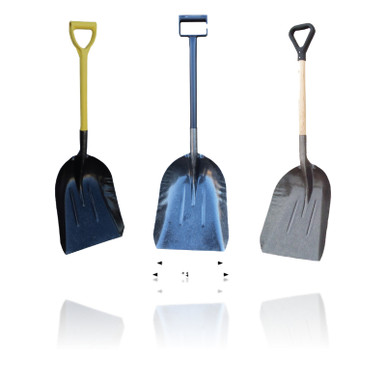 C&R 10SS-FiberScoop #10 Steel Scoop Shovel, 3 versionsThe product data lists the #10 steel scoop with a PolyCore fiberglass D-handle, an all-steel D-handle or a wood D-handle
Reading a shovel. The blade is sized by a number (#2 is the standard digging blade, about 9-1/2 by 11-1/2 inches; #10 and #12 are scoop sizes, bigger as the number rises), shaped round-point, square-point or scoop, with a lift (the angle between blade and handle) that is high for throwing and low for digging; the handle is a 48 inch long handle for leverage and reach or a 27 to 30 inch D-handle for working close and in trucks and trailers; the material is wood (ash), fiberglass or steel. A roofing crew owns a square-point shovel for the ground, a scoop for the debris trailer, a tear-off spade for the roof and a mattock for the odd stump and trench. The cards below answer the shovel questions as they are asked.
Shovels, question by question
Blade sizes and handle options are from the product data on this site; the shovel-vs-spade distinction and the blade numbering are the trade’s.
Shovels in plain words
- Shovel: dished blade at an angle, for lifting and throwing. Spade: flat blade in line with the handle, for cutting down.
- Three types: round-point (dig), square-point (scrape and lift off a hard surface), scoop (volume of loose material).
- Coal shovel = square scoop with a D-handle. #10 and #12 scoops are the big snow, mulch and debris shovels.
- Steel for rock, shingles and gravel; aluminum for mulch and snow; poly for snow and feed only.
- Long handle (48 in) for leverage and throwing; D-handle (27–30 in) for trailers, trenches and roofs.
- A tear-off spade is a flat spade with a fulcrum for prying shingles; a pitchfork moves the debris.
- Sharpen the top side of the edge at 45 degrees with a file; leave the back flat.
- Mattock digs and grubs; pick breaks; cutter mattock adds an axe blade for roots.
Questions people ask
What is considered a spade shovel?
A digging shovel with a flat, spade-like blade; the trade mixes the terms. A true spade has its blade in line with the handle for cutting straight down.
What are the three types of shovels?
Round-point for digging, square-point for scraping and lifting off hard surfaces, and scoop for volume of loose material.
What type of shovel is used for digging?
A round-point #2 shovel in soft ground; a spade or mattock in hard ground or roots.
What type of shovel is for mulch?
An aluminum or steel scoop, or a pitchfork for stringy bark and shingle debris.
What is a coal shovel?
A square-point scoop with high sides and a short D-handle, now used for gravel, sand, mulch and debris out of trucks and trailers.
What is a shank shovel?
A shovel with a solid steel shank running the length of the socket (closed back) for strength.
What is a drainage shovel?
A narrow 4 to 6 inch long-bladed round-point on a long handle for cleaning trench bottoms and laying drain pipe.
What is a Cornish shovel?
The British long-handled heart-shaped mining shovel; the US equivalent is a long-handle round point.
Is a spade or shovel better for digging?
A round-point shovel enters hard ground more easily; a spade cuts a clean straight-sided hole; use the shovel to move the spoil.
What is a small plant shovel called?
A garden trowel.
How do I sharpen a shovel?
File a 45 degree bevel on the top side of the edge from the center out, leave the back flat and knock off the burr.
What is the average length of a shovel handle?
44 to 48 inches for a long handle; 27 to 30 inches for a D-handle.
Is it better to get a steel or poly scoop?
Steel for anything hard or sharp (gravel, shingles); poly only for snow and feed.
What are square shovels for?
Scraping slabs, squaring trenches, lifting loose material off a flat surface and spreading gravel.
What do you call a pointy shovel?
A round-point or digging shovel.
What is a cutter mattock used for?
Grubbing roots and hard ground with the adze side and cutting roots with the axe side.
What is another name for a mattock?
Grub hoe, grubbing mattock or grub axe.
What are the differences between a pickaxe and a mattock?
A pick has points for breaking rock; a mattock has an adze blade for digging and grubbing, plus a pick or axe on the other side.
Do farmers still use pitchforks?
Yes, for hay and bedding; roofers use the same fork to load tear-off debris.
Is it better to have a heavier or lighter axe?
A 3-1/2 lb head on a 36 inch handle is the standard felling and splitting weight; lighter heads for limbing, heavier mauls for splitting rounds.
Related guides
Roof tear-off toolsShingle shovels, spud bars and how long it takesWheelbarrows, tires and utility trailersSteel vs poly, tire sizes and the 60/40 rulePush brooms, handles and extension polesBristles, braces and telescoping polesBack supports and lifting beltsWhat NIOSH saysWork gloves for roofingGloves by job: roofingThe ratings, test results and standards shown here are the manufacturers' published values, reproduced as published. Nothing on this page is a recommendation by Bayshore Safety that any product is suitable for a particular task, hazard or workplace. Selecting safety products and protective equipment is the responsibility of the end user and the employer, based on their own hazard assessment and the regulations that apply to their work. Confirm every value on the manufacturer's own documentation before use.