Home › Guides › Roofing tools › Saw blades and TPI
Guide · Cutting · Hacksaw, circular and reciprocating saw blades

How many teeth per inch for cutting metal, and can a 10 inch blade go on a 12 inch saw? Hacksaw blades at 18, 24 and 32 TPI, the three-tooth rule, bi-metal and carbide, circular blade sizes, arbor and kerf, 24T vs 60T, and reciprocating blades

Teeth per inch (TPI) is chosen by the thickness of what is cut: at least three teeth must be in the material at once, so thin metal needs fine teeth and thick stock coarse ones. For a hacksaw that means 32 TPI for sheet metal and thin-wall tube under 1/16 inch, 24 TPI for 1/16 to 1/8 inch (conduit, angle, bolts), 18 TPI for 1/8 to 1/4 inch and 14 TPI for thicker bar; 18 and 24 cover most jobsite steel and 18 is the all-rounder. Reciprocating blades follow the same rule (14 to 18 TPI bi-metal for metal, 6 to 10 TPI for wood and demolition). A smaller circular blade on a larger saw is fine as long as the arbor hole matches (5/8 inch on most 7-1/4 inch saws, 1 inch on 10 and 12 inch saws); it just cuts shallower and the saw’s rated speed still applies. A larger blade than the saw is rated for does not fit the guard and is not used.
Bayshore Safety. Industrial safety, roofing tools and jobsite supplies since 2017. · Current as of November 2026 · the C&R blade product data on this site (super heavy-duty hacksaw; hacksaw blades 5 per card; bi-metal reciprocating saw blades 6 in 14T, 6 in 18T and 12 in 10T; 7-1/4 in circular saw blades in 24 and 40 tooth); the three-tooth rule and TPI-by-thickness convention printed on hacksaw and reciprocating blade packs; the arbor and diameter markings on circular saw blades and the saw manufacturers’ maximum blade diameter ratings
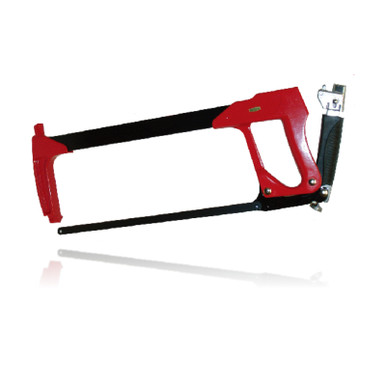
C&R H-2015 Hacksaw, Heavy DutyC&R H-2015 Hacksaw, Heavy DutyThe product data lists the C&R reciprocating blades as bi-metal in 6 in 14 and 18 tooth and 12 in 10 tooth

One rule covers the questions. The three-tooth rule: at least three teeth, and no more than about twenty-four, should be in contact with the work. Fewer and the teeth snag and strip; more and the gullets pack with chips and the blade rubs instead of cutting. With that rule, "what TPI for metal", "is 18 or 24 better", "is more teeth better", "what will a hacksaw cut", "what blade for aluminum" and the circular and reciprocating blade questions all have the same answer worked for the thickness in hand. The cards take them in order, then cover blade length, high-tension frames, the steels, circular blade sizing and kerf, and what a reciprocating saw should not do.

Saw blades, question by question

TPI pairings follow the three-tooth rule the blade manufacturers print on their packs; blade sizes are from the product data on this site.

How many teeth per inch for cutting metal, and is 18 or 24 TPI better for metal?By thickness: 32 TPI under 1/16 inch (sheet metal, thin conduit wall), 24 TPI for 1/16 to 1/8 inch (EMT, angle iron, bolts, threaded rod, flashing stacks), 18 TPI for 1/8 to 1/4 inch (pipe, bar, strut), 14 TPI above 1/4 inch. 18 is the one blade to own; 24 is the second for conduit and bolts; 32 is for sheet and tube so thin it would snag an 18. For a reciprocating saw, 14 and 18 TPI bi-metal blades do the same jobs, and the 6 inch 18T is the metal-cutting standard. Is more teeth better for metal? Only down to the thickness that keeps three teeth in the cut; past that the blade loads up and burns.
What type of blade cuts metal, and what will a hacksaw cut?A hacksaw with a bi-metal blade cuts mild steel, stainless (slowly), aluminum, brass, copper, bolts, threaded rod, pipe, EMT, angle, rebar, and also plastic pipe, fiberglass and wood in a pinch; it will not cut hardened steel (files, drill bits, spring steel) except with a carbide-grit rod blade, and it is slow on anything over about 1/2 inch. Can you use a hacksaw to cut steel? Yes; that is what it is for. Power alternatives: a reciprocating saw with a metal blade, a portable bandsaw (the cleanest for pipe and strut), an angle grinder with a cutoff wheel (fastest, roughest, sparks), a circular saw with a metal-cutting carbide blade for sheet and roofing panels. A power hacksaw is the old shop machine that reciprocates a hacksaw frame; the portable bandsaw replaced it.
What is the standard hacksaw blade size, and what are the different types?12 inches long by 1/2 inch wide by 0.025 inch thick, with a pin hole at each end 11-7/8 inches apart; 10 inch blades fit older and compact frames. Types by material: carbon steel (cheap, dulls fast), high-speed steel (hard, brittle), bi-metal (an HSS tooth strip welded to a spring-steel back: the standard, flexes without snapping), and carbide-grit rods for tile, glass and hardened steel. By tooth: 14, 18, 24 and 32 TPI with raked or wavy set. The price of a 12 inch blade is a few dollars; our blades come 5 to a card by the case.
What is a high-tension hacksaw, and what type of hacksaw cuts metal?Every hacksaw cuts metal; a high-tension frame is one that tensions the blade to 30,000 psi or more with a lever or a large wing nut, instead of the 10,000 psi of a plain frame. A tight blade cuts straight, does not buckle on the push stroke and lasts longer; a loose one wanders and snaps. Our H-2015 is a super heavy-duty frame with quick blade change. Teeth point forward (away from the handle); a hacksaw cuts on the push stroke, with light pressure on the return.
Can I use a 10 inch blade on a 12 inch saw, a 7 inch blade on a 6-1/2 inch saw, or a 6-1/2 blade in a 7-1/4 saw?Smaller on larger: yes, if the arbor matches (12 and 10 inch miter and table saws both use a 1 inch arbor; 7-1/4 and 6-1/2 inch circular saws use 5/8 inch, some with a diamond knockout) and the blade’s maximum rpm is at or above the saw’s speed; the only loss is depth of cut (a 10 inch blade on a 12 inch miter saw cuts about an inch less). A 5 inch blade on a 6-1/2 saw is the same story. Larger on smaller: no. A 7 inch blade will not fit inside a 6-1/2 inch saw’s guard, and a 7-1/4 blade on a 6-1/2 saw is the same problem; the saw is rated for the diameter on its nameplate. Do all circular saw blades fit all saws? No: match the diameter to the saw rating, the arbor hole to the arbor, and the blade rpm rating to the saw.
What does 24T or 40T mean, what is a 60 tooth blade for, and which blade gives the cleanest cut?The T is tooth count on the whole blade. On a 7-1/4 inch blade, 18 to 24T is a framing (rip and rough crosscut) blade: fast, splintery, the all-day blade for studs, sheathing and decking (our CIRC-725). 40T is a combination or finish crosscut blade: slower, cleaner, for trim, plywood faces and siding (CIRC-420). 60T is a fine-finish blade for melamine, veneer plywood, laminate and plastic trim, and it burns in thick wet lumber. On 10 and 12 inch saws the counts scale up: 24 to 40T rip and framing, 60T general crosscut, 80 to 100T fine finish. Cleanest cut: the highest tooth count with an ATB (alternate top bevel) grind and a thin kerf, on a sharp blade, with the good face of the material down on a circular saw (the teeth cut upward) and up on a table or miter saw.
What is kerf, how deep does a circular saw cut, and what is the largest blade?Kerf is the width of the cut, set by the tooth width: full-kerf blades are about 1/8 inch, thin-kerf about 3/32, which cuts faster on a cordless saw and wastes less. Depth of cut on a 7-1/4 inch saw is about 2-1/2 inches at 90 degrees and 1-7/8 at 45, enough for 2x lumber either way; a 6-1/2 inch saw cuts about 2-1/8 inches; a 10 inch saw about 3-1/2. The largest common circular saw blades are 10-1/4 and 16-5/16 inch beam saws for timber framing. A blade’s arbor hole and diameter are stamped on it; the max rpm too.
Are jigsaw blades the same as reciprocating saw blades, and are all reciprocating blades the same?No and no. Jigsaw blades are short (2 to 5 inches) with a T-shank or U-shank; reciprocating (Sawzall-type) blades are 4 to 12 inches with a universal 1/2 inch tang that fits every reciprocating saw. Within reciprocating blades the differences are length (6 inch for most work, 9 and 12 inch for demolition and pruning), TPI (6 to 10 for wood and nail-embedded wood, 14 to 18 for metal, 10 to 14 for demolition blades that cut both), material (carbon for wood, bi-metal for anything with nails or metal, carbide-tipped for cast iron, thick steel and fiber cement) and thickness (demolition blades are thicker so they do not bend in a cut). Our bi-metal blades are 6 inch 14T and 18T and 12 inch 10T.
What is the reciprocating blade for aluminum, and what should you not do with a reciprocating saw?Aluminum: a bi-metal 14 to 18 TPI blade cut with wax or a little oil so the gullets do not load; fine-tooth 24 TPI for thin extrusions and gutter. Yes, a reciprocating saw cuts aluminum, and copper and brass. What not to do: cut into anything you cannot see behind (wiring, pipes, the other side of a wall), use a wood blade on nails, run a bent blade, cut above shoulder height without a second hand on the saw, pry with the blade, or pull the saw from the cut while the blade is still moving. It will cut tree branches and small trunks with a 9 or 12 inch pruning blade (6 TPI), and it will cut a tree down only if the tree is small enough for the blade length; it is not a chainsaw.
What TPI for wood, and what length reciprocating blade do I need?Wood: 6 TPI for fast rough cuts and pruning, 8 to 10 for general wood and demolition (nails included on a bi-metal blade), 14 for clean cuts in thin wood and plastic. Length: 6 inch for most framing and metal, 9 inch for 4x material and reaching into walls, 12 inch for pruning and for cutting through a sill plate or a doubled header in one pass. A blade should extend at least an inch past the far side of the cut at the end of the stroke so it does not hammer the material.
Which circular saw blade for the general work, and can a circular saw cut laminate flooring?For a 7-1/4 inch saw, a 24T framing blade for the framing and a 40T for trim and siding cover almost everything; we stock both by the case of 25 because crews go through them. Laminate flooring: yes, with a 40 to 60T blade, the finished face down, and expect fast dulling because the wear layer is abrasive; a carbide blade sold for laminate lasts longer. A circular saw blade cuts upward on the near side (the teeth come up through the shoe), which is why chipping shows on the top face. Bauer or any other brand: we do not rate blades we do not carry.

Saw blades in plain words

  • Three-tooth rule: at least three teeth in the material at once. Thin stock, fine teeth; thick stock, coarse teeth.
  • Hacksaw: 32 TPI under 1/16 inch, 24 for 1/16 to 1/8, 18 for 1/8 to 1/4, 14 above. 18 is the all-rounder.
  • Standard hacksaw blade: 12 x 1/2 x 0.025 inch, bi-metal; teeth forward; cuts on the push.
  • High-tension frame: 30,000 psi on the blade so it cuts straight and does not snap.
  • Smaller circular blade on a larger saw: fine if the arbor matches. Larger blade than the saw’s rating: never.
  • 24T framing, 40T trim and siding, 60T fine finish on a 7-1/4 inch saw. Kerf is cut width, about 1/8 inch full or 3/32 thin.
  • Reciprocating blades: 6 to 10 TPI wood and demolition, 14 to 18 metal, bi-metal for anything with nails, carbide for cast iron and fiber cement.
  • Jigsaw and reciprocating blades are different shanks and do not interchange.

Questions people ask

What type of blade cuts metal?

A bi-metal hacksaw or reciprocating blade at 14 to 32 TPI by thickness, a carbide metal-cutting circular blade for sheet, or a cutoff wheel.

Can I use a 10 inch blade on a 12 inch saw?

Yes, if the arbor is the same (1 inch) and the blade rpm rating is at least the saw’s; you lose about an inch of cut depth.

How many teeth per inch for cutting metal?

Three teeth in the material at once: 32 TPI for sheet, 24 for 1/16 to 1/8 inch, 18 for 1/8 to 1/4, 14 above.

What will a hacksaw cut?

Mild steel, stainless, aluminum, brass, copper, bolts, rod, pipe, conduit, angle, rebar, plastic pipe and wood; not hardened steel without a carbide-grit blade.

What reciprocating blade cuts aluminum?

A bi-metal 14 to 18 TPI blade with wax or oil; 24 TPI for thin extrusions and gutter.

Is 18 or 24 TPI better for metal?

18 for 1/8 to 1/4 inch stock, 24 for 1/16 to 1/8 inch; 18 is the single blade to own.

Is a 24 or 32 TPI hacksaw blade better?

24 for conduit, bolts and angle; 32 only for sheet metal and very thin tube.

Are jigsaw blades the same as reciprocating saw blades?

No; jigsaw blades are short with T or U shanks, reciprocating blades are 4 to 12 inches with a universal 1/2 inch tang.

Can I put a 7 inch blade on a 6-1/2 inch circular saw?

No; it will not fit the guard and the saw is rated for 6-1/2 inches.

What TPI is for cutting wood?

6 for rough cuts and pruning, 8 to 10 for general wood and demolition, 14 for clean cuts in thin stock.

What is a 60 tooth circular saw blade used for?

Fine finish cuts in melamine, veneer plywood, laminate and plastic trim.

Is more teeth on a saw blade better for metal?

Only until three teeth are in the cut; beyond that the gullets pack and the blade burns.

Can you use a hacksaw to cut steel?

Yes; that is its job, with a bi-metal blade at the TPI for the thickness.

What does 24T mean on a circular saw blade?

24 teeth on the blade: a fast, rough framing blade.

Do all circular saw blades fit all circular saws?

No; match diameter, arbor hole and rpm rating to the saw.

What is the standard size of a hacksaw blade?

12 inches long, 1/2 inch wide, 0.025 inch thick.

Is there a power hacksaw?

Yes, the old shop machine; the portable bandsaw and reciprocating saw replaced it on jobsites.

What is a high tension hacksaw?

A frame that tensions the blade to 30,000 psi or more so it cuts straight and lasts.

Are all reciprocating blades the same?

No; they differ in length, TPI, material and thickness, and only the 1/2 inch tang is universal.

What circular saw blade gives the cleanest cut?

A sharp high-tooth-count ATB thin-kerf blade with the good face down on a circular saw.

What should you not do with a reciprocating saw?

Cut blind into walls, use a wood blade on nails, run a bent blade, pry with it, or pull it out while the blade moves.

What are the different types of hacksaw blades?

Carbon steel, high-speed steel, bi-metal and carbide-grit, in 14 to 32 TPI.

What is a 32 TPI hacksaw blade used for?

Sheet metal and thin-wall tube under 1/16 inch.

How deep does a circular saw blade cut?

About 2-1/2 inches at 90 degrees on a 7-1/4 inch saw, 2-1/8 on a 6-1/2, 3-1/2 on a 10 inch.

What is kerf on a circular saw blade?

The width of the cut, about 1/8 inch on a full-kerf blade and 3/32 on a thin-kerf.

The ratings, test results and standards shown here are the manufacturers' published values, reproduced as published. Nothing on this page is a recommendation by Bayshore Safety that any product is suitable for a particular task, hazard or workplace. Selecting safety products and protective equipment is the responsibility of the end user and the employer, based on their own hazard assessment and the regulations that apply to their work. Confirm every value on the manufacturer's own documentation before use.

Setting up a roofing crew or a shop?Call (925) 215-7337 or email us the trades, the crew size and the quantities and we will quote tools and supplies by the case, with the part numbers listed. We sell nationwide.
All roofing tools
How to buyCard, purchase order or invoice terms; quotes on request; agencies and institutions welcome.
Live Service & SupportReal people who know the products, Monday to Friday 7:30am to 4pm Pacific. 925-215-7337
We DeliverWe ship nationwide. Parcel and LTL freight to job sites and businesses across the U.S.