
What is a spill berm, and when is one used?
A spill berm is a portable, flexible-walled tray, usually a coated fabric floor with walls a few inches to a foot high, that you park a tank, a tote, a drum rack or a fuel truck inside so that a leak stays in the berm instead of running onto the ground or into a drain. It is secondary containment you can roll up and move. The EPA’s oil spill prevention rule lists dikes and berms first among the containment methods a facility must have, and sizes them to hold the whole of the largest container plus room for rain. A berm is used wherever oil or fuel sits on bare ground or pavement outdoors: generator and fuel tank pads, refueling spots, equipment staging, frac tanks, transformer work and wash-down of equipment.
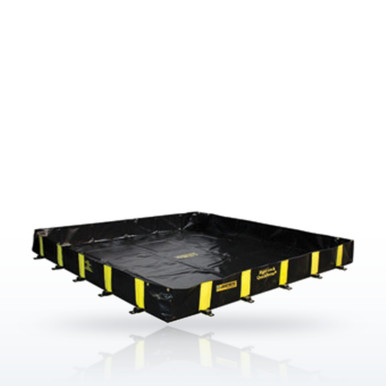
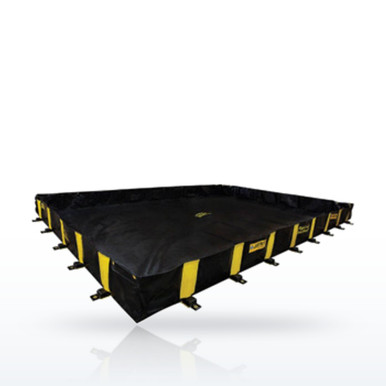
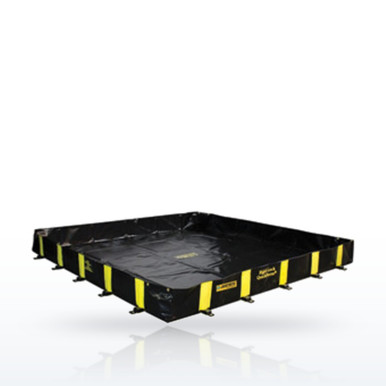 Justrite Rigid-Lock QuickBerm drive-over spill berm, 10 x 10 ft745-gallon capacity, 12-inch walls
Why a berm instead of a curb or a pallet? A concrete curb is permanent and a spill pallet holds four drums. A lot of oil sits somewhere else: a 500-gallon fuel tank on a trailer, a generator at a jobsite, a tote at a well pad, a fuel truck parked overnight. Those move, so the containment has to move with them. A berm folds into a bag, sets up on any flat ground in minutes, and holds what the rule says it has to hold. When the job ends it goes on the next truck.
What does the EPA require?
The SPCC rule applies to a facility that stores more than 1,320 gallons of oil above ground in containers of 55 gallons and up and could reach water. For those facilities, the rule says this about containment.
How is a spill berm sized?
Start with the largest single container that will sit in it. A 500-gallon tank needs a berm of at least 500 gallons; two 275-gallon totes need at least 275 gallons, because only the largest one is assumed to fail. Then add freeboard for rain if the berm is outdoors and uncovered. The EPA has said it considers the 25-year, 24-hour storm the appropriate design figure for most facilities, but left the number to the plan. A 10 by 10 foot berm with 12-inch walls holds about 745 gallons; a 15 by 40 foot berm with 12-inch walls about 4,488 gallons. The berm floor also has to be big enough for the equipment to stand inside the walls with room to work.
40 CFR 112.8(c)(2) and (c)(11) (largest single container plus sufficient freeboard for precipitation); EPA SPCC guidance on sufficient freeboard (25-year, 24-hour storm); capacities as published by the manufacturers of the berms shown below.For drums, the same arithmetic applies, and a second rule is often used alongside it: the hazardous waste container rule sizes containment to 10 percent of the total volume of the containers or the volume of the largest container, whichever is greater. For a 4 by 4 foot berm with four 55-gallon drums, 10 percent is 22 gallons and the largest drum is 55, so 55 gallons is the figure.
40 CFR 264.175(b)(3), container storage areas at permitted hazardous waste facilities; used by manufacturers and inspectors as the sizing convention for drum containment generally.What are the kinds of spill berm?
- Drive-over berms: foam-filled or rigid-lock walls that a vehicle can drive across and that spring back up. For fuel trucks, equipment and anything on wheels. Walls are typically 12 inches.
- Bracket or stake-wall berms (often sold as economy berms): a fabric liner held up by removable angle brackets. Lighter and lower cost for the same footprint; the brackets come out to drive in, then go back.
- Foam-wall mini berms: a small tray with 4 to 6 inch foam walls, for a drum, a transfer pump, a transformer or a hose connection.
- Maintenance berms: 2 inch walls, 2 by 4 feet, to catch drips under a vehicle or a piece of equipment in the shop.
- Washout berms: deeper walls (14 inches on the 4 by 4 foot model) for concrete truck chute washout, which construction stormwater permits do not allow in runoff.
- Track mats and ground covers go under the berm on gravel and rough ground to protect the floor from punctures; the floor is what makes the berm impervious.
When is a berm used outside an SPCC plan?
Stormwater permits. A construction site that disturbs an acre or more, and an industrial facility in a listed category, discharges under a stormwater permit whose pollution prevention plan has to describe how fuel, oil and chemicals are kept out of runoff; a berm under the fuel tank and the generator is the usual answer. Hazardous waste sites. OSHA requires a spill containment program able to contain and isolate the entire volume being transferred where major spills may occur during drum or container handling. Fleet and construction yards. Any place a fuel tank or a tote sits on dirt or pavement near a drain, whether or not a plan requires it, because the cleanup and the reporting after a release cost far more than the berm.
40 CFR 122.26(b)(14)(x) and (b)(15) (construction stormwater permits, 5 acres and 1 to 5 acres) and 122.26(b)(14) (industrial categories); EPA 2021 Multi-Sector General Permit and 2022 Construction General Permit, SWPPP requirements; 29 CFR 1910.120(j)(1)(viii); 40 CFR 110.3 and 110.6 (reportable oil discharges).Spill berms by capacity
18 items · prices liveCapacity, footprint and wall height are as published by the manufacturer for each berm; see the product page and spec sheet. Capacity is the volume of the berm itself, before freeboard. Free shipping on orders over $199.
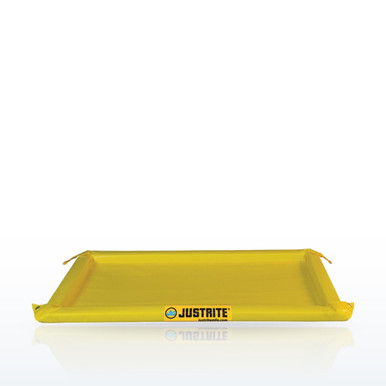
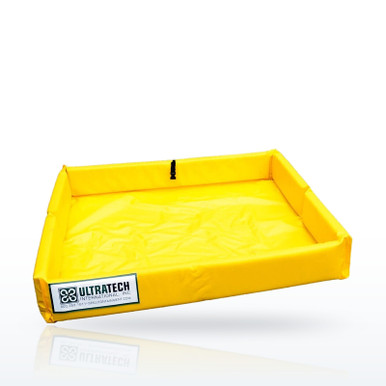
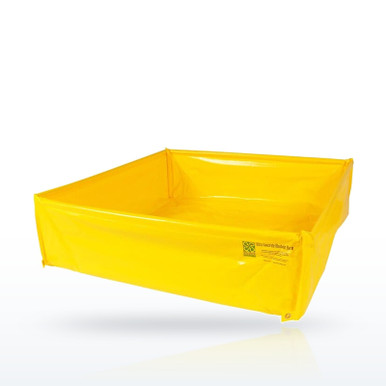
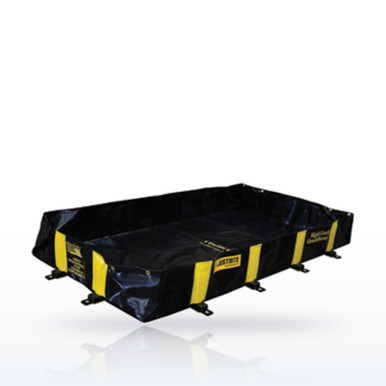
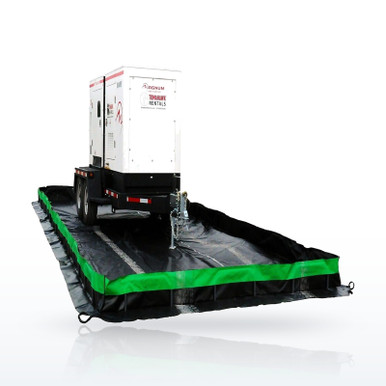
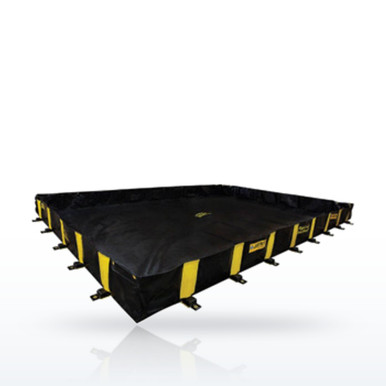



Spill pallets for drums and IBC totes, drain covers and sorbent booms are in the spill control finder. Sizes not listed, including custom footprints, are quoted on request: call (925) 215-7337.
Questions people ask
What is the difference between a spill berm and a spill pallet?
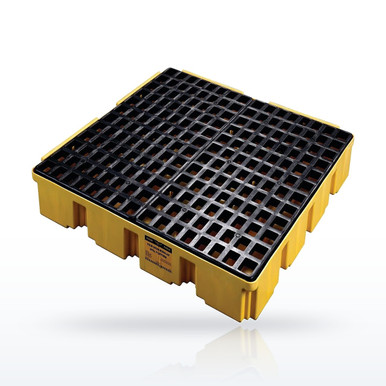
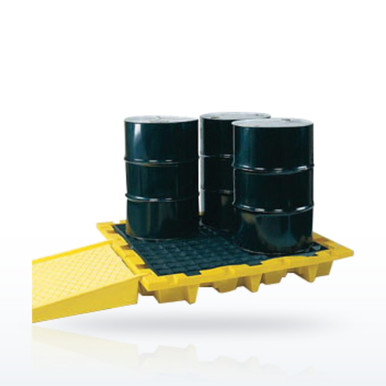
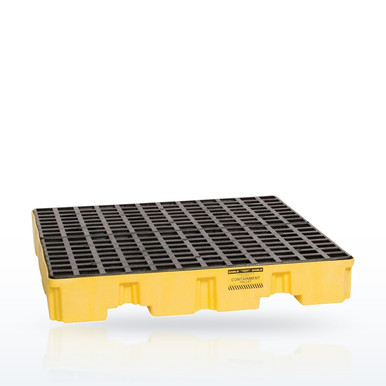
A pallet is a rigid poly sump with a grate, sized for 1 to 8 drums or an IBC tote, and the containers sit on it. A berm is a flexible-walled tray that can be as large as a truck, folds up, and takes anything that can be rolled or driven into it.
How big does a spill berm need to be?
Large enough to hold the entire capacity of the largest single container inside it, plus room for rain if it is outdoors. (40 CFR 112.8(c)(2) and (c)(11).) The equipment footprint sets the minimum length and width.
Does a spill berm need to be covered?
The rule does not require a cover; it requires freeboard for precipitation and a way to drain rainwater through a manual valve after inspection. A cover or a drain valve with a sorbent filter reduces how often you have to deal with rainwater.
Can you drive over a spill berm?
Only a berm built for it. Drive-over berms have foam or rigid-lock walls that compress under a tire and stand back up; bracket-wall berms need the brackets removed first; mini berms and maintenance berms are not for vehicles. The manufacturer data for each berm says which.
What is a spill berm made of?
A coated fabric, typically PVC, polyurethane or a copolymer, with foam or metal wall supports. The coating decides chemical resistance; manufacturers publish compatibility by fluid.
Who needs an SPCC plan?
A non-transportation facility with more than 1,320 gallons of oil above ground (counting containers of 55 gallons and up) or more than 42,000 gallons underground, that could reasonably be expected to discharge to navigable waters. (40 CFR 112.1.)
How is rainwater removed from a berm?
Inspect it, confirm there is no oil, then drain through a manual open-and-closed valve or pump it out. The rule prohibits flapper valves and requires the accumulation to be inspected before draining. (40 CFR 112.8(b)(1) and (b)(2).)
Is a berm required for a fuel truck?
The SPCC rule excepts mobile refuelers and tank trucks from the sized-containment paragraphs, but the facility still has to provide general containment under 112.7(c) for where it loads, unloads and parks them. Many facilities use a drive-over berm for that.
Standards and ratings on this page are as published in the documents named and by the manufacturers named. The employer’s hazard assessment and written program decide what applies at a given workplace. Verify a rating on the product and its spec sheet before use.