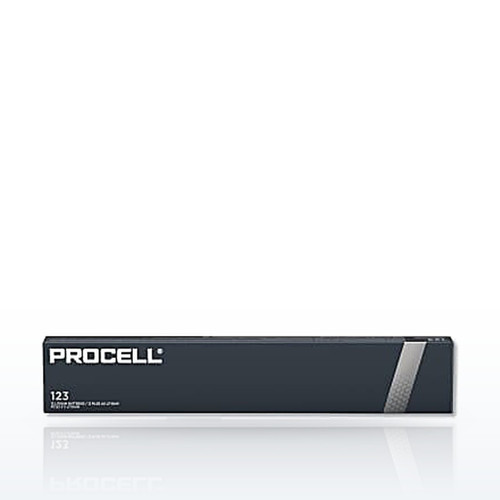
Description
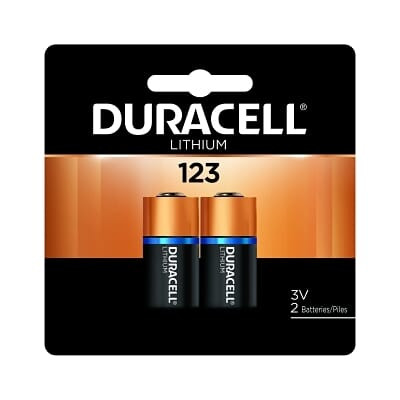
Duracell PL123BDK Procell High Power Lithium CR123, 3V: Procell 123 lithium batteries; lithium-manganese dioxide (Li/MnO2); nominal voltage 3.2-3.3 V; nominal capacity 1600 mAh (100 Ohm Cont, 2 V cut-off); designation ANSI 5018LC / IEC CR17345; operating temperature -20°C to 75°C (-4°F to 167°F); typical weight 17.0 g (0.60 oz.) a cell; lithium metal content approx. 0.53 g a cell. Storage life as the manufacturer prints it: 10-year guaranteed shelf life; individually date-coded for FIFO rotation across multi-site supply rooms
. The manufacturer describes it: Procell High Power Lithium CR123 batteries are designed to deliver safe power with high energy density (3V) and a flat, low self-discharge profile across high-drain devices used in hospitality, industrial, infrastructure, medical, and safety & security operations, including industrial cameras, laser rangefinders, barcode scanners, portable instruments, access control devices, and security sensors. Design, safety, manufacturing, and qualification follow Procell's stringent battery standards. Sold by the box of 12 batteries; the price is for the whole box. That is $4.30 a battery at the price shown. Country of origin: USA. We ship by ground; delivery is not available to every state. All the Duracell Procell professional batteries we stock are on the Duracell Procell professional batteries page.
Duracell PL123BDK specifications
From the Product Technical Data Sheet
| Specification | Detail |
|---|---|
| Data sheet | CR123AH0322 |
| Chemistry | Li/MnO2 |
| Battery type | Lithium/Manganese Dioxide Battery |
| Size | CR123A |
| Nominal voltage | 3.2-3.3 V (typical voltage at +20°C) |
| Nominal capacity | 1600 mAh (100 Ohm Cont, 2 V cut-off) |
| Nominal energy | 4.35 Wh |
| Impedance | 350 mOhm (AC impedance @ 1kHz) |
| Standard continuous discharge current | 20 mA |
| Maximum continuous discharge current | 60 mA |
| Typical weight | 17.0 g (0.60 oz.) |
| Storage temperature range | 5°C to 30°C (41°F to 86° F) |
| Operating temperature range | -20°C to 75°C (-4°F to 167°F) |
| ANSI designation | 5018LC |
| Lithium metal content | approx. 0.53 g |
| Safety standard on the sheet | IEC 60086-4 |
| Transport test on the sheet | UN 38.3 |
| Self-discharge | <1% after 1 year of storage at + 20 °C |
| Typical applications the sheet lists | Security Devices (sensors, monitoring cameras); Smoke Detectors; Wireless Sensors; Door Locks; High Intensity Flashlights; Laser Sights |
| Tests listed on the sheet | IEC 60086-4 tests A Altitude, B Thermal cycling, C Vibration, D Shock, E External short circuit, F Impact, G Crush, H Forced discharge: Pass |
Source: the manufacturer's Product Technical Data Sheet CR123AH0322 (PDF), read Nov 22 2026; the sheet's figures. Delivered capacity depends on the load, the temperature and the cut-off voltage, as the sheet says.
From the manufacturer's product page
| Specification | Detail |
|---|---|
| Product | Procell High Power Lithium CR123, 3V |
| Part number | PL123BDK |
| Pack sizes the manufacturer lists | 12 to the box |
| Nominal capacity on the page | 1,550 mAh |
| ANSI number on the page | 5018LC |
| Other sizes in the line | CR2 |
| Storage life | 10-year guaranteed shelf life; individually date-coded for FIFO rotation across multi-site supply rooms |
| Professional devices the manufacturer lists | Door Locks Thermostats Smoke Detectors Remote security cameras Flashlights Defibrillators |
| Product features | High-drain reliability across all CR123-powered devices: industrial cameras, laser rangefinders, barcode scanners, portable instruments, access control devices, and security sensors; Operating range, -4°F to 167°F, for environments where standard batteries fail; Design, safety, manufacturing, and qualification follow Procell's stringent battery standards - the High Power Lithium standard; Equivalent to CR123A, DL123A, EL123A, and 123 battery types |
Source: the manufacturer's product page (PL123), read Nov 22 2026; wording is the manufacturer's, its marketing words dropped.
From the Article Information Sheet
| Specification | Detail |
|---|---|
| Document | Duracell High Power Lithium Batteries, Article Information Sheet (2026 English edition) |
| Description | Duracell branded consumer lithium battery |
| Product category | Electro-technical device |
| Use | Portable power source for electronic devices |
| Cells the sheet covers | CR2 (CR15H270), CR-V3, 1/3N (CR/DL 1/3N, CR11108), 123 (123A, CR123A, DL123A, CR17345), 2/3A (CR17335), 223 (CR223, CR-P2, DL223), 245 (CR245, 2CR5, DL245), 28L (PX28L, 2CR11108, 2CR13252), CR17450 (CR-A) |
| Small parts warning the sheet requires | Required for 1/3N, 123, 28L, CR2 batteries: Keep out of reach of children. If swallowed, consult a physician immediately. |
| Normal conditions of use | Exposure to contents inside the sealed battery will not occur unless the battery leaks, is exposed to high temperatures, or is mechanically abused. |
| Handling precautions | Avoid mechanical and electrical abuse. Do not short circuit or install incorrectly. Batteries may rupture or vent if disassembled, crushed, recharged or exposed to high temperatures. Install batteries in accordance with equipment instructions. |
| Storage precautions | Store batteries in a dry place at normal room temperature. Refrigeration does not make them last longer. |
| First aid if swallowed | Required for sizes 1/3N, 123, 28L, CR2: Keep away from children. If swallowed, consult a physician immediately. Call National Ingestion Hotline (800-408-8666). |
| Fire hazard | Batteries may rupture or leak if involved in a fire. |
| Fires involving large quantities | Large quantities of batteries involved in a fire will rupture and release irritating fumes from thermal degradation. Use a Class "D" fire extinguisher or other smothering agent such as Lith-X, copper powder or dry sand. If using water, use enough to smother the fire. Using an insufficient amount of water will make the fire worse. Cooling exterior of batteries will help prevent rupturing. Burning batteries generate toxic and corrosive lithium hydroxide fumes. Firefighters should wear self-contained breathing apparatus. Detailed information on fighting a lithium metal battery fire can be found in US DOT Emergency Response Guide 138 (Substances-Water-Reactive). |
| Collection and disposal | Dispose of used (or excess) batteries in compliance with federal, state/provincial and local regulations. Do not accumulate large quantities of used batteries for disposal as accumulations could cause batteries to short-circuit. Do not incinerate. In states & countries, where there are regulations for the collection and recycling of batteries, consumers should dispose of their used batteries into the collection network at municipal depots and retailers. Do not dispose of batteries with household trash. |
| RCRA line (40 CFR 261) | "Charged" lithium metal batteries meet the criteria (D003 - Reactivity) of a hazardous waste as defined under the Resource Conservation and Recovery Act (RCRA) 40 CRT 261.23. If recycled, lithium metal batteries are classified as Universal Waste. |
| Transport status | The transportation of lithium metal batteries is regulated by ICAO, IATA, IMDG, IMO, US DOT, ADR. |
| Training line | Persons preparing or distributing lithium batteries for transportation are required by regulations to be trained in their level of responsibility. |
| UN identification | UN3090 Lithium metal batteries; UN3091 Lithium metal batteries packed with or contained in equipment |
| Hazard classification | Hazard Classification 9 |
| UN 38.3 test summary | UN38.3 Test Summary Documents that are required by the UN Model Regulations, can be requested by sending an email request to UN38.3_duracell@duracell.com |
| US DOT line | US DOT - SP 29, A54, A100, A101 |
| Air transport line | IATA 67th Edition, ICAO Packaging Instructions (PI) 968 - PI 970 |
| Total lithium content and cell weight (the sheet's table) | 0.56 g lithium, cell weight 17 g |
Source: the manufacturer's Article Information Sheet (PDF), its Safety Data Sheet form for batteries, read Nov 22 2026; the sheet's words.
Product details
| Specification | Detail |
|---|---|
| Part number | PL123BDK |
| Pack | Box of 12 |
| UPC | 041333004389 |
| Country of origin | USA |
| Sold by | Box of 12 |
| Hazardous material for shipping | Yes: lithium metal batteries; shipped by ground |
| Delivery | Not available to every state |
Source: the manufacturer's product record.
Battery safety and the rules
The manufacturer publishes an Article Information Sheet for its lithium batteries in place of a Safety Data Sheet, and says why: Articles, such as batteries, are exempt from GHS SDS classification criteria. The GHS criteria is not designed or intended to be used to classify the physical, health and environmental hazards of an article. Branded consumer batteries are defined as electro-technical devices. The design, safety, manufacture, and qualification of branded consumer batteries follow ANSI and IEC battery standards.
The sheet (Duracell High Power Lithium Batteries, Article Information Sheet (2026 English edition)) prints: Avoid mechanical and electrical abuse. Do not short circuit or install incorrectly. Batteries may rupture or vent if disassembled, crushed, recharged or exposed to high temperatures. Install batteries in accordance with equipment instructions.
; Store batteries in a dry place at normal room temperature. Refrigeration does not make them last longer.
; Required for 1/3N, 123, 28L, CR2 batteries: Keep out of reach of children. If swallowed, consult a physician immediately.
; Required for sizes 1/3N, 123, 28L, CR2: Keep away from children. If swallowed, consult a physician immediately. Call National Ingestion Hotline (800-408-8666).
; Batteries may rupture or leak if involved in a fire.
; Large quantities of batteries involved in a fire will rupture and release irritating fumes from thermal degradation. Use a Class "D" fire extinguisher or other smothering agent such as Lith-X, copper powder or dry sand. If using water, use enough to smother the fire. Using an insufficient amount of water will make the fire worse. Cooling exterior of batteries will help prevent rupturing. Burning batteries generate toxic and corrosive lithium hydroxide fumes. Firefighters should wear self-contained breathing apparatus. Detailed information on fighting a lithium metal battery fire can be found in US DOT Emergency Response Guide 138 (Substances-Water-Reactive).
; Dispose of used (or excess) batteries in compliance with federal, state/provincial and local regulations. Do not accumulate large quantities of used batteries for disposal as accumulations could cause batteries to short-circuit. Do not incinerate. In states & countries, where there are regulations for the collection and recycling of batteries, consumers should dispose of their used batteries into the collection network at municipal depots and retailers. Do not dispose of batteries with household trash.
; The transportation of lithium metal batteries is regulated by ICAO, IATA, IMDG, IMO, US DOT, ADR.
; UN3090 Lithium metal batteries; UN3091 Lithium metal batteries packed with or contained in equipment
. Its lithium-content table gives the 123 cell 0.56 g of lithium at a cell weight of 17 g. Those are the manufacturer's statements; the rule paragraphs are quoted here so the employer reads the rule itself.
29 CFR 1910.1200(c) Definitions: Article means a manufactured item other than a fluid or particle: (i) Which is formed to a specific shape or design during manufacture; (ii) Which has end use function(s) dependent in whole or in part upon its shape or design during end use; and (iii) Which under normal conditions of use does not release more than very small quantities, e.g., minute or trace amounts of a hazardous chemical (as determined under paragraph (d) of this section), and does not pose a physical hazard or health risk to employees.
29 CFR 1910.1200(b)(6) Scope and application: this section does not apply to: ... (v) Articles (as that term is defined in paragraph (c) of this section).
29 CFR 1910.1200(b)(1) Hazard communication, scope and application: this section requires chemical manufacturers or importers to classify the hazards of chemicals which they produce or import, and all employers to provide information to their employees about the hazardous chemicals to which they are exposed, by means of a hazard communication program, labels and other forms of warning, safety data sheets, and information and training.
49 CFR 173.185 (Lithium cells and batteries) is the US Department of Transportation rule the manufacturer's data sheet points to for the United States; the Article Information Sheet adds that persons preparing or distributing lithium batteries for transportation are required by regulations to be trained in their level of responsibility.
The manufacturer prints the designations, standards and figures in the tables above (IEC 60086-5, ANSI C18.1M, Part-2) and no other standard, rating or approval for this Procell 123 lithium batteries; nothing beyond the manufacturer's printed figures is claimed here. Where batteries are stored, installed and collected for disposal, which of the manufacturer's handling and disposal lines apply and which state recycling rules apply at the job site is the employer's call under 1910.1200 and the hazard assessment of 1910.132(d). Lithium metal batteries are a hazardous material for shipping and the product record restricts them in some states: we ship them by ground and delivery is not available to every state.
Source: OSHA 29 CFR 1910.1200 and DOT 49 CFR 173.185 as published on ecfr.gov (1910.1200 173.185); the manufacturer's Article Information Sheet (PDF) and data sheets index; read Nov 22 2026.
Duracell PL123BDK, as Duracell describes it
Product name on the manufacturer's page: Procell High Power Lithium CR123, 3V; sold 12 to the box on its page.
In the manufacturer's words: 10-year guaranteed shelf life; individually date-coded for FIFO rotation across multi-site supply rooms
.
As the manufacturer prints it:
- Design, safety, manufacturing, and qualification follow Procell's stringent battery standards
- Wide operating range: -4°F to 167°F, built for environments
- Individually date-coded for FIFO inventory management
- High-drain reliability across all CR123-powered devices: Industrial cameras, laser rangefinders, barcode scanners, portable instruments, access control devices, and security sensors
- Operating range, -4°F to 167°F, for environments where standard batteries fail
- Design, safety, manufacturing, and qualification follow Procell's stringent battery standards - the High Power Lithium standard
- Equivalent to CR123A, DL123A, EL123A, and 123 battery types
Devices the page lists: Door Locks Thermostats Smoke Detectors Remote security cameras Flashlights Defibrillators.
About the manufacturer: Duracell Inc. of Bethel, Connecticut (a Berkshire Hathaway company, as its data sheets print) makes the Coppertop, Optimum, lithium and rechargeable lines; its US battery operations are in LaGrange, Georgia, as its Article Information Sheets print. Procell is the Duracell company's professional business-to-business battery brand, in the manufacturer's words.
Source: the manufacturer's product page (PL123); wording is the manufacturer's, its marketing words dropped.
What you get
One box of 12 (Duracell PL123BDK): one box of 12 Procell High Power Lithium CR123 batteries (PL123BDK). Sold by the box of 12 batteries; the price is for the whole box. That is $4.30 a battery at the price shown. Nothing else is in the box.
Related Duracell part numbers
All the Duracell Procell professional batteries we stock are on the Duracell Procell professional batteries page (6 listings).
Source: Product names in the manufacturer's words; the items listed beside this one are the other packs on this page, the same product group and the other Duracell listings we stock; prices are ours.
Duracell PL123BDK questions
What does the data sheet print for the Duracell PL123BDK cell? Lithium/Manganese Dioxide Battery, nominal voltage 3.2-3.3 V (typical voltage at +20°C), nominal capacity 1600 mAh (100 Ohm Cont, 2 V cut-off), impedance 350 mOhm (AC impedance @ 1kHz), typical weight 17.0 g (0.60 oz.), operating temperature range -20°C to 75°C (-4°F to 167°F) (sheet CR123AH0322).
What size designation does the Duracell PL123BDK cell carry? ANSI 5018LC and IEC CR17345, as the manufacturer prints it.
How long does the manufacturer say the Duracell PL123BDK Procell 123 lithium batteries keep in storage? 10 years, as the storage-life line quoted in the table above puts it; the data sheet prints self-discharge of <1% after 1 year of storage at + 20 °C. The sheet says to store them in a dry place at normal room temperature.
How do the Duracell PL123BDK Procell 123 lithium batteries ship? As a hazardous material by ground; delivery is not available to every state. The manufacturer's Article Information Sheet lists lithium metal batteries under UN3090 Lithium metal batteries; UN3091 Lithium metal batteries packed with or contained in equipment, hazard class 9, and says the shipping cartons are designed to prevent short circuit; the data sheet gives the lithium metal content as approx. 0.53 g a cell.
How are the Duracell PL123BDK Procell 123 lithium batteries sold? Sold by the box of 12 batteries; the price is for the whole box. That is $4.30 a battery at the price shown.
Where are the Duracell PL123BDK Procell 123 lithium batteries made? The product record gives the country of origin as USA; the manufacturer's page prints no origin line.
Duracell PL123BDK documents
- Duracell product page: Procell High Power Lithium CR123, 3V
- Duracell Product Technical Data Sheet CR123AH0322 (PDF)
- Duracell Article Information Sheet: Duracell High Power Lithium Batteries (PDF)
- Duracell Product Technical Data Sheets library
- Duracell Battery Cross Reference Chart
- Duracell battery care, use and disposal page
- Procell, all batteries (the Duracell company's professional line)
- OSHA 29 CFR 1910.1200 (eCFR)
- DOT 49 CFR 173.185 (eCFR)
Source: Duracell product pages and the documents its Technical Library links; eCFR where a rule is quoted.
Manufacturer part number: PL123BDK (Procell High Power Lithium CR123, 3V).