
Bayshore Safety & Industrial Supplies Guide
Ammonia inhalants (smelling salts) in a first aid kit: what they are, what they smell like, what the label says they are for, whether you can buy them over the counter, why athletes sniff them, and how the Red Cross says to help a person who faints
An ammonia inhalant is a crushable capsule or a sealed wipe holding a small dose of aromatic ammonia spirit; crushed under the nose, the ammonia vapor irritates the lining of the nose and lungs and makes the person gasp and breathe in sharply. First Aid Only prints "aromatic stimulant to assist in reviving victims of fainting or shock" on its 9-001 capsules, each holding 0.33 cc, and sells them 10 to a box and 100 to a box, plus ammonia inhalant wipes. They are sold without a prescription; "smelling salts" is the older name for the same product, and the gym versions are the same ammonia at higher strength. The Red Cross fainting page does not use them: its care is to check responsiveness and breathing, start CPR if the person is not breathing, place a breathing but unresponsive person in the recovery position, and for someone who feels faint, lie them down, have them cross or tense their legs, loosen tight clothing, and call 911 if it does not pass in a minute or two.
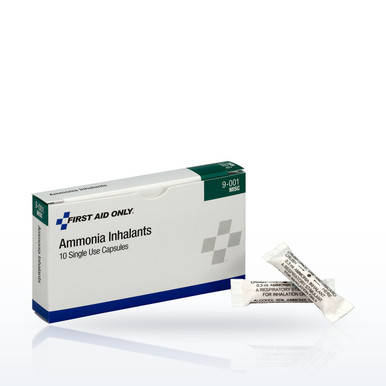 First Aid Only 9-001 Ammonia Inhalants, 10 per BoxFirst Aid Only prints 10 crushable capsules of ammonia inhalant, 0.33 cc each, an aromatic stimulant
Why a kit item needs a page of its own. Ammonia inhalants have been in first aid kits for a century and in gym bags for a decade, and the questions split the same way: what are they for, can I buy them, are they legal, what do they smell like, and why do lifters sniff them. The first aid answer is short and the Red Cross answer is shorter: an inhalant is a stimulant the manufacturer labels for reviving a person who has fainted, and the Red Cross first aid for fainting does not call for one. This page gives the manufacturer’s label, the Red Cross fainting steps, the purchase and legality answers, and the honest line on the gym use, which is outside first aid.
What an ammonia inhalant is
The questions, one by one
Can you buy ammonia inhalants or smelling salts over the counter, and is it legal?
Yes and yes. Ammonia inhalants are an over-the-counter first aid product; First Aid Only’s capsules and wipes are sold by the box with no prescription, and we sell nationwide. Sports smelling salts are sold as supplements. The "banned" stories are about sports leagues restricting their use on the sideline, not a law about buying them.
What are ammonia inhalants used for in a first aid kit?
The label use: to help revive a person who has fainted or feels faint, by making them gasp. First Aid Only prints "to assist in reviving victims of fainting or shock". They have no place in CPR, in a head injury, or for someone who is unresponsive for a reason other than a simple faint; the Red Cross fainting steps above are the first aid, and an inhalant is at most something a trained person adds to them.
How do the Red Cross fainting steps go?
Check the scene and the person. If unresponsive and not breathing, start CPR or compression-only CPR and use an AED. If breathing but unresponsive with no injuries, call 911 and put them in the recovery position. If they respond, keep checking, keep them from getting cold or overheated, give care for shock, reassure them, watch breathing and responsiveness. To prevent a faint: lie the person on their back, have them cross their legs or contract their leg muscles, loosen tight clothing, and call 911 if it does not improve in 1 to 2 minutes or comes back.
What do smelling salts smell like, and what does ammonia do when you sniff it?
Household ammonia at full strength: the same sharp smell as a cleaning bottle, which hits the nose, throat and eyes at once. The vapor triggers the inhalation reflex; the gasp and the surge of alertness last a few seconds to a minute. It is an irritant: too close, too long or too often and it burns the nasal lining, and it is never used on someone who cannot pull away.
Why do athletes, powerlifters and football players sniff ammonia, and is it safe?
For the gasp and the jolt of alertness before a lift or a play; the sports products are stronger than first aid capsules and are sold as supplements. That use is outside first aid and the manufacturer’s label, and several leagues have restricted it on the sideline, in part because the jolt can mask a concussion. Daily use, and use to wake up, are not what the product is labeled for; the honest answer to "is it healthy" is that an irritant is not.
Is it safe to wake someone up with smelling salts?
Not someone who is unresponsive: the Red Cross steps for an unresponsive person are CPR if not breathing and the recovery position if breathing, with 911 called; jerking the head back from an inhalant can worsen a neck injury, and the inhalant tells you nothing about why they are out. The label use is a simple faint in a person who is coming round.
How long do smelling salts last after sniffing, and how do they last in storage?
The effect: seconds to a minute. The product: the sealed capsule or wipe keeps until the expiration date printed on the box; an opened capsule is spent. They are checked with the kit and replaced when dated or crushed.
What is aromatic ammonia spirit, and what could cause an ammonia smell in my nose?
Aromatic ammonia spirit is the pharmacopeia name for the solution in the capsule. A persistent ammonia smell in the nose without an inhalant is a medical question for a clinician, not a first aid one.
Does a Z308.1 kit have to carry ammonia inhalants?
No. Z308.1-2021 does not list them; they are an optional supplementary item some kit makers include and First Aid Only sells separately. A Class A or B kit is complete without them.
How do I make smelling salts?
You do not; aromatic ammonia spirit is a pharmacy preparation, the capsule is dosed and sealed, and a home mixture of ammonia is an inhalation hazard. The unit box in the band is the product.
In plain words
- A sealed capsule or wipe of aromatic ammonia; crushed under the nose, it makes the person gasp.
- Label: a stimulant to assist in reviving a person who has fainted. Not for CPR, not for head injuries, not for someone who cannot pull away.
- Red Cross for fainting: check breathing, CPR or recovery position, lie down, legs tensed, 911 if it does not pass in 1 to 2 minutes.
- Sold over the counter; legal to buy; gym use is outside first aid.
- Not a Z308.1 item; an optional add-on.
Questions people ask
Can you buy ammonia inhalants over the counter?
Yes; First Aid Only sells 10 and 100-count boxes and wipes without a prescription.
Can you legally buy smelling salts?
Yes; the restrictions in the news are sports-league sideline rules, not purchase laws.
What are ammonia inhalants used for?
The label: an aromatic stimulant to assist in reviving a person who has fainted or feels faint.
What do smelling salts smell like?
Sharp household ammonia; it stings the nose and eyes.
Why do athletes sniff ammonia?
For the gasp and the jolt of alertness; it is outside first aid and the label, and some leagues restrict it.
Is it safe to wake someone with smelling salts?
Not an unresponsive person; the Red Cross steps are CPR or the recovery position and 911.
What does the Red Cross say to do for fainting?
Check breathing; CPR if not breathing; recovery position if breathing and unresponsive; lie down, tense the legs, loosen clothing, 911 if not better in 1 to 2 minutes.
Does an ANSI first aid kit need ammonia inhalants?
No; Z308.1-2021 does not list them.
How much is in a capsule?
First Aid Only prints 0.33 cc of aromatic stimulant per crushable capsule.
How long do smelling salts last?
The effect a minute at most; the sealed product until the date on the box.
The ratings, test results and standards shown here are the manufacturers' published values, reproduced as published. Nothing on this page is a recommendation by Bayshore Safety that any product is suitable for a particular task, hazard or workplace. Selecting safety products and protective equipment is the responsibility of the end user and the employer, based on their own hazard assessment and the regulations that apply to their work. Confirm every value on the manufacturer's own documentation before use.
© 2026 Bayshore Safety & Industrial Supplies, Inc. All rights reserved. This guide may not be copied or republished without written permission.