Home › Guides › Roofing tools › Contractor bags, film and tape
Guide · Jobsite consumables · Contractor bags, drum liners, stretch wrap, duct tape and packing tape

What are contractor bags, and how do they differ from garbage bags? 3 mil and 42 gallon bags, 55 gallon drum liners, garbage bag sizes, stretch wrap sizes and how many pallets a roll covers, duct tape vs HVAC tape, and clear vs brown packing tape

A contractor bag is a heavy trash bag, 3 mil thick (three thousandths of an inch; a kitchen bag is 0.7 to 0.9 mil) and 42 gallons (32 by 50 inches), made to hold demolition debris, shingle scraps, drywall, lath and nails without tearing when it is dragged and thrown; a 55 gallon drum liner is a thinner (2 mil) bag sized to line a 55 gallon drum or barrel for lighter waste. Stretch wrap (stretch film, pallet wrap) is a linear low-density polyethylene film, 18 inches wide in 80 to 120 gauge (0.8 to 1.2 mil), on a 1,000 to 1,500 foot roll, that stretches up to about 250 percent and clings to itself to hold a pallet load together; a 1,500 ft roll wraps 40 to 60 pallets depending on how many wraps each gets. Duct tape is a cloth-backed rubber-adhesive tape for everything except ducts, where UL 181 foil tape is the listed product; packing tape is a polypropylene film tape for cartons, in clear (shows what is under it) and tan (hides it).
Bayshore Safety. Industrial safety, roofing tools and jobsite supplies since 2017. · Current as of November 2026 · the C&R product data on this site (42 gallon 3 mil contractor trash bags, 32 x 50 in, 20 per box; 55 gallon 2 mil drum liners, 25 per roll; 18 in x 1,500 ft 80 gauge stretch film in clear and black and 18 in x 1,000 ft 120 gauge, made in USA; 5 in x 1,000 ft mini stretch film; 2 in x 60 ft contractor-grade duct tape, made in USA; clear and tan packing tape; 5 gallon bucket); the bag trade’s mil and gallon sizing and the film trade’s gauge convention (80 gauge = 0.8 mil); the UL 181 listing that distinguishes HVAC foil tape from general duct tape
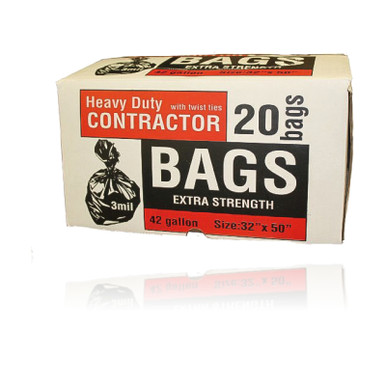
C&R Trash-20 Contractor Trash Bags, 42 gallon, 3 mil, 20 countC&R Trash-20 Contractor Trash Bags, 42 gallon, 3 mil, 20 countThe product data lists the Trash-20 as 42 gallon contractor trash bags, 32 x 50 in, 3 mil, 20 to a box

Reading the numbers. Bags are sold by gallons (capacity) and mil (thickness); film by width, length and gauge (100 gauge is 1 mil); tape by width, length and backing. Those numbers answer most of what people ask: what contractor bags are good for and how they differ from garbage bags, the size of a standard garbage bag and a contractor bag, how much they cost, what stretch wrap is for and its standard size, how many pallets a roll covers and how to wrap one, whether duct tape is HVAC tape, what it will not stick to and what to do when it gets wet, and whether clear or brown packing tape is better. The cards take them in that order.

Bags, film and tape, question by question

Sizes, mil and gauge are from the product data on this site; the UL 181 distinction is the listing printed on HVAC tapes.

What are contractor bags good for, and what is the difference between contractor bags and garbage bags?Thickness and shape. A contractor bag is 3 mil (some are 4 to 6), a kitchen bag is under 1 mil and a lawn bag about 1.5; the 3 mil film takes the corners of drywall, the edges of shingle scraps, nails, broken tile and glass without splitting, and holds 40 to 60 pounds when dragged. Contractor bags are also cut wider than they are tall (32 x 50 inches for 42 gallons, often with a flat bottom) so they stand open for shoveling. Uses: tear-off scraps that are not worth a trailer, drywall and lath, insulation, yard waste, carpet pad, packing a jobsite out, sandbags in a storm, and as a tarp for a tool pile. They are not for hazardous waste (asbestos, lead paint chips, solvents), which have their own labeled bags and rules.
What is the size of a standard garbage bag, and of a contractor bag?Household: 13 gallon kitchen bags (about 24 x 27 inches), 30 to 33 gallon trash bags (30 x 36), 39 to 45 gallon lawn and leaf bags (33 x 44 to 40 x 46). Contractor: 42 gallon (32 x 50) is the standard, with 55 and 60 gallon (38 x 58) for bulky light debris. Drum liners: 55 gallon (38 x 60) to line a drum, 2 mil for light waste. Bag capacity is nominal; a 42 gallon bag filled with shingle scraps holds what one person can lift, which is far less than 42 gallons of water.
How much do contractor bags cost, and where are cheap contractor bags?By the box of 20 or the case; the price per bag follows mil and gallon and the band below has the current price for our 42 gallon 3 mil box. The cheap bags are the thin ones, and a 1.5 mil bag that splits on a shingle edge costs more in time than the 3 mil bag that does not. We sell by the box and case nationwide.
What is a drum liner, and how is it different from a trash bag?A drum liner is a bag sized to the inside of a 55 gallon steel or plastic drum (about 38 by 60 inches), in 1.5 to 3 mil, sold on a roll of 25 or 50 (ours is 2 mil, 25 per roll). It lines the drum so the drum stays clean and the waste lifts out as one bag; it is for light and dry waste, floor sweepings, packaging and rags, not for sharp demolition debris (a contractor bag) or liquids. A drum liner is also what goes in the big wheeled shop cans and the 44 gallon round cans.
What is stretch wrap, what is it made of, and what is the standard size?Linear low-density polyethylene (LLDPE) film, cast or blown, that stretches 150 to 300 percent and clings to itself without adhesive. Standard hand-wrap rolls are 18 inches wide by 1,000 or 1,500 feet on a 3 inch core, in 60, 70, 80, 90 and 120 gauge (0.6 to 1.2 mil); 80 gauge is the general-purpose pallet film (ours in clear and black, 1,500 ft) and 120 gauge is for heavy, sharp or irregular loads (ours at 1,000 ft). Machine film comes in 20 and 30 inch widths on larger rolls. Mini rolls (5 inches by 1,000 ft, ours is the Wrap-5) bundle pipe, lumber, ladders, cords and loose parts. Black film hides the load and resists UV; clear shows the labels.
What do you use stretch wrap for, how many pallets does a roll cover, and how do you wrap a pallet?Uses: holding a pallet of shingle bundles, buckets, boxes or tools together for the forklift and the truck; bundling lumber, pipe, ladders and cords; covering a tool stack against dust; wrapping furniture and doors for a move; and keeping a roll of roofing from unrolling. A 1,500 ft roll at 80 gauge covers 40 to 60 pallets at three to four wraps per layer; a 1,000 ft roll about 30 to 40. To wrap a pallet: tie the film tail around a corner of the pallet base, walk around the load wrapping the base two or three times so the load is locked to the pallet (the single most important step), spiral up with each wrap overlapping the last by half, stretch the film by pulling as you walk, wrap the top two or three times, come back down if the load is tall or heavy, and tear and press the tail. A wrap dispenser with a brake makes the stretch even. Shrink wrap is a different film that is heated to shrink; stretch wrap is not heated. What is the price of a roll? The band below has it by gauge.
What is the difference between duct tape and HVAC tape, and can duct tape be used on HVAC?Duct tape is a polyethylene-coated cloth tape with a rubber adhesive: strong, tearable by hand, and its adhesive dries out and lets go with heat, which is why it fails on actual ducts within a year. HVAC tape is aluminum foil tape with an acrylic adhesive listed to UL 181A or 181B for sealing duct seams and joints, and the mechanical codes require a listed tape or mastic on ducts. So duct tape is not used on HVAC ducts; it is used on everything else: holding a tarp, bundling, marking, patching a hose for a day, wrapping a handle. Is one brand stronger than another? We do not rate other manufacturers’ tapes; our duct tape is a 2 inch by 60 ft contractor grade made in the USA.
What will duct tape not stick to, and what happens if it gets wet?It does not hold on dusty, oily or rough surfaces (raw concrete, dirty metal, brick), on polyethylene and polypropylene plastics (poly tarps, buckets, coolers), on silicone, on anything cold (the rubber adhesive stiffens below about 40°F) or hot (it softens and creeps above about 140°F), or on rubber roofing (and it leaves residue on EPDM). Wet: the cloth backing is coated and sheds water, so an applied patch survives rain for a while, but water that gets under the edge lifts it and a wet surface will not take it in the first place. Residue comes off with a citrus remover (the roof cement guide linked below). Duct tape is not insulation tape: electrical tape is a vinyl tape rated for voltage, and duct tape is not.
Is clear or brown packing tape better, and what are the types?Same tape, different film color: packing tape (carton sealing tape) is a 2 or 3 inch polypropylene film with an acrylic (clear, the common one; long shelf life) or hot-melt (tan or clear; stickier, for cold rooms and recycled cartons) adhesive, 1.9 to 3.1 mil. Clear lets a label or a printed carton show through; tan (brown) hides the seam, matches kraft boxes and is the shipping-room standard. Neither is stronger by color. Paper (water-activated gummed) tape bonds to the carton fibers and is the tamper-evident and recyclable choice. Mailing tape, shipping tape and carton tape are the same thing; cellophane (scotch-type) tape is a thin office tape and does not seal a box. Ours come clear by the 6-pack and tan singly.
What tape sticks to rubber, seals water leaks, and is the most waterproof?Rubber (EPDM, tires, hoses): a self-fusing silicone tape (it bonds to itself, not the rubber, and seals a hose for a season) or the membrane manufacturer’s tape on a roof. Water leaks: no tape seals a pressurized pipe for long; self-fusing silicone tape is the emergency wrap, and a repair clamp is the fix. The most waterproof tapes are the butyl and foil-backed flashing tapes in the butyl guide linked below, which seal by compression and do not depend on a thin adhesive film. Duct tape is for none of those.
How do you tell if a bucket is HDPE, and what is a 5 gallon bucket used for on a roof?The recycling code 2 molded in the bottom means HDPE (high-density polyethylene), the material of nearly every 5 gallon pail; a food-grade bucket is also marked. On a roof a 5 gallon bucket carries nails, hand tools, a bundle of hook blades and the coffee, hauls up on the hoisting wheel, holds the magnet sweeper’s load and the bucket grid for a roller, and, with a lid, keeps the roof cement from skinning. Ours is sold singly.

Bags, film and tape in plain words

  • Contractor bag: 42 gallon, 32 x 50 inches, 3 mil; for demolition scraps and sharp debris. Kitchen bags are under 1 mil.
  • Drum liner: 55 gallon, 38 x 60 inches, 2 mil; for light dry waste in a drum or big can.
  • Stretch wrap: 18 inch x 1,000 or 1,500 ft, 80 gauge general, 120 heavy; 100 gauge is 1 mil. A 1,500 ft roll does 40 to 60 pallets.
  • Wrap a pallet: lock the base with two or three wraps, spiral up with half overlap, pull to stretch, top wraps, back down if heavy.
  • Duct tape for everything but ducts; HVAC ducts take UL 181 foil tape or mastic.
  • Duct tape will not stick to dust, oil, poly plastics, silicone, rubber roofing, cold or hot surfaces.
  • Packing tape is the same film in clear or tan; hot-melt for cold rooms, acrylic for shelf life, gummed paper for tamper evidence.
  • Recycling code 2 on the bottom means HDPE.

Questions people ask

What are contractor bags good for?

Demolition scraps, shingle pieces, drywall, lath, nails, insulation, packing out a site and sandbags; not hazardous waste.

What is the difference between contractor bags and garbage bags?

Contractor bags are 3 mil and cut wide (32 x 50 inches for 42 gallons); household bags are under 1 to 1.5 mil and split on sharp debris.

What is the typical size of a garbage bag?

13 gallon kitchen (24 x 27 in), 30 to 33 gallon trash (30 x 36), 39 to 45 gallon lawn (up to 40 x 46); contractor bags 42 gallon (32 x 50).

What is the standard size of stretch film?

18 inches wide by 1,000 or 1,500 feet in 80 gauge for hand wrapping; 120 gauge for heavy loads; 20 to 30 inch machine rolls.

What is the price of stretch film wrap?

By the case of 4 rolls at 80 or 120 gauge; the band on this page has the current prices.

How much do contractor bags cost?

By the box of 20; the current price for our 42 gallon 3 mil bag is in the band above.

What is the difference between duct tape and HVAC tape?

Duct tape is cloth with rubber adhesive and fails with heat; HVAC tape is UL 181 foil tape with acrylic adhesive, the only tape the codes allow on ducts.

What do you use stretch wrap for?

Holding pallet loads together, bundling pipe, lumber, ladders and cords, covering stacks and keeping rolls from unrolling.

What material is stretch wrap made of?

Linear low-density polyethylene (LLDPE), cast or blown.

Is clear or brown packing tape better?

Neither; the film is the same. Clear shows labels, tan hides seams; hot-melt adhesive for cold rooms, acrylic for shelf life.

How many pallets will a roll of stretch wrap cover?

About 40 to 60 pallets from a 1,500 ft roll at three to four wraps per layer; 30 to 40 from a 1,000 ft roll.

Can I use duct tape instead of insulation tape?

No; electrical tape is vinyl rated for voltage and duct tape is not.

What should you not use duct tape for?

HVAC ducts, electrical insulation, rubber roofing, poly tarps and buckets, pressurized leaks and anything hot or cold.

What is the difference between packing tape and scotch tape?

Packing tape is 2 to 3 inch polypropylene carton tape; scotch-type cellophane tape is thin office tape that does not seal a box.

What happens if duct tape gets wet?

The coated backing sheds rain for a while, but water under the edge lifts it and it will not stick to a wet surface.

What will duct tape not stick to?

Dusty, oily or rough surfaces, polyethylene and polypropylene plastics, silicone, EPDM, and cold or hot surfaces.

How to wrap a pallet for shipping?

Lock the film to the pallet base with two or three wraps, spiral up with half overlap while pulling to stretch, wrap the top, come back down if heavy, press the tail.

What tape is used to seal water leaks?

Self-fusing silicone tape as an emergency wrap on a hose or pipe; a clamp or a repair is the fix.

What type of tape sticks to rubber?

Self-fusing silicone tape bonds to itself around rubber; on a rubber roof only the membrane manufacturer’s tape.

How do you tell if a bucket is HDPE?

Recycling code 2 molded in the bottom.

What are some alternatives to pallet wrap?

Strapping (poly or steel banding) with corner boards, stretch hoods on machines, or shrink film with a heat gun for small loads.

The ratings, test results and standards shown here are the manufacturers' published values, reproduced as published. Nothing on this page is a recommendation by Bayshore Safety that any product is suitable for a particular task, hazard or workplace. Selecting safety products and protective equipment is the responsibility of the end user and the employer, based on their own hazard assessment and the regulations that apply to their work. Confirm every value on the manufacturer's own documentation before use.

Setting up a roofing crew or a shop?Call (925) 215-7337 or email us the trades, the crew size and the quantities and we will quote tools and supplies by the case, with the part numbers listed. We sell nationwide.
All roofing tools
How to buyCard, purchase order or invoice terms; quotes on request; agencies and institutions welcome.
Live Service & SupportReal people who know the products, Monday to Friday 7:30am to 4pm Pacific. 925-215-7337
We DeliverWe ship nationwide. Parcel and LTL freight to job sites and businesses across the U.S.