
Bayshore Safety & Industrial Supplies Guide
DEET vs DEET-free insect repellent and sunscreen packets for outdoor crews: what DEET is, whether bug spray without DEET works, repellent wipes vs sprays, SPF 30 sunscreen packets, poison ivy pre-contact and post-contact washes, and tick removal
DEET (N,N-diethyl-meta-toluamide) is the repellent the EPA has registered since 1957 and the one with the longest record against mosquitoes and ticks; First Aid Only’s BugX30 towelettes carry 30 percent DEET and print "effective for 7 or more hours against mosquitoes, ticks, chiggers, fleas, mites, black flies, sand flies and gnats". DEET-free repellents use picaridin, IR3535 or oil of lemon eucalyptus, which the EPA also registers and the CDC lists as effective; First Aid Only’s BugX DEET-free wipes are the no-DEET option for a crew whose policy or skin asks for one. A wipe puts a measured dose on the skin without the overspray of an aerosol, which is why kits carry towelettes. SunX30 is an SPF 30 broad-spectrum (UVA and UVB) sunscreen in 0.25 oz packets and wipes, printed water and sweat resistant and PABA-free; IvyX is a pre-contact barrier lotion against urushiol and a post-contact cleanser. The Red Cross insect bites and stings page is the first aid frame: scrape out the stinger, wash, cold pack, and 911 for breathing trouble or swelling of the face or throat.
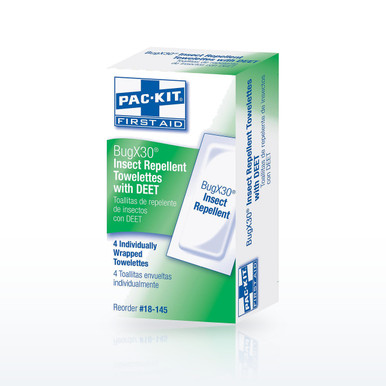 First Aid Only 18-145 BugX30 Insect Repellent Wipes DEET, 3 CountsFirst Aid Only prints BugX30 insect repellent towelettes with 30 percent DEET, effective for 7 or more hours, 4 per unit box
Why the percentage and the form are the two questions. The DEET question people ask is really two: does a repellent without DEET work (yes, the EPA-registered alternatives do, for shorter periods), and what percentage of DEET to buy (the percentage sets how long it lasts, not how well it works, and 30 percent is the common outdoor-work strength). The form matters for a crew: a towelette in a kit or a cabinet is a dose per worker with no aerosol in the truck. This page gives the manufacturer’s statements on BugX, SunX and IvyX, the EPA and CDC frame on repellent actives as the labels state it, the Red Cross first aid for bites, stings and poison plant contact, and tick removal with the kit’s tweezers.
The skin protection items for an outdoor crew
Statements are First Aid Only’s; the actives are on each label.
The questions, one by one
What is DEET, and what is it made of?
N,N-diethyl-meta-toluamide, a synthetic repellent developed for the US Army in 1946 and registered by the EPA for public use in 1957; it is a liquid that interferes with the receptors mosquitoes and ticks use to find skin. It is the active in BugX30 at 30 percent. The EPA’s position, as the labels carry it, is that DEET products used as directed are safe for adults and children over two months; the label gives the reapplication interval and says to wash it off at the end of the day.
Is bug spray without DEET effective, and which is better, DEET or DEET-free?
Yes, when the active is one the EPA registers and the CDC lists: picaridin, IR3535, oil of lemon eucalyptus (PMD) and 2-undecanone. They protect for shorter periods than 30 percent DEET and some are weaker against ticks, so the label’s hours and the reapplication rule matter more. "Better" is the wrong frame: DEET has the longest record and the longest duration; a DEET-free product is the one to use where DEET damages gear (it softens some plastics and finishes) or where a worker reacts to it. First Aid Only sells both so a crew can carry both.
What percent DEET should I get, and how long does DEET last?
The percentage sets the hours, not the strength of protection: roughly, 10 percent lasts about two hours, 20 to 30 percent four to eight, and above 30 percent the added hours flatten; the EPA label on each product gives its own figure. First Aid Only prints 7 or more hours for its 30 percent towelettes, which covers a shift. More than 30 percent is for a long day in heavy tick country and is a concentration many employers cap in their policy.
Are DEET wipes and repellent wipes effective, and why use wipes?
A towelette carries the same active as a spray and puts it where the hand wipes it; it is effective for the hours its label states. Wipes exist for the cabinet and the truck: a sealed dose per worker, no aerosol in a closed cab, nothing in the eyes, and the SmartCompliance refill slot. First Aid Only prints "individually wrapped in easy-to-carry foil pack" on its BugX30 towelettes.
How do you apply insect repellent, and what if you don’t wash DEET off?
As the label says: on exposed skin and clothing, not under clothing, not on cuts or irritated skin, not on the hands of small children, sunscreen first and repellent over it, and wash it off with soap and water when you come in. Leaving it on overnight is the thing the label tells you not to do; the skin reactions people report are mostly from repeated unwashed applications.
What is the most effective mosquito repellent, and what about ticks?
The EPA-registered actives, used as labeled, are the ones that work; DEET and picaridin have the most evidence, and for ticks DEET at 20 percent or more and picaridin at 20 percent are the ones the CDC names, with permethrin-treated clothing as the other tool (a clothing treatment, not a skin product, and not in this line). Candles, wristbands, dryer sheets and essential oils that are not EPA-registered are not repellents in the regulatory sense and we do not sell them.
Why use sunscreen wipes, what is the difference between SPF 30 and 50, and does sunscreen protect against welding?
A wipe or a packet is a dose a worker can carry and a cabinet can stock; First Aid Only’s SunX30 comes in 0.25 oz packets, towelettes, a lotion-and-wipe combo and a gallon pump. SPF 30 blocks about 97 percent of UVB and SPF 50 about 98 percent; the label’s reapplication (every two hours, and after sweating or water) matters more than the number. Welding arc UV is far stronger than sun and is a PPE problem (a welding helmet, a hood, FR sleeves and gloves); sunscreen is not welding protection, and the welding PPE guides cover it.
How do I clean up poison ivy oil, remove it from shoes, and is it better to cover the rash or let it breathe?
Urushiol is an oil that stays active on boots, tools and gloves for months; it comes off skin with a post-contact cleanser (IvyX post-contact) or soap and cool water within minutes, and off boots and tools with soap and water or rubbing alcohol while wearing gloves. The Red Cross poison exposure page frames the skin contact: remove contaminated clothing, flush the skin with water, wash with soap, and call poison control or a clinician for a severe or spreading reaction. Hydrocortisone cream (the ointment guide linked below) is the kit item for the itch; the rash itself is left uncovered unless it weeps, and a face, eye or genital rash is a clinician’s.
Which herb or clay for poison ivy, and which antihistamine for the itch?
Not first aid questions; a first aid kit carries the pre-contact barrier, the post-contact cleanser, hydrocortisone and sting relief, and the Red Cross poison exposure steps. An oral antihistamine is a medication on the medications guide linked below, and what a person takes is between them and the Drug Facts label or their clinician.
How do you remove a tick, and how long is poison ivy oil active?
Grasp the tick with pointed tweezers as close to the skin as possible, pull straight up with steady pressure, do not twist or crush it, clean the bite with an antiseptic wipe, and note the date; a rash or fever in the following weeks is a clinician’s visit. Urushiol stays active on surfaces for a year or more, which is why the tools get washed and the pre-contact lotion goes on before the brush cutting.
Does OSHA require sunscreen or insect repellent?
No standard names either; OSHA’s heat and outdoor-work guidance names sun protection and the general duty clause is the hook for a known vector hazard (ticks in a Lyme area, mosquitoes in a West Nile season). Employers that supply them stock the packets and wipes in the cabinet beside the first aid kit, which is why they come in unit boxes and SmartCompliance refills.
In plain words
- DEET: the longest-tested repellent; 30 percent lasts a shift (First Aid Only prints 7 or more hours).
- DEET-free (picaridin, IR3535, lemon eucalyptus): EPA-registered and effective for fewer hours; use where DEET hurts gear or skin.
- Wipes: a sealed dose per worker, no aerosol in the cab.
- Sunscreen first, repellent over it; wash both off at the end of the day.
- SPF 30 packets and wipes; reapply every two hours and after sweating.
- IvyX pre-contact before the brush, post-contact after; wash the tools too.
- Stings: scrape, wash, cold pack, 911 for breathing trouble or facial swelling (Red Cross). Ticks: tweezers, straight out, note the date.
Questions people ask
What is DEET?
N,N-diethyl-meta-toluamide, the EPA-registered repellent with the longest record; BugX30 towelettes carry 30 percent.
Is bug spray without DEET effective?
Yes when the active is EPA-registered (picaridin, IR3535, oil of lemon eucalyptus), for shorter periods than 30 percent DEET.
What percent DEET should I get?
The percentage sets the hours; 30 percent covers a shift (First Aid Only prints 7 or more hours); more than 30 adds little.
Are DEET wipes effective?
Yes, for the hours the label states; a wipe is a sealed dose with no aerosol.
Which is better, DEET or DEET-free?
DEET lasts longer and has the most evidence; DEET-free is for gear and skin DEET bothers. Carry both.
How long does DEET last?
Two hours at 10 percent to roughly a shift at 30 percent; the label gives each product’s figure.
Why use sunscreen wipes?
A dose per worker that fits a kit and a cabinet; SunX30 is SPF 30, broad-spectrum, water and sweat resistant.
What is the difference between SPF 30 and 50?
About 97 vs 98 percent of UVB; reapplication every two hours matters more.
How do I clean up poison ivy oil?
A post-contact cleanser or soap and cool water at once; boots and tools washed with soap or alcohol while gloved.
How do you remove a tick?
Pointed tweezers close to the skin, straight out, no twisting; clean the bite; note the date.
What does the Red Cross say about stings?
Scrape out the stinger, wash, cold pack, watch for an allergic reaction, 911 for breathing trouble or facial swelling.
Does OSHA require sunscreen or repellent?
No standard names them; employers supply them under outdoor-work guidance and the general duty clause.
The ratings, test results and standards shown here are the manufacturers' published values, reproduced as published. Nothing on this page is a recommendation by Bayshore Safety that any product is suitable for a particular task, hazard or workplace. Selecting safety products and protective equipment is the responsibility of the end user and the employer, based on their own hazard assessment and the regulations that apply to their work. Confirm every value on the manufacturer's own documentation before use.
© 2026 Bayshore Safety & Industrial Supplies, Inc. All rights reserved. This guide may not be copied or republished without written permission.