
Welding and grinding: what disposable garments can and cannot do
29 CFR 1910.252(b)(3) requires employees exposed to the hazards of welding, cutting or brazing to be protected by PPE in accordance with 1910.132, and says the appropriate protective clothing will vary with the size, nature and location of the work. It names no fabric, so the manufacturer’s warnings carry the weight. International Enviroguard’s cleanroom catalog states that its cleanroom apparel should not be used around heat, flames, sparks or in potentially flammable or explosive environments, and its industrial catalog lists the MicroGuard MP flammability result as “Melt-down”; the Seam Safety Guide ticks the sparks and flames column for PyroGuard FR only. An ordinary SMS, polypropylene or microporous coverall near welding spatter or grinding sparks is therefore a hazard by the manufacturer’s own statement. PyroGuard FR passes ASTM D6413 with char damage under 6 inches and after flame under 2 seconds, and the manufacturer describes it as secondary FR clothing worn over primary FR apparel to protect it from dirt, grease, non-toxic liquids, sparks and flames; it is not a welding jacket. Grinding that makes dust and no sparks, such as masonry, drywall or composites, is a particle job, where MicroGuard MP publishes an ASTM F2299 particle result and SMS a Helmke drum result.
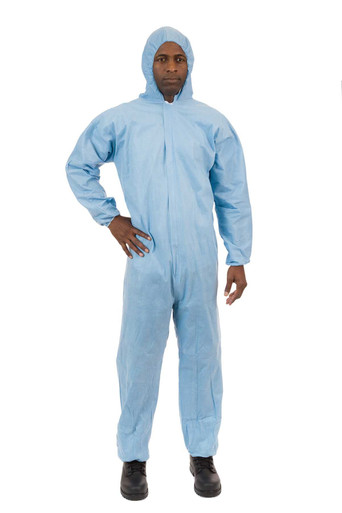 Enviroguard 9015 PyroGuard FR Disposable FR Coverall, Hood, Elastic Wrist and AnklePhosphate-based FR fabric with attached hood, elastic wrists and ankles. ASTM D6413 char damage under 6 inches, after flame under 2 seconds. Worn over primary FR apparel, per the manufacturer.
Why is this guide mostly about what not to wear? Because the usual disposable coverall is made of polypropylene or a polyethylene film, and those melt. OSHA’s welding standard hands the clothing decision to the general PPE rule and says only that the clothing varies with the size, nature and location of the work. The fabric manufacturer fills in the rest: its own catalog says do not use the non-FR garments around heat, flames or sparks, and reports the microporous fabric’s flammability result as melt-down. Welding spatter and grinding sparks are exactly that exposure. The manufacturer’s FR line exists for a narrower reason, to keep a welder’s primary FR clothing clean, and the sheet says so.
29 CFR 1910.252(b)(3); International Enviroguard Cleanroom Catalog warning; Industrial Catalog, MicroGuard MP physical properties (Flammability, GB/T 4744-1997, Melt-down); PyroGuard FR sell sheet.What do the rule and the sheets say?
The operative words, source by source.
Can you wear a Tyvek-type coverall while welding?
Not by the fabric manufacturer’s own warning. The non-FR disposables we carry are polypropylene (spunbond and SMS) or a polypropylene nonwoven laminated to a microporous film, and the manufacturer says not to use its non-FR cleanroom garments around heat, flames or sparks and reports the microporous fabric as melting down in a flammability test. OSHA’s electric power standard describes the same problem for a different trade: clothing that could melt onto the skin or ignite and continue to burn is prohibited, and its note names polypropylene and polyester among the fibers covered. Welding spatter and the slag from cutting are molten metal; a melting coverall over the welder’s leathers or FR shirt is a burn that the leathers were there to stop.
International Enviroguard Cleanroom Catalog warning; Industrial Catalog MicroGuard MP table; 29 CFR 1910.269(l)(8)(iii) and its note.The welding standard itself does not list fabrics. It says the clothing varies with the size, nature and location of the work and sends the employer to 1910.132, where the hazard assessment is the document that records why a given garment was chosen. Heat and sources of high temperature that could ignite protective equipment are on the Appendix B survey list for exactly this reason.
29 CFR 1910.252(b)(3); 1910.132(d)(1) and (d)(2); Appendix B to Subpart I of Part 1910, 3.a(e) and 3.b(b).What is an FR disposable for on a welding job?
Keeping the primary FR clothing clean. The PyroGuard FR sheet says it is secondary FR protective clothing designed to be worn over top of primary FR apparel to extend its life and protect it from dirt, grease, non-toxic liquids, sparks and flames. It lists electrical work, refinery turnarounds, oil and gas, manufacturing and industrial settings as applications. The fabric is treated with a phosphate-based fire retardant that the manufacturer says deprives flames of fuel, and it chars rather than drips. The flame test is ASTM D6413, which ASTM describes as a vertical flame resistance test of textiles under laboratory conditions that is not to be used to appraise fire hazard under actual fire conditions. None of that makes it a welding jacket: it has no leather, no arc rating and no claim against molten metal beyond the sparks and flames wording, and the manufacturer calls it secondary.
PyroGuard FR sell sheet (description, applications, physical properties); ASTM D6413/D6413M scope 1.1 and 1.2.PyroGuard CRFR is the same idea with a chemical barrier and taped seams, for work where both splash and flash fire are a concern; the manufacturer states it is not designed to be worn as a primary FR garment, is single use and should not be washed or re-used. The welder’s own protection, the leathers, the helmet, the shaded lens under the Appendix B chart, is a separate decision that these garments do not touch.
PyroGuard CRFR sell sheet and Industrial Catalog; Appendix B to Subpart I of Part 1910, paragraph 8 (eye and face selection chart, welding).What about grinding?
Grinding splits in two. Grinding steel throws sparks, which are hot metal particles, and the manufacturer’s sparks warning applies to the non-FR fabrics the same as it does for welding; a melting coverall sleeve on a grinder is the same burn. Grinding masonry, concrete, drywall, fiberglass, wood or plastic throws dust and no sparks, and that is a particle job. For particle work MicroGuard MP publishes dry and wet particle filtration efficiency by ASTM F2299 with the result No Particle Penetration and air permeability under 0.55 cfm, and SMS publishes a Helmke drum result of Category 1 and is described as an excellent dust and particulate barrier that breathes. Polypropylene is described for dust and particulates in non-hazardous environments. The construction silica standard, where it applies, controls the dust with engineering controls and respirators; its clothing lines are a ban on cleaning clothing with compressed air where that could add exposure, and protective clothing for monitoring observers where an area requires it. The coverall is about keeping the dust off the clothes and out of the truck.
International Enviroguard Cleanroom Catalog warning; MicroGuard MP, SMS and Polypropylene sell sheets; 29 CFR 1926.1153(f)(2) and (d)(2)(vii)(B).Sleeves are the common half-measure on a grinding job: 8065 microporous sleeves and 4065 Body Filter 95+ sleeves cover the forearm where the dust lands, and are no more spark-proof than the coverall. Where the grinder makes sparks, the sleeve has to be the welder’s leather sleeve, not a disposable.
International Enviroguard MicroGuard MP and Body Filter 95+ garment lists; Cleanroom Catalog warning.What does ASTM D6413 actually show?
ASTM’s scope says the method measures the vertical flame resistance of textiles, evaluating afterflame and afterglow as part of the measure, under controlled laboratory conditions, and that it shall not be used to describe or appraise the fire hazard or fire risk of materials under actual fire conditions. On the PyroGuard sheets the reported figures are char damage under 6 inches and after flame under 2 seconds, with the industrial catalog adding char lengths of 4.7 and 4.5 inches for CRFR. Read it as: the fabric stops burning when the flame is taken away and does not drip. It is not a rating against spatter, slag or arc, and the sheets do not claim one.
ASTM D6413/D6413M scope 1.1 through 1.2; PyroGuard FR and PyroGuard CRFR sell sheets; Industrial Catalog, PyroGuard CRFR testing table.What should the hazard assessment say for a shop that welds and grinds?
Two lines. For welding, cutting, brazing and spark-throwing grinding: the primary protection is the welder’s FR and leather clothing chosen under 1910.252(b)(3) and 1910.132; non-FR disposable coveralls are not worn over it, per the manufacturer’s warning; if a disposable layer is wanted to keep the FR clothing clean, it is an FR disposable such as PyroGuard FR worn over primary FR, and it carries no arc rating. For dust-only grinding and cleanup: a particle coverall with a published particle result, a hood if the dust is overhead, and the respirator the exposure assessment calls for. The fire watch and the 35-foot rule in 1910.252(a)(2) apply to the people in the area whatever they are wearing.
29 CFR 1910.252(a)(2)(iii)(A) and (b)(3); 1910.132(d); PyroGuard FR sell sheet; Cleanroom Catalog warning.Questions people ask
Can you wear a Tyvek suit while welding?
The non-FR disposables we carry are polypropylene or polypropylene film laminates, and the manufacturer states its non-FR cleanroom apparel should not be used around heat, flames or sparks and reports the microporous fabric as melting down in a flammability test. 1910.252(b)(3) sends the clothing choice to the 1910.132 hazard assessment.
What does OSHA 1910.252 say about welding clothing?
That employees exposed to welding, cutting or brazing hazards are protected by PPE in accordance with 1910.132, and that appropriate protective clothing varies with the size, nature and location of the work (1910.252(b)(3)).
Is PyroGuard FR a welding coverall?
No. The manufacturer describes it as secondary FR clothing worn over primary FR apparel to protect it from dirt, grease, non-toxic liquids, sparks and flames; it passes ASTM D6413 and carries no arc or molten-metal rating.
What coverall is for grinding dust?
Where the grinding makes dust and no sparks, MicroGuard MP publishes an ASTM F2299 particle result of No Particle Penetration and SMS a Helmke drum Category 1 result. Where it makes sparks, the manufacturer’s sparks warning applies.
Does ASTM D6413 mean the fabric is fireproof?
No. ASTM’s scope says it measures vertical flame resistance, afterflame and afterglow under laboratory conditions and is not to be used to appraise fire hazard under actual fire conditions.
Can PyroGuard CRFR be reused after a shift?
The manufacturer states it is single use and should not be washed or re-used, and that it is not designed as a primary FR garment.
Who decides what a welder wears?
The employer, through the 1910.132(d) hazard assessment that 1910.252(b)(3) points to; Appendix B lists heat and sources of high temperature that could ignite protective equipment among the hazards to survey.
Related guides
Arc flash and flash fireWhy ordinary disposables are a hazardWhat disposable coveralls are made ofSMS, microporous film, polypropylene and FR fabricsOSHA 1910.132 hazard assessmentWhat the employer has to documentCoveralls for fiberglass and insulationCoveralls, hoods and sleeves for itchy dustThe ratings, test results and standards shown here are the manufacturers' published values, reproduced as published. Nothing on this page is a recommendation by Bayshore Safety that any product is suitable for a particular task, hazard or workplace. Selecting safety products and protective equipment is the responsibility of the end user and the employer, based on their own hazard assessment and the regulations that apply to their work. Confirm every value on the manufacturer's own documentation before use.