
What disposable coveralls are made of: SMS, microporous film, polypropylene, laminates and FR fabrics
Almost every disposable coverall starts with polypropylene: a plain spunbond suit is one layer of bonded fibers and stops dust only, and SMS adds a fine meltblown web between two spunbond layers and holds light splash as well as dust. A microporous film coverall, such as International Enviroguard MicroGuard MP, laminates a thin film with microscopic pores onto the non-woven so liquid stays out while water vapor escapes. Chemical splash suits use a membrane or multi-layer film (ChemSplash 1 and 2) and the biological suits (ViroGuard, ViroGuard 2) use laminates tested against blood and bloodborne pathogens. FR disposables are either a treated breathable fabric (PyroGuard FR) or a bi-laminate that is also chemical resistant (PyroGuard CRFR). DuPont Tyvek is the exception to the polypropylene rule: flash-spun high-density polyethylene with no film at all; each manufacturer’s construction and the tests it publishes are listed below, fabric by fabric.
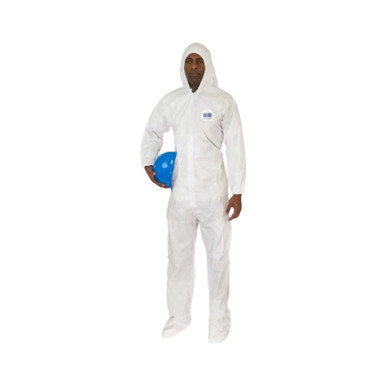 Enviroguard 8019 MicroGuard MP Disposable Microporous Coverall with Hood and Boot, Elastic Wrist, Open AnkleSoft non-woven fabric laminated to a microporous film. No particle penetration (ASTM F2299), ASTM F903 pass on six liquids, F1670 blood, per the sell sheet.
Why does the fabric matter? A white coverall looks like every other white coverall. The difference is in the layers: how many, whether one is a film, and whether the manufacturer has put the fabric through a liquid, particle, blood or flame test and published the result. This page gives the construction of each fabric we carry in the manufacturer’s own words, the tests behind it, and the seam that goes with it.
International Enviroguard sell sheets and brand pages; DuPont Tyvek 400 TY122S product page.What are the five constructions?
From one layer to four.
What is each fabric made of, and what is it tested for?
Each manufacturer’s construction wording and the tests it publishes. A blank in a manufacturer’s data is a blank here; no test has been added.
| Fabric | Construction, in the manufacturer’s words | What the manufacturer tests it for | Seams |
|---|---|---|---|
| Polypropylene | Spunbond polypropylene, a lightweight non-woven | Dry particulates in non-hazardous environments; Helmke drum Category 1 on hoods and bouffants | Serged |
| SMS | Spunbond / meltblown / spunbond polypropylene, three layers | Particulates and light liquid splashes or sprays; Helmke drum Category 1; tensile 26.5 / 18.7 lbs (ASTM D5034) | Serged |
| ValuGuard MP | Lightweight microporous fabric, 1.67 oz/yd² | Light liquid splash and non-hazardous dust; tear and break strength only | Serged |
| MicroGuard MP | Soft non-woven fabric laminated to a microporous film, 1.6 oz/yd² | ASTM F2299 no particle penetration; ASTM F903 pass on six liquids; ASTM F1670 blood; EN 1149-1 surface resistance | Serged |
| Body Filter 95+ | Proprietary laminated non-woven | 0.05% penetration at 0.3 micron (TSI 8130); air permeability 8.65 cfm | Serged |
| ViroGuard | Microporous fabric, blue, tear- and abrasion-resistant | ASTM F1670 and F1671 (fabric); ASTM F903 pass on seven chemicals; hydrohead 255.2 cm | Serged |
| ViroGuard 2 | Proprietary laminated non-woven, 2.7 oz/yd² | ASTM F1670 and F1671 on fabric and seams; ASTM D6978 fentanyl citrate over 240 minutes | Taped |
| ChemSplash 1 | Proprietary hybrid membrane fabric | ISO 6530 penetration and repellency classes on nine chemicals; ASTM F1670; Type 5 and 6; EN 1149-5 | Serged (YS) or taped (YT) |
| ChemSplash 2 | Proprietary multi-layer film, 2.9 oz/yd² | ASTM F903 pass on nineteen F1001 chemicals; ASTM F739 on three gases; F1670 and F1671 | Taped |
| PyroGuard FR | Breathable fabric with a phosphate-based fire retardant | ASTM D6413 vertical flame: char under 6 inches, after-flame under 2 seconds; EN 1149-5 | Serged |
| PyroGuard CRFR | Proprietary bi-laminate, self-extinguishing, 5.8 oz/yd² | ASTM D6413; ASTM F903 and F739 chemical table; ASTM F1930 body burn over Nomex | Taped |
| MicroGuard CE / GammaGuard CE | Microporous film fabric, clean-processed; GammaGuard CE sterilized to 10⁻⁶ SAL, 1.8 oz/yd² | ISO 5 to 9 cleanroom suitability; Helmke drum Category 1; ASTM F1670 (MicroGuard CE) | Serged (CE) / bound (GammaGuard) |
| DuPont Tyvek 400 | Flash-spun high-density polyethylene, no film or laminate, 1.2 oz/yd² | Inherent particle barrier down to 1.0 micron; hydrostatic head 45 in H₂O; 16 CFR 1610 Class 1 | Serged |
What is the difference between SMS and microporous film?
SMS has no film. Its barrier is the meltblown web, a mat of microfibers fine enough to catch dust and shed a light spray, sandwiched between spunbond layers that give it tear strength. Air passes through it, which is why every SMS sheet talks about heat stress, and why the manufacturer’s capability chart ticks dry particulate and overspray for SMS and nothing wetter. A microporous film coverall puts a continuous film on the non-woven; the film has pores small enough to stop liquid water and large enough to pass water vapor. That is why MicroGuard MP can publish ASTM F903 penetration passes for oils, bleach and caustic, and an air permeability under 0.55 cfm, and SMS cannot. The trade is breathability for a liquid barrier.
International Enviroguard Industrial Catalog (Understanding the SMS fabric layers); SMS sell sheet; MicroGuard MP sell sheet and brand page; Seam Safety Guide capability chart.One more difference matters on the job. The manufacturer’s seam guide explains that a breathable fabric pumps less air through the needle holes of a serged seam than a film fabric does, and concludes that a breathable garment can give better overall dust protection than a similar non-breathable one even though the film filters better. The fabric number and the garment’s performance are not the same thing.
International Enviroguard Seam Safety Guide, Wicking and the Bellows Effect.What makes a chemical splash fabric different?
The construction is proprietary, so the data is the only thing to go on. ChemSplash 1 is described as a hybrid membrane and tested by ISO 6530, the European gutter test that pours a chemical down an inclined swatch and scores penetration and repellency in classes; it scores penetration Class 3 on all nine chemicals listed, with repellency from Class 1 for n-heptane and toluene to Class 3 for the acids. ChemSplash 2 is a multi-layer film tested the American way: ASTM F903 penetration on nineteen ASTM F1001 chemicals, all passes, and ASTM F739 permeation on three gases, reported as breakthrough times of 160, 320 and 20 minutes. PyroGuard CRFR is a bi-laminate with both an F903 penetration time and an F739 breakthrough time for each of forty chemicals. How to read those tables is its own guide.
International Enviroguard ChemSplash 1, ChemSplash 2 and PyroGuard CRFR sell sheets, agent testing tables; ISO 6530:2005 and ASTM F903-18 and F739-20 scopes, as summarized by ISO and ASTM.What makes a biological fabric different?
The tests. ASTM F1670 presses synthetic blood against the fabric and looks for it on the other side; F1671 repeats the test with a bacteriophage, a virus surrogate small enough to model hepatitis B and C and HIV. ViroGuard, a blue microporous fabric, passes both on the fabric. ViroGuard 2, a laminated non-woven with taped seams, passes both on the fabric and on the seams, which is the distinction CDC guidance draws for a wet patient, and it adds an ASTM D6978 result of more than 240 minutes against fentanyl citrate. MicroGuard MP and ChemSplash 1 publish F1670 only; ChemSplash 2 publishes both.
ASTM F1670/F1670M-25 and F1671/F1671M-26 scopes, as summarized by ASTM; International Enviroguard ViroGuard and ViroGuard 2 sell sheets; Ebola PPE guidance sheet.What makes an FR disposable different?
Ordinary polypropylene, microporous and polyethylene coveralls melt. The manufacturer’s catalog lists MicroGuard MP as melt-down in a flammability test, and DuPont says Tyvek 400 will ignite and continue to burn and melt. PyroGuard FR carries a phosphate-based fire retardant that the manufacturer says deprives flames of fuel so the fabric chars; PyroGuard CRFR is a self-extinguishing bi-laminate that does not melt or drip when ignited. Both pass ASTM D6413, the vertical flame test, with char length under 6 inches and after-flame under 2 seconds. The manufacturer is explicit that neither is primary FR clothing: they are worn over FR and arc-rated apparel to keep it clean and to keep flammable liquids off it.
International Enviroguard Industrial Catalog (MicroGuard MP flammability); PyroGuard FR and PyroGuard CRFR sell sheets; DuPont Tyvek 400 TY122S page; ASTM D6413/D6413M-22 scope, as summarized by ASTM.What is Tyvek made of?
High-density polyethylene and nothing else. DuPont describes Tyvek as a 100 percent synthetic material made from high-density polyethylene fibers, spun and bonded under high heat and pressure with no binders; the Tyvek 400 product page calls the fabric flash-spun high-density polyethylene with no films or laminates. Because the fibers are fused rather than glued, tiny perforations remain that pass water vapor, and the random fiber lay gives tear and puncture resistance. DuPont publishes 1.2 oz/yd² basis weight, 5.9 mil thickness, 45 inches of water hydrostatic head and a particle barrier it describes as inherent down to 1.0 micron. It is the one coverall fabric on this page that is not built on polypropylene.
DuPont, What is Tyvek (dupont.com); DuPont Tyvek 400 TY122S product page, typical physical properties.Questions people ask
What are disposable coveralls made of?
Mostly polypropylene: a single spunbond layer for dust, three-layer SMS for dust and light splash, or a non-woven laminated to a microporous film for liquids and particles. Chemical, biological and FR suits use proprietary membranes, films and laminates; DuPont Tyvek is flash-spun high-density polyethylene.
What does SMS stand for?
Spunbond, meltblown, spunbond: two spunbond polypropylene faces around a meltblown polypropylene middle layer, which International Enviroguard describes as a tri-laminate non-woven used for masks, filters and safety clothing.
Is microporous film the same as Tyvek?
No. Microporous coveralls are a non-woven fabric laminated to a film with microscopic pores; Tyvek 400 is flash-spun high-density polyethylene with no film or laminate, per DuPont.
Which disposable coverall fabric is waterproof?
None of them is sold as waterproof. MicroGuard MP publishes 18.8 kPa water resistance and ASTM F903 passes on six liquids; Tyvek 400 publishes a 45-inch hydrostatic head; ChemSplash and ViroGuard publish chemical and blood penetration results instead.
Are disposable coveralls flame resistant?
Ordinary ones are not; the manufacturer’s catalog lists MicroGuard MP as melt-down and DuPont says Tyvek 400 ignites and melts. PyroGuard FR and PyroGuard CRFR pass ASTM D6413 and are worn over primary FR clothing, not instead of it.
What is a laminated non-woven?
A non-woven fabric bonded to another layer, usually a film. International Enviroguard uses the term for Body Filter 95+ and ViroGuard 2 and calls the layer proprietary; what it publishes is the test data, not the recipe.
The ratings, test results and standards shown here are the manufacturers' published values, reproduced as published. Nothing on this page is a recommendation by Bayshore Safety that any product is suitable for a particular task, hazard or workplace. Selecting safety products and protective equipment is the responsibility of the end user and the employer, based on their own hazard assessment and the regulations that apply to their work. Confirm every value on the manufacturer's own documentation before use.