
OSHA 1910.132 hazard assessment for protective clothing: what the employer has to document
29 CFR 1910.132(d)(1) requires the employer to assess the workplace to determine whether hazards are present, or are likely to be present, that make PPE necessary, and then to select the PPE that will protect each affected employee from those hazards, communicate the selection, and select PPE that properly fits. 1910.132(d)(2) requires a written certification of that assessment with four things on it: the workplace evaluated, the person certifying, the date or dates of the assessment, and words identifying the document as a certification of hazard assessment. 1910.132(f) adds training on when PPE is necessary, what PPE, how to don, doff, adjust and wear it, its limitations, and its care, maintenance, useful life and disposal. Appendix B to Subpart I is a non-mandatory walk-through procedure: survey the hazard sources, organize and analyze the data, then match the protective equipment to the hazard. For a disposable coverall, the data the assessment compares against is the manufacturer’s published test data: particle holdout, liquid penetration, blood penetration or flame resistance, by the named test method.
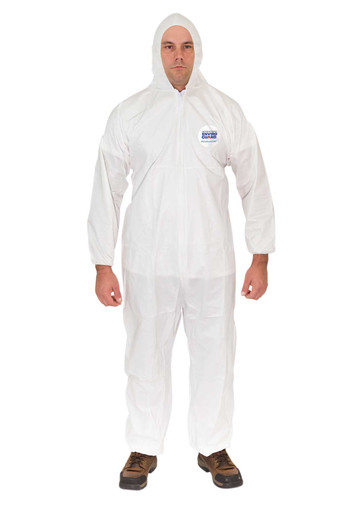 Enviroguard 8015 MicroGuard MP Disposable Microporous Coverall with Hood, Elastic Wrist and AnkleMicroporous film laminate, attached hood, elastic wrists and ankles. Published ASTM F2299 particle result and ASTM F903 liquid penetration list on the sell sheet.
Why does the rule start with an assessment instead of a list of PPE? 1910.132(a) covers every kind of protective equipment, including protective clothing, wherever it is necessary by reason of hazards of processes or environment, chemical hazards, radiological hazards or mechanical irritants that can injure through absorption, inhalation or physical contact. OSHA cannot know what is in a given plant, so the rule puts the finding on the employer: look at the work, decide what can hurt someone, and pick equipment that handles it. The written certification is the proof that the look happened. Without it, a coverall purchase is a guess.
29 CFR 1910.132(a) and (d)(1); the construction equivalent is 1926.95(a).What goes on the hazard assessment form?
There is no OSHA form. These are the elements the standard and Appendix B name, laid out the way a one-page certification is usually built.
What does OSHA 1910.132(d) require the employer to do?
Three things. First, assess the workplace to determine whether hazards are present or are likely to be present that necessitate PPE. Second, if they are, select the types of PPE that will protect the affected employee from the hazards identified, have each affected employee use them, communicate the selection decisions to each affected employee, and select PPE that properly fits. Third, verify that the assessment was performed through a written certification. The note to (d)(1) says non-mandatory Appendix B contains an example of procedures that would comply with the hazard assessment requirement; it is an example, not the only way.
29 CFR 1910.132(d)(1), (d)(1)(i) through (iii) and (d)(2), and the note to (d)(1).Paragraph (g) is worth reading before relying on (d) for every decision. It says paragraphs (d) and (f) apply only to 1910.133 (eye and face), 1910.135 (head), 1910.136 (foot), 1910.138 (hand) and 1910.140 (personal fall protection), and do not apply to 1910.134 (respirators) and 1910.137 (electrical protective equipment), which carry their own selection and training rules. Protective clothing is covered by the general duty in 1910.132(a), and the substance-specific standards that require clothing, such as 1910.1001 for asbestos, 1910.1025 for lead, 1910.1030 for bloodborne pathogens and 1910.120 for hazardous waste operations, each state their own clothing, removal and disposal rules. The same assessment form is where employers record the clothing decision.
29 CFR 1910.132(g); 1910.132(a); the clothing paragraphs are at 1910.1001(h), 1910.1025(g), 1910.1030(d)(3) and 1910.120(g).What has to be on the written certification?
Four items: the workplace evaluated; the person certifying that the evaluation has been performed; the date or dates of the hazard assessment; and something that identifies the document as a certification of hazard assessment. That is the whole list in (d)(2). OSHA does not require the hazards found or the PPE chosen to be on the certification itself, but Appendix B 3.c and 3.d describe organizing and analyzing the survey data so the selection can be made. The usual form carries the hazard-by-hazard analysis above the certification lines.
29 CFR 1910.132(d)(2); Appendix B to Subpart I, paragraphs 3.c and 3.d.How does the Appendix B walk-through work?
Appendix B 3 lays out the steps. Survey: walk the areas in question and identify sources of hazards to workers and co-workers under the basic categories, which are impact, penetration, compression, chemical, heat, harmful dust and light radiation. During the walk the safety officer observes sources of motion, high temperatures, chemical exposures, harmful dust, light radiation, falling, sharp and rolling objects, workplace layout and electrical hazards, and reviews injury data. Organize the data, then analyze it: for each hazard found, estimate the type, level of risk and seriousness of potential injury, and consider exposure to several hazards at the same time.
Appendix B to Subpart I of Part 1910, paragraphs 3.a through 3.d.Appendix B 1 sets the order of controls: PPE alone should not be relied on, but used in conjunction with guards, engineering controls and sound manufacturing practices.
Appendix B to Subpart I of Part 1910, paragraph 1.What data does the assessment compare a disposable coverall against?
Appendix B 4 says to become familiar with what the available protective equipment can do, for example splash protection or impact protection, compare the hazards in the environment with the capabilities of the equipment, and select equipment that ensures a level of protection greater than the minimum required. For gloves, Appendix B 11 says to request documentation from the manufacturer that they meet the appropriate test standard for the hazard anticipated; garment data is read the same way, and a sheet only counts for the test it names.
Appendix B to Subpart I of Part 1910, paragraphs 4 and 11.On the International Enviroguard sheets, by Appendix B category. Harmful dust: MicroGuard MP lists dry and wet particle filtration efficiency by ASTM F2299 with the result “No Particle Penetration”; SMS lists a Helmke drum result of Category 1 by IEST-RP-CC003.4; Polypropylene is described as an excellent dust and particulate barrier for non-hazardous environments. Chemical: ChemSplash 1 lists nine agents by ISO 6530 / EN 368 with penetration and repellency classes; MicroGuard MP lists six liquids by ASTM F903 as Pass. Blood: ViroGuard 2 lists ASTM F1670 and F1671 as Pass for fabric and seams; ViroGuard lists both as Pass for fabric. Heat: PyroGuard FR and PyroGuard CRFR list ASTM D6413 vertical flame results of char damage under 6 inches and after flame under 2 seconds, and the manufacturer states both are secondary garments to be worn over primary FR apparel. Each is a line the assessment can quote; none says the garment is right for a job, and the manufacturer’s statement that Polypropylene and ValuGuard MP are for non-hazardous environments is part of the data too.
International Enviroguard MicroGuard MP, SMS, Polypropylene, ChemSplash 1, ViroGuard, ViroGuard 2, PyroGuard FR and PyroGuard CRFR sell sheets (physical properties, agent testing and barrier tables, verbatim).Where does the safety data sheet fit?
The Hazard Communication standard requires every safety data sheet to carry Section 8, Exposure controls/personal protection. For a chemical hazard that is the chemical manufacturer’s statement of what protection the product needs, and the assessment compares it with the garment manufacturer’s chemical test list. If the chemical is not on the garment’s list, the sheet gives no answer for it, and the form should say so.
29 CFR 1910.1200(g)(2)(viii).What training and payment rules go with the assessment?
1910.132(f)(1) requires training for each employee who must use PPE, covering when PPE is necessary, what PPE is necessary, how to properly don, doff, adjust and wear it, its limitations, and its proper care, maintenance, useful life and disposal. Each employee has to demonstrate understanding and the ability to use the PPE properly before doing work that requires it, and retraining is required when the workplace or the PPE changes or the employee shows they have not retained the skill.
29 CFR 1910.132(f)(1)(i) through (v), (f)(2) and (f)(3).1910.132(h) requires the employer to provide the PPE used to comply with Subpart I at no cost to employees, with exceptions for non-specialty safety-toe footwear and prescription safety eyewear worn off the job, and for everyday clothing such as long-sleeve shirts, long pants, street shoes and normal work boots. 1910.132(e) adds that defective or damaged PPE shall not be used.
29 CFR 1910.132(h)(1), (h)(2), (h)(4)(ii) and (e).Questions people ask
Does OSHA require a written hazard assessment for PPE?
Yes. 29 CFR 1910.132(d)(2) requires a written certification identifying the workplace evaluated, the person certifying, the date or dates of the assessment, and the document as a certification of hazard assessment.
Is there an OSHA hazard assessment form?
No. The standard names what the certification must contain, and Appendix B to Subpart I gives a non-mandatory walk-through procedure; the layout of the form is up to the employer.
What hazards does Appendix B say to look for?
Impact, penetration, compression (roll-over), chemical, heat, harmful dust and light (optical) radiation, plus the sources listed in Appendix B 3.b such as chemical exposures, harmful dust, high temperatures and electrical hazards.
Does 1910.132(d) apply to protective clothing?
Paragraph (g) states that (d) and (f) apply to the eye and face, head, foot, hand and fall protection sections; protective clothing is required under the general duty in 1910.132(a), and substance-specific standards such as 1910.1001, 1910.1025, 1910.1030 and 1910.120 carry their own clothing rules. The assessment is still where employers document the clothing choice.
Who pays for disposable coveralls required by the assessment?
The employer, under 1910.132(h)(1). The exceptions in (h)(2) and (h)(4) are for ordinary footwear, prescription safety eyewear worn off the job and everyday clothing, not for required protective garments.
What training does 1910.132 require for PPE?
When PPE is necessary, what PPE, how to don, doff, adjust and wear it, its limitations, and its care, maintenance, useful life and disposal, with a demonstration of understanding before the work starts (1910.132(f)(1) and (f)(2)).
How often does the hazard assessment have to be redone?
The standard sets no interval. Appendix B 7 says the safety officer reassesses as necessary when new equipment or processes come in, when accident records show a problem, or when previously selected PPE needs re-evaluation.
The ratings, test results and standards shown here are the manufacturers' published values, reproduced as published. Nothing on this page is a recommendation by Bayshore Safety that any product is suitable for a particular task, hazard or workplace. Selecting safety products and protective equipment is the responsibility of the end user and the employer, based on their own hazard assessment and the regulations that apply to their work. Confirm every value on the manufacturer's own documentation before use.