
Fiberglass, insulation and attic work: coveralls, hoods and sleeves for itchy dust
OSHA groups fiberglass (glass wool and glass filament), mineral wool (rock and slag wool) and refractory ceramic fibers as synthetic mineral fibers, and says the only general-industry exposure limits that apply to them are the nuisance dust limits in 1910.1000 Table Z-3, 15 mg/m³ total and 5 mg/m³ respirable. OSHA’s solutions page lists engineering controls, administrative actions such as limiting exposure time and providing showers, and PPE, which it describes as proper respiratory protection and clothing. The NIOSH Pocket Guide entry for fibrous glass dust gives the exposure routes as inhalation and skin or eye contact, the symptoms as irritation of the eyes, skin, nose and throat and breathing difficulty, and the personal protection codes Prevent skin contact, Prevent eye contact, Wash skin daily and Change daily, with an N95 filtering facepiece acceptable up to 10 times the NIOSH REL. There is no fiberglass clothing standard; the employer’s 1910.132 hazard assessment decides, and the garment data to compare is the manufacturer’s particle result and its own list of uses. ValuGuard MP is the one International Enviroguard fabric whose sheet names fiberglass; MicroGuard MP publishes an ASTM F2299 particle result; SMS a Helmke drum result; hoods and sleeves cover the neck and forearms where the itch starts.
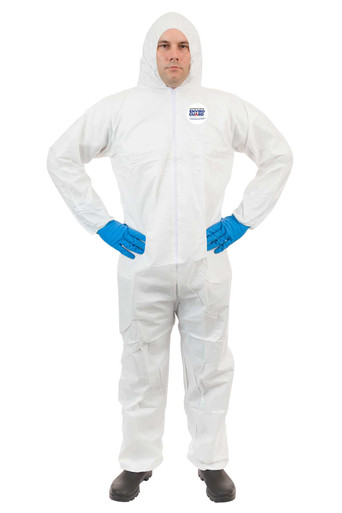 Enviroguard 8115 ValuGuard MP Disposable Lightweight Microporous Coverall with Hood, Elastic Wrist and AnkleLightweight microporous fabric with attached hood, elastic wrists and ankles. Fiberglass, resins, varnish, paints and non-hazardous dusts are the manufacturer’s listed applications. High MVTR per the manufacturer.
Why does fiberglass itch, and why is that the point? NIOSH describes glass wool fibers with diameters down to 0.05 micron and lengths over 1 micron, and lists the symptoms as irritation of the eyes, skin, nose and throat. The fibers lodge in skin and in the weave of a cotton shirt and keep working for the rest of the day, which is why the NIOSH personal protection codes for fibrous glass are prevent skin contact, prevent eye contact, wash skin daily and change clothing daily. A coverall that comes off at the attic hatch and goes in the bag is the change-daily rule done in one move, and it keeps the fibers out of the truck seat.
NIOSH Pocket Guide to Chemical Hazards, Fibrous glass dust: physical description, symptoms, personal protection and sanitation.What do OSHA and NIOSH say about fiberglass exposure?
The agency pages, line by line.
What should you wear to install or remove fiberglass insulation?
No OSHA standard names a garment for fiberglass, so the answer comes from the general PPE rule and the agency guidance. 1910.132(a) requires protective clothing wherever mechanical irritants encountered in a manner capable of causing injury through physical contact make it necessary, and 1910.132(d) requires the employer to assess the hazard and select PPE that protects and fits. NIOSH’s protection codes give the assessment its target: prevent skin contact, prevent eye contact, wash daily, change daily. OSHA’s own description of the PPE for synthetic mineral fibers is respiratory protection and clothing. The practical reading is long sleeves and legs closed at the wrist and ankle, the neck and head covered where the work is overhead, goggles rather than glasses in an attic, and the respirator the exposure assessment calls for, which NIOSH puts at an N95 filtering facepiece up to ten times its REL.
29 CFR 1910.132(a) and (d)(1); OSHA Synthetic Mineral Fibers, Possible Solutions; NIOSH Pocket Guide, Fibrous glass dust, personal protection and respirator recommendations.Which disposable fabric does the manufacturer list for fiberglass?
ValuGuard MP. Its sheet says the garments offer protection against light liquid splashes, non-hazardous dusts, varnish, resins, fiberglass and paints, and that the fabric has a high moisture vapor transmission rate so heat and vapor can escape; it is a lightweight microporous fabric at 1.67 oz per square yard by ASTM D3776 with tear strength of 7.7 and 3.6 lb and break strength of 17.6 and 11.7 lb in the machine and cross directions. It is stated to be for non-hazardous applications and environments. MicroGuard MP is heavier in test data rather than weight: 1.6 oz per square yard, dry and wet particle filtration efficiency by ASTM F2299 with the result No Particle Penetration, air permeability under 0.55 cfm, and a manufacturer description of a soft nonwoven laminated to a microporous film that lets heat and moisture vapor escape. SMS publishes a Helmke drum result of Category 1 and is described as a breathable three-layer polypropylene fabric for dust, particulates and light splash. Polypropylene is a spunbond fabric described for dust, dirt and grime in non-hazardous environments, with construction and environmental cleanup among its listed uses.
ValuGuard MP sell sheet (description, applications, physical properties); MicroGuard MP sell sheet (physical properties) and brand page; SMS sell sheet; Polypropylene sell sheet.Fiberglass fibers are not a particle-size test target on any of these sheets, so the particle results are the nearest published data, not a fiberglass rating. What the sheets agree on is that all four fabrics are described as dust barriers and three of them as breathable, which matters in an attic in summer more than any lab number.
ValuGuard MP, MicroGuard MP, SMS and Polypropylene sell sheets, as above.Hood, collar, open ankle or boots?
Overhead work drops fibers down the collar, so the hooded styles are the ones for ceiling batts and attic blow-in: 8015 and 8115 (hood, elastic wrists and ankles), 8019 and 8119 (hood and boots), 2225 (SMS hood) and 2019 (polypropylene hood and boots). Wall batts and crawl spaces at waist height can use a collar style with elastic wrists and ankles, 8013 or 2223, or the open-ankle 8012, 8112, 2222 and 2012 over work boots. Attached boots cover the laces, which is where fibers collect; a hood under the respirator strap and over the goggle strap closes the gap at the neck.
International Enviroguard MicroGuard MP, ValuGuard MP, SMS and Polypropylene garment lists.What are the hoods and sleeves for?
For the crew that will not wear a hooded coverall in the heat. The 8002 MicroGuard MP hood has an elastic face and comes to the shoulders, so it covers the neck and the back of the head under a hard hat; the NH2000 polypropylene head and face cover, which the manufacturer calls a Ninja Hood, leaves only the eyes open. The 8065 microporous sleeves are 18 inches with elastic at both ends; the 4065 Body Filter 95+ sleeves are 21 inches, and the Body Filter 95+ fabric publishes a penetration result of 0.05 percent by TSI 8130 at 0.3 micron. Sleeves go from the glove to above the elbow, which is the stretch of skin that takes the itch when a short-sleeve crew handles batts.
MicroGuard MP garment list (8002, 8065); Polypropylene garment list (NH2000); Body Filter 95+ sell sheet and Industrial Catalog (4065; penetration, TSI 8130).How do you take it off without taking the fibers home?
NIOSH’s codes are change daily and wash skin daily, and OSHA’s solutions page points to NIOSH’s study of hazardous substances carried from the workplace into workers’ homes, fibrous glass among them. The coverall comes off at the hatch or the truck and goes into a bag, and hands and face get washed, which is the wash-daily code. A disposable coverall makes the laundry question go away: a reusable coverall full of glass fiber otherwise goes home to the washing machine, which is the route the NIOSH home-contamination study describes.
NIOSH Pocket Guide, Fibrous glass dust, personal protection and sanitation; OSHA Synthetic Mineral Fibers, Possible Solutions (NIOSH Publication No. 97-125, Protect Your Family; Reduce Contamination at Home).Questions people ask
Does OSHA have a fiberglass standard?
No. OSHA’s synthetic mineral fibers page says the nuisance dust limits in 1910.1000 Table Z-3 are the only PELs that apply in general industry, and lists 1910.1200 Hazard Communication as the other applicable standard; clothing falls under the 1910.132 hazard assessment.
What PPE does NIOSH recommend for fiberglass dust?
The Pocket Guide codes are Prevent skin contact, Prevent eye contact, Wash skin daily and Change daily, with an N95, R95 or P95 particulate respirator acceptable up to 10 times the NIOSH REL.
What coverall is best for insulation work?
No agency names one. ValuGuard MP is the Enviroguard fabric whose sheet lists fiberglass; MicroGuard MP publishes an ASTM F2299 particle result and SMS a Helmke drum result; the employer’s hazard assessment decides.
Is fiberglass insulation a carcinogen?
OSHA states there is insufficient evidence that synthetic mineral fibers cause respiratory disease in humans and that insulation glass wool, glass filament, rock wool and slag wool are not classifiable; NTP lists certain inhalable glass wool fibers and respirable ceramic fibers as reasonably anticipated carcinogens.
Do I need a hood for attic work?
Nothing requires it. NIOSH’s code is prevent skin contact, and overhead work drops fibers down the collar; hooded styles and separate hoods cover the neck and head.
Can I wash a fiberglass coverall and wear it again?
NIOSH’s code is change daily. The Enviroguard garments here are sold as disposable; a reusable coverall carries the fibers into the laundry, which OSHA’s solutions page flags through NIOSH’s home-contamination study.
What is the exposure limit for fiberglass?
OSHA PEL 15 mg/m³ total and 5 mg/m³ respirable as nuisance dust; NIOSH REL 3 fibers/cm³ for fibers 3.5 micron or thinner and 10 micron or longer, and 5 mg/m³ total (NIOSH Pocket Guide).
The ratings, test results and standards shown here are the manufacturers' published values, reproduced as published. Nothing on this page is a recommendation by Bayshore Safety that any product is suitable for a particular task, hazard or workplace. Selecting safety products and protective equipment is the responsibility of the end user and the employer, based on their own hazard assessment and the regulations that apply to their work. Confirm every value on the manufacturer's own documentation before use.