
Draeger tubes in heat, cold, humidity and at altitude: what the handbook says to correct
Draeger tubes are calibrated at about 20 °C, 1,013 hPa and normal humidity. Pressure is the one that always needs correcting: the reading is almost directly proportional to ambient pressure because the volume drawn through the tube changes, so the concentration equals the reading times 1,013 divided by the actual pressure in mbar (hPa). At 2000 m the pressure is about 790 mbar, so a reading is multiplied by about 1.28. Temperature does not measurably change the reaction between 0 and 40 °C; the drawn volume changes about 3.5 % per 10 °C and is corrected by the gas law, and each tube states its permissible temperature range. Humidity as vapor does not affect a tube designed to be water-resistant, and every entry states a permissible absolute humidity in mg H2O/L; liquid water must be kept off the reagent (section 2.6, pp. 41–44; section 6.1.1, p. 115).
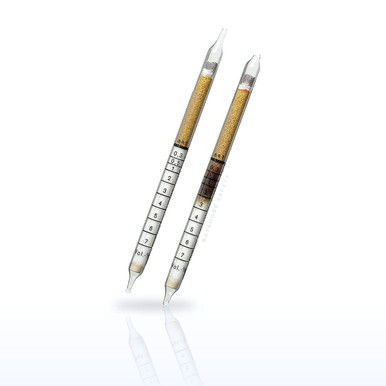 Draeger Carbon Monoxide 2/a Detector Tubes, Box of 10Carbon monoxide 2/a, the CO tube whose pre-layer dries the sample per the handbook
Why does pressure matter more than temperature? The handbook’s example: air with 50 ppm CO reads 50 ppm at 1013 mbar and 150 ppm when the same air, tube and pump are at 3040 mbar, although the concentration in ppm has not changed, because three times the mass of gas passed through the tube. Multiplying by 1013/3040 gives the true 50 ppm. The same applies at altitude (Table 2: 500 m 950 mbar, 1000 m 900 mbar, 1500 m 840 mbar, 2000 m 790 mbar) and underground (1000 m below, 1120 mbar). Temperature, by contrast, is handled by keeping the tube itself between 0 and 40 °C; the air drawn in can be well below 0 °C or several hundred degrees (pp. 42–43).
The three influences, as section 2.6 treats them
How to use the limits on a tube page
- Temperature: the entry gives a range such as 10 to 40 °C (Formaldehyde 0.2/a) or 10 to 50 °C (Ammonia 5/a). That is the tube temperature during measurement.
- Humidity: the entry gives an absolute humidity, for example 3 to 15 mg H2O/L or < 20 mg H2O/L. The handbook’s section 1.3 relates absolute humidity to temperature and relative humidity: at 25 °C, 22.94 mg/L is 100 % relative humidity (p. 14).
- Pressure: apply the factor to the reading whenever the site is well above or below sea level or pressurized; the tube entry does not restate it because it applies to all tubes (p. 115).
- Extreme sites: the hot-pack holder (8316130, with spare hot packs 8316139) and the hot air probe (CH00213) are the handbook’s accessories for cold and hot sampling (p. 92).
Questions people ask
Do Draeger tubes work at altitude?
Yes, with the pressure correction: concentration = reading × 1,013 ÷ actual pressure in hPa. At 2000 m (about 790 mbar) the factor is about 1.28 (handbook pp. 42–43, 115).
Do Draeger tubes work in the cold?
The reaction is not measurably affected down to 0 °C tube temperature; below that some reagents can freeze. With the hot-pack holder all short-term tubes can be used down to –20 °C (p. 44).
Does humidity affect a Draeger tube?
Water vapor does not affect tubes designed to be water-resistant, within the absolute humidity stated for the tube; liquid water must not reach the reagent (p. 41).
Is there a temperature correction factor?
The drawn volume changes about 3.5 % per 10 °C and can be corrected with the gas law; outside 0 to 40 °C tube temperature the handbook says a correction is almost impossible, so the tube is kept in range instead (p. 43).
Why does the CO tube have a pre-layer?
Its reagent system (iodine pentoxide, sulfuric acid, silica gel) is highly sensitive to humidity; the pre-layer absorbs the moisture so the indicating layer sees dry air (p. 42).
Related guides
How to read a Draeger tube: the stain, the scale and the three cases the handbook describesReading a tubeWhat is cross-sensitivity on a Draeger tube, and how is it listed?Cross-sensitivityHow many pump strokes does a Draeger tube take, and how long does a reading take?Strokes and measuring timeWhat do Draeger tubes measure? The gases, the ranges and what the number on the tube meansWhat Draeger tubes measureStandards and ratings on this page are as published in the documents named and by the manufacturers named. The employer’s hazard assessment and written program decide what applies at a given workplace. Verify a rating on the product and its spec sheet before use.