
How to read a Draeger tube: the stain, the scale and the three cases the handbook describes
The concentration is the length of the discoloration read against the scale printed on the tube, after the full number of strokes for that scale. The handbook sets five requirements for a correct reading: watch the tube during the whole measurement, read it immediately afterward per the instructions for use, in adequate light, against a light background, and compare it with an unused tube. The entire visible length of the discoloration is read, even where the colors differ. Three cases occur: the stain ends square to the tube, and the value is read directly; the stain is oblique, and the average of the long and short ends is taken; the stain is diffuse, and the endpoint is where a weak discoloration is still visible (section 2.5, pp. 39–40).
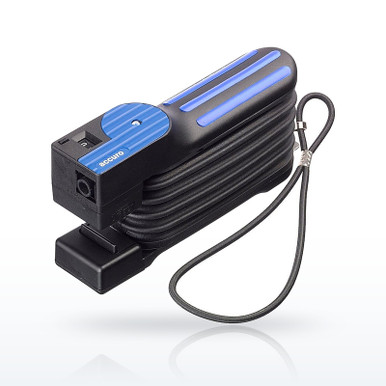 Draeger accuro detector tube hand pumpBellows pump, 100 mL (± 5 %) per stroke, 1 to 50 strokes and higher, no power supply (handbook p. 31)
Why watch the tube during the strokes? The handbook gives the reason: at a high concentration the whole layer can discolor abruptly, sometimes during the first stroke, and a tube that is fully discolored is read as "above range", not as the last number on the scale. Watching also catches the two-scale case: many tubes carry a high range with few strokes and a low range with more strokes. The measurement starts with the strokes for the high range; if the stain shows a more precise reading is possible on the low range, the remaining strokes are added at once and the second scale is read (p. 35).
The five requirements for reading, from section 2.5
The three endpoint cases (handbook examples 1 to 3, p. 40)
What to do when the stain is not a neat line:
- Square endpoint: the color indication ends at right angles to the tube axis; read the value directly off the scale.
- Oblique endpoint: the stain runs at an angle, with one long and one short side; take the average of the two and state that as the concentration.
- Diffuse endpoint: no clear edge; the endpoint is the point at which a weak discoloration is still visible.
- Two scales: the strokes and the unit for each range are printed on the tube next to that scale; the high range needs fewer strokes, the low range more (p. 35).
- Accuracy: the relative standard deviation printed for each tube (typically ± 10 to 30 %) covers the whole measuring, temperature and humidity range for Draeger tubes; observers reading the same stain differently is one of the listed random errors (p. 86).
Tubes with two scales and tubes with one
6 items · prices liveTwo-scale tubes carry both stroke counts on the tube; the handbook entry on each product page gives them. Orders ship in 1–2 business days.
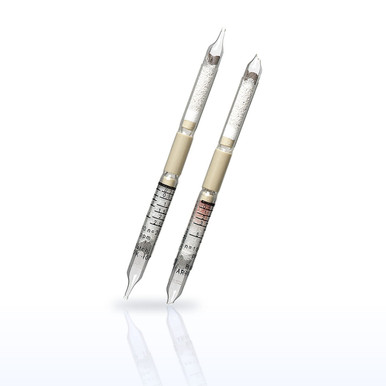
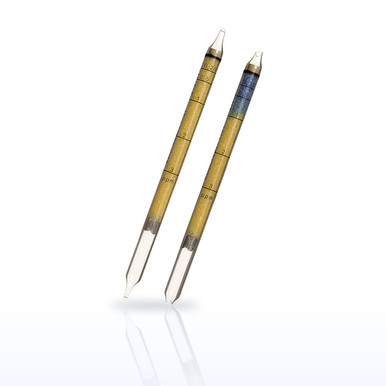
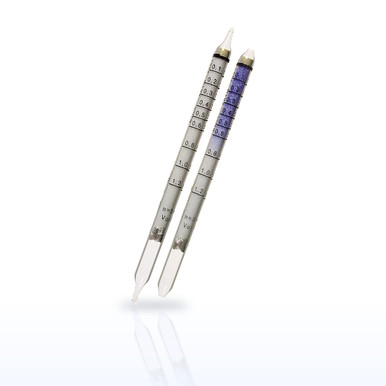
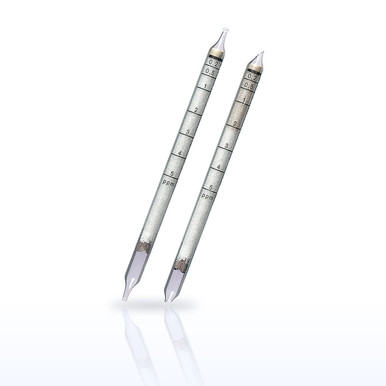
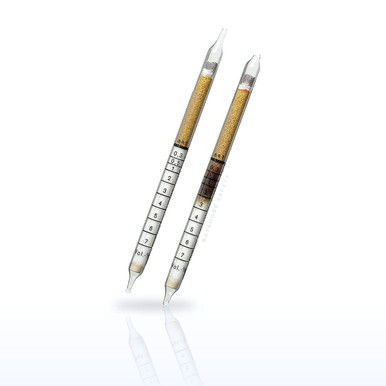
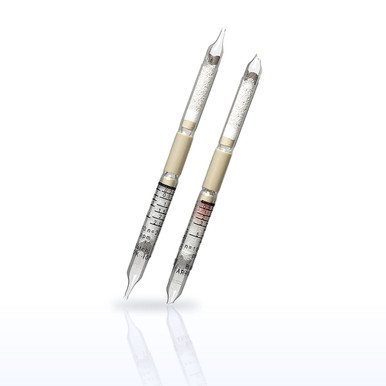
Every Draeger tube we list, with the handbook data, is on the Draeger tubes A–Z chart; each gas has its own page with the OSHA and NIOSH limits.
Questions people ask
How do you read a Draeger tube?
Pull the stated strokes, then read the full length of the discoloration against the printed scale, at once, in good light, against a white background, compared with an unused tube (handbook section 2.5).
What if the stain is slanted?
Take the average of the long and short ends of the discoloration (handbook example 2, p. 40).
What if the whole tube changes color?
The concentration is above the range of that scale; the handbook notes this can happen abruptly at high concentrations, even during the first stroke (p. 39).
Can I keep the tube as a record?
The handbook says storing a used tube to preserve evidence is usually not useful, because the discoloration can change afterward (p. 39). Note the reading, the tube, the strokes and the time instead.
Why does the same gas give slightly different readings on two tubes?
Each batch is calibrated individually and scale marks can differ between batches within a defined tolerance; the printed standard deviation covers this (pp. 68, 86).
Related guides
How many pump strokes does a Draeger tube take, and how long does a reading take?Strokes and measuring timeWhat is cross-sensitivity on a Draeger tube, and how is it listed?Cross-sensitivityDraeger tubes in heat, cold, humidity and at altitude: what the handbook says to correctTemperature, humidity, pressureThe Draeger accuro pump: how it works, the leak check, strokes and the kitsaccuro pumpStandards and ratings on this page are as published in the documents named and by the manufacturers named. The employer’s hazard assessment and written program decide what applies at a given workplace. Verify a rating on the product and its spec sheet before use.