
What gauge extension cord do you need, and how long can it be? 10, 12, 14 and 16 gauge, 12/3 and 10/3, watts and amps by gauge and length, voltage drop at 100 feet, outdoor cords and GFCI, what never goes on a cord, and 30 and 50 amp twist-lock cords
For jobsite tools the answer is a 12 gauge, three-conductor cord (12/3) up to 100 feet; it carries 15 amps with little voltage drop, which is what a circular saw, a roofing nailer compressor or a grinder draws. 14 gauge is fine to 50 feet for drills and lights; 16 gauge is a lamp cord and 10 gauge is for 20 to 30 amp loads and runs past 100 feet. The gauge number gets smaller as the wire gets bigger. A cord is rated in amps (NEC Table 400.5(A)(1): 16 AWG 13 A, 14 AWG 18 A, 12 AWG 25 A, 10 AWG 30 A), and the practical limit on a long cord is voltage drop, which starves a motor; that is why a 100 ft cord is 12 gauge and a 150 ft run is 10. Nothing with a heating element or a compressor that runs for hours (space heater, refrigerator, air conditioner) belongs on a light-duty household cord.
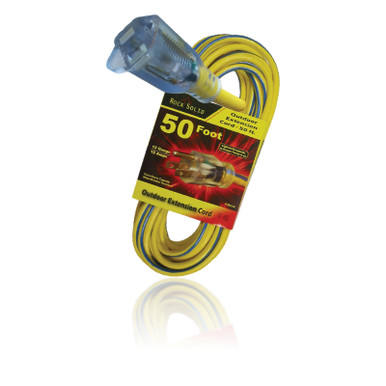 C&R 508-E Extension Cord, 50 ft and 100 ft, 12/3 gauge, Single TapThe product data lists the 508-E and 509-E as 12/3 single-tap extension cords in 50 and 100 ft
Reading a cord. The jacket is printed with its gauge and conductor count (12/3 is three 12 AWG conductors: hot, neutral, ground), its jacket type (SJTW: junior hard service, thermoplastic, weather resistant, the outdoor jobsite cord; SOOW: hard service, oil-resistant, the heaviest), its amp rating and a listing mark. From those three facts every question below is answered: how many watts a cord carries, which gauge for portable power or a refrigerator, how long it can be, whether it is an outdoor cord, why a 25 ft cord is or is not enough, and what should never be plugged into one.
Extension cords, question by question
Ampacities are NEC Table 400.5(A)(1) values for three-conductor cords; watts are amps times 120 volts. Jacket letters are the UL 62 designations printed on the cord.
Extension cords in plain words
- Smaller gauge number, bigger wire: 16 light duty, 14 medium, 12 heavy duty, 10 for 20 to 30 amp loads.
- 12/3 means three 12 AWG conductors (hot, neutral, ground); it is the 100 ft jobsite cord.
- Watts are amps times volts: 15 A at 120 V is 1,800 W; voltage drop over a long thin cord takes some of it.
- Rule of thumb for a 15 amp tool: 50 ft of 14 gauge, 100 ft of 12 gauge, 150 ft of 10 gauge.
- W in the jacket code (SJTW, SOOW) means outdoor rated; no W means indoor only.
- Heaters, air conditioners, refrigerators and anything with a heating element stay off light household cords; the appliance manual governs.
- Twist-lock power cords are matched to the outlet: L5-30 (120 V), L6-30 (240 V), L14-30 (120/240 V) at 30 A on 10 gauge; 14-50 at 50 A on 6 gauge.
- On construction sites receptacles on cords need GFCI protection or an assured grounding program (29 CFR 1926.405).
Questions people ask
What appliances should never be plugged into an extension cord?
Space heaters, air conditioners, refrigerators and freezers, microwaves, toasters and ovens, washers and dryers: anything with a heating element or a compressor that runs for hours, per the appliance manuals and the fire-safety agencies.
Which is better for my home, a 50 amp or a 30 amp power plug?
Whichever matches the power unit’s outlet and the house inlet: 50 A supplies up to 12,000 W on 6 gauge cord, 30 A up to 7,200 W on 10 gauge.
How long can a 50 amp power cord be?
Most are sold at 25 to 50 feet; 100 feet of 6 gauge runs about 5 percent drop at full load.
What gauge extension cord should you use for a portable power unit?
12 gauge from the 120 V outlets to tools; 10 gauge for a 30 A twist-lock cord; 6 gauge for a 50 A cord.
Is a 25 foot extension cord enough?
When the outlet is within 25 feet, yes, in any gauge the tool needs; voltage drop at 25 feet is negligible.
Is there an extension cord that you can use for a refrigerator?
A short, grounded 12 or 14 gauge cord carries a refrigerator; the manual usually says to avoid any cord, and a 16 gauge lamp cord is the one to avoid.
What is the longest extension cord I can get?
100 feet off the shelf; 150 and 200 feet are made in 10 and 12 gauge for site work.
Is a 12-3 gauge extension cord heavy duty?
Yes; 12 gauge is the heavy-duty class in retail labeling and the 100 ft jobsite standard.
What size extension cord to run a refrigerator on a portable power unit?
12 gauge, grounded, as short as practical, from the power unit’s 120 V outlet.
What is the extension cord for outside use?
One with a W in its jacket code (SJTW, SJEOW, SOOW), 12 gauge for tools, with GFCI protection on the circuit.
Do I need a 30 amp or 50 amp twist-lock power cord?
The one that matches the power unit’s outlet and the inlet it feeds; they are not interchangeable.
Will a 12 gauge extension cord run a refrigerator?
Yes, with capacity to spare; a refrigerator draws 3 to 6 amps running.
What are the different types of extension cords?
By gauge, conductor count, jacket (SPT, SJT, SJTW, SOOW), end type (single, triple tap, locking) and use (portable power unit, RV, welder).
Can you use an outdoor extension cord inside the house?
Yes; the W jacket is rated for both. Indoor cords cannot go outside.
Are all extension cords for outdoor use?
No; only cords with a W in the jacket code are weather rated.
How to waterproof an extension cord connection?
A weatherproof cord connector housing or outdoor connection box, kept off the ground with a drip loop; tape and bags are not a rating.
How thick is an average extension cord?
About 0.3 inch for 16 gauge SJTW, 0.45 inch for 12 gauge, 0.55 inch for 10 gauge; read the printing, not the thickness.
Are all 30 amp twist-lock power cords the same?
No: L5-30 is 120 V, L6-30 is 240 V two-pole and L14-30 is 120/240 V four-wire; the plugs do not interchange.
Can I run a 1500 watt heater on an extension cord?
It draws 12.5 A; a short 12 gauge SJTW cord is inside its rating, a 16 gauge household cord is not, and the heater manual usually says no cord at all.
Is there such a thing as an extension cord with prongs on both ends?
Not as a listed product; it is a shock hazard. Feed a building through an inlet and transfer switch.
What is the difference between a cord and a cable?
In the code, a flexible cord is the portable stranded assembly with a plug (SJTW); a cable is fixed building wiring (NM, MC). Cords are not substitutes for cable.
Can you leave an extension cord plugged in outside in the rain?
A W-rated cord with weather-resistant connectors kept off the ground on a GFCI circuit, yes; a connection lying in a puddle, no.
How many watts can a 14 gauge 100 ft extension cord handle?
About 1,500 watts usable at 100 feet after voltage drop; 1,800 W on paper at 15 A.
What is the difference between a 12 and 14 gauge extension cord?
12 gauge has about 60 percent more copper, carries more current and loses less voltage over the same length.
Can a 10 gauge extension cord handle 30 amps?
Yes; 10 AWG three-conductor cord is rated 30 A, which is the 30 A twist-lock cord size.
What is a 10/3 extension cord rated for?
30 amps; it is the L5-30, L6-30 and L14-30 twist-lock cord size.
What is a 10 gauge cord’s diameter?
About 0.55 inch over the jacket for SJTW; the conductor itself is about 0.1 inch.
Related guides
Air hose, fittings and air tool oilFor roofing nailersWhere roofers and contractors buy tools and suppliesSupply houses, distributors and buying by the caseLockout devices by energy typeBreakers, valves, plugs and cablesHow do you detect a natural gas or propane leak?The odorant and what a detector readsFire extinguisher classesA, B, C, D and KThe ratings, test results and standards shown here are the manufacturers' published values, reproduced as published. Nothing on this page is a recommendation by Bayshore Safety that any product is suitable for a particular task, hazard or workplace. Selecting safety products and protective equipment is the responsibility of the end user and the employer, based on their own hazard assessment and the regulations that apply to their work. Confirm every value on the manufacturer's own documentation before use.