Home › Guides › Roofing tools › Air hose and air tool oil
Guide · Jobsite air · Air hose, couplers, manifolds and air tool oil for roofing nailers

1/4 or 3/8, polyurethane, PVC or rubber: which air hose for roofing nailers? Hose size and length, polyurethane in cold weather, 1/4 NPT fittings and couplers, 3-way manifolds, air tool oil vs compressor oil, and what not to put in an air tool

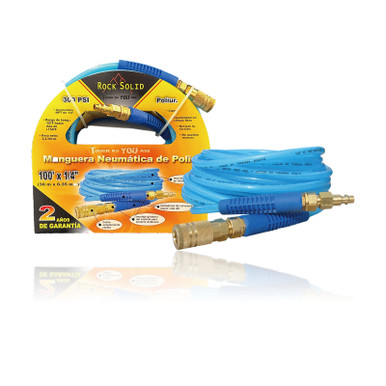
A roofing or framing nailer runs on a 1/4 inch inside-diameter hose up to about 100 feet; 3/8 inch hose carries more air for tools that run continuously (sanders, grinders, impact wrenches) and for runs over 100 feet, at twice the weight. Polyurethane hose is the light, kink-resistant hose that stays flexible in cold and is what roofing crews drag across shingles (our blue 1/4 inch poly in 50 and 100 ft, with ends attached); reinforced PVC is the low-cost shop hose that stiffens in cold; rubber is the heaviest and most durable for a shop floor. Fittings are 1/4 inch NPT (the thread on the tool and the hose ends) and the quick couplers come in industrial interchange and automotive patterns that do not mate. Air tool oil is a light, detergent-free oil put into the tool’s air inlet a few drops a day; compressor oil is a heavier oil for the pump crankcase, and the two are not swapped.
Bayshore Safety. Industrial safety, roofing tools and jobsite supplies since 2017. · Current as of November 2026 · the C&R and Marvel product data on this site (blue polyurethane air hose 1/4 in x 50 ft and 1/4 in x 100 ft with ends attached, cold-weather flexibility, by the case of 5; flexible reinforced PVC air hose 1/4 in x 100 ft by the case of 6; solid brass 2-piece coupler set with 1/4 in NPT air inlet; 5-piece coupler set; replacement swivel end for 1/4 in poly hose; 3-way air hose head; Marvel air tool oil 4 oz by the case of 12); the pneumatic nailer manufacturers’ published air requirements (70 to 120 psi, 1/4 in NPT inlet, a few drops of air tool oil per day) and the Industrial Interchange and Automotive coupler patterns as marked on couplers
C&R Air-12725 Air Hose, 1/4 in x 50 ft and 1/4 in x 100 ft, BlueC&R Air-12725 Air Hose, 1/4 in x 50 ft and 1/4 in x 100 ft, BlueThe product data lists the Air-12725 and Air-10000 as blue polyurethane air hose, 1/4 in x 50 and 100 ft, with cold-weather flexibility

The air system on a roofing truck. A compressor on the ground, a 3-way manifold at the eave, three poly hoses up the roof to three nailers, a bottle of air tool oil in the glove box. Every question people ask follows that layout: 1/4 or 3/8 hose, PVC or rubber or poly, which fittings, what thread, what oil, whether another oil or a lubricant spray will do, and whether the compressor takes the same oil as the tools. The cards below answer them in that order with the data on this site and what the nailer manufacturers publish about their own tools.

Air hose and oil, question by question

Hose sizes and fittings are from the product data on this site; air requirements are what the nailer manufacturers publish for their tools.

Should I get 1/4 or 3/8 air hose?For nailers and staplers, 1/4 inch: a roofing nailer uses a small burst of air per shot and a 1/4 inch hose at 100 feet supplies it with a few psi of drop, and the hose weighs half what 3/8 does, which matters when it is dragged over a ridge. For tools that run continuously (die grinders, sanders, impact wrenches, spray guns) or for a run over 100 feet to several tools, 3/8 inch keeps the pressure up. The fittings are 1/4 inch NPT on both hose sizes; the number is the hose bore, not the thread.
Which is better, PVC, rubber or polyurethane air hose?Different jobs. Polyurethane: lightest, most kink resistant, stays flexible to about 0°F, resists abrasion on shingles and concrete, costs the most per foot; the roofing and framing hose. Reinforced PVC: the low-cost hose, fine in a warm shop, stiff and kinky below about 40°F and prone to holding its coil. Rubber: heavy, durable, flexible in cold, resists oil and heat, the shop-floor and mechanic’s hose, and the heaviest to drag. Hybrid (PVC/rubber blends) sits between. Our poly hose data lists cold-weather flexibility and ends attached; our reinforced PVC is the 1/4 x 100 ft shop hose. The hose brands people ask about are not ours to rate.
What thread is an air compressor fitting, and what is NPT?1/4 inch NPT (National Pipe Taper) is the thread on nearly every air tool inlet, hose end and coupler in the US; it is a tapered thread that seals on the threads with sealant tape or paste, and its nominal size (1/4) is the pipe size, not the measured diameter (the male thread is about 0.54 inch across). Larger compressors and manifolds use 3/8 and 1/2 NPT. Our 2-piece coupler set has a solid brass head with a 1/4 inch NPT air inlet; the 5-piece set is the plugs and coupler for a hose and tools; the swivel end replaces the fitting on a 1/4 inch poly hose so the hose does not twist at the tool.
What are the coupler types, and why does a plug not fit?Quick couplers (the female half with the sleeve) and plugs (the male half) come in patterns: industrial interchange (Type D, the most common 1/4 inch pattern), automotive (Type C, slightly different plug nose), ARO (Type A) and the European and Japanese patterns on imported tools; the patterns do not mate, and a universal coupler accepts the first three. The fix for a truck full of mismatched tools is one pattern everywhere: all industrial plugs, all industrial couplers. A 3-way air hose head (our 3-Way) is a manifold with three outlets so one hose from the compressor feeds three nailers at the eave.
Is there a difference between air compressor oil and air tool oil, and what oil goes in an air compressor?Yes. Air tool oil is a thin (about ISO 32, like a light machine oil), non-detergent, often anti-corrosion oil put into the tool to lubricate the piston and O-rings and blow out with the exhaust; it is sold in small bottles (our Marvel air tool oil is 4 oz by the case of 12). Compressor oil is the crankcase oil for an oil-lubricated pump: a heavier non-detergent oil (SAE 30 or ISO 100 is typical; synthetic compressor oils exist) that stays in the pump. The compressor manual names its oil; many small portable compressors are oil-free and take none. Can I use SAE 10W-30 in my air compressor? Not unless the manual says so: automotive oils carry detergents that foam in a compressor pump and carry over into the air. Air tool oil in a compressor crankcase is too thin; compressor oil in a nailer is too thick.
What type of oil can I put in my air tool, and can I use WD-40, ATF or motor oil instead?Air tool oil, period: it is formulated to be thin enough to atomize in the air stream, to lubricate the piston and seals, and not to swell the O-rings. A lubricant spray of the WD-40 type is a solvent with a little oil; it washes the lubricant out of the tool and leaves it dry, and it is for freeing a rusted screw, not oiling a nailer. ATF (automatic transmission fluid) is about the right viscosity and some mechanics use it, but it carries detergents and additives the tool manufacturers do not approve and it will void a warranty. Motor oil is too thick and has detergents. Diesel and kerosene clean a gummed tool and are not lubricants. The nailer manual names air tool oil; a 4 oz bottle lasts a tool a season.
How much air tool oil does a nailer need, and how often?Two to five drops into the air inlet before the first shot each day and again after lunch on a production day, with the tool connected and fired a few times so the oil travels; more oil than that blows out the exhaust onto the shingles (and oil on a shingle or a membrane is a stain and a slip). Oil-free nailers (the manual says so) take none. An inline lubricator on the manifold doses every tool on the line automatically; a filter-regulator ahead of it takes the water out of the air, which matters more than the oil in humid weather: water in the line rusts the tool and freezes in the hose in winter.
What pressure and how long a hose for roofing nailers?Roofing coil nailers run 70 to 120 psi (the manual gives the range; about 90 is typical) and the compressor is set a little higher to allow for hose drop; a 100 foot 1/4 inch hose drops about 5 to 10 psi at a nailer’s intermittent draw. For a two-story house, a 100 foot hose from the compressor on the ground to the manifold at the eave and 50 foot hoses from the manifold to the nailers is the usual layout; the 3-way head lets three nailers share one feed. Hose on a roof is run along the course lines and never across a walkway or the ladder; OSHA’s 1926.302(b) covers pneumatic tools (secured hose connections, no hoisting by the hose, safety clips or retainers on the tools), and the hose is disconnected before any jam is cleared.
What is the replacement swivel end for, and how do you repair an air hose?A swivel end (our CP-SWE fits 1/4 inch poly hose only) is a brass fitting with a rotating joint that screws onto the hose end so the hose can spin at the tool instead of kinking; it replaces a cut or crushed end. To repair a hose: cut out the damaged section square, push a barbed splice or a new barbed end into the hose (warm poly in hot water first) and clamp it with a hose clamp or a crimp ferrule; a splice in the middle of a 100 foot hose is where it will kink next, so most crews keep a 50 and a 100 and replace a hose that has been cut twice.

Air hose and oil in plain words

  • 1/4 inch hose for nailers to 100 feet; 3/8 for continuous tools and longer runs. The fitting is 1/4 NPT on both.
  • Polyurethane for the roof (light, no kinks, flexible in cold); PVC for a warm shop; rubber for the shop floor.
  • Couplers come in patterns that do not mate; standardize the truck on industrial interchange.
  • Air tool oil is thin, non-detergent, for the tool: 2 to 5 drops a day in the inlet. Compressor oil is for the pump crankcase. Never swap them.
  • No WD-40-type sprays, ATF or motor oil in a nailer; the manual says air tool oil.
  • Water in the line does more harm than missing oil; a filter-regulator ahead of the lubricator.
  • Roofing nailers: 70 to 120 psi, about 90 typical; 5 to 10 psi drop over 100 feet of 1/4 hose.
  • Disconnect the hose before clearing a jam; secure connections; never hoist by the hose (1926.302(b)).

Questions people ask

What type of oil can I put in my air compressor?

The non-detergent compressor oil the manual names (SAE 30 or ISO 100 class, or a synthetic compressor oil); oil-free compressors take none.

Is there a difference between air compressor oil and air tool oil?

Yes: air tool oil is thin and goes in the tool inlet; compressor oil is heavier and stays in the pump crankcase.

Can I use WD-40 instead of pneumatic oil?

No; it is a solvent spray that washes the lubricant out of the tool.

Should I get 3/8 or 1/2 air hose?

For nailers, 1/4 inch; 3/8 for continuous-running tools and runs over 100 feet; 1/2 only for high-volume shop lines.

Which is better, PVC or rubber air hose?

Rubber is durable and cold-flexible for the shop; PVC is cheap and stiffens in cold; polyurethane is the light roofing hose.

What thread is an air compressor fitting?

1/4 inch NPT on tools, hose ends and couplers; 3/8 and 1/2 NPT on larger compressors and manifolds.

Can I use SAE 10W-30 in my air compressor?

Only if the manual says so; automotive oils carry detergents that foam in a pump. Use compressor oil.

Can I use ATF instead of air tool oil?

Not without the tool manufacturer’s approval; it carries additives and voids warranties. Air tool oil costs a few dollars.

How much air tool oil does a nailer need?

Two to five drops in the inlet at the start of each day and after lunch on a production day; oil-free tools take none.

What is a 3-way air hose head?

A manifold with three outlets so one feed hose supplies three nailers at the eave.

What pressure for a roofing nailer?

70 to 120 psi per the manual, about 90 typical, with the compressor set a little higher for hose drop.

Why does my air plug not fit the coupler?

The patterns differ (industrial, automotive, ARO); standardize on one or use a universal coupler.

The ratings, test results and standards shown here are the manufacturers' published values, reproduced as published. Nothing on this page is a recommendation by Bayshore Safety that any product is suitable for a particular task, hazard or workplace. Selecting safety products and protective equipment is the responsibility of the end user and the employer, based on their own hazard assessment and the regulations that apply to their work. Confirm every value on the manufacturer's own documentation before use.

Setting up a roofing crew or a shop?Call (925) 215-7337 or email us the trades, the crew size and the quantities and we will quote tools and supplies by the case, with the part numbers listed. We sell nationwide.
All roofing tools
How to buyCard, purchase order or invoice terms; quotes on request; agencies and institutions welcome.
Live Service & SupportReal people who know the products, Monday to Friday 7:30am to 4pm Pacific. 925-215-7337
We DeliverWe ship nationwide. Parcel and LTL freight to job sites and businesses across the U.S.