
Bayshore Safety & Industrial Supplies Guide
Finger splints, arm slings and triangular bandages: the kinds of finger splint, the three types of arm sling, what to use when you have no sling, how a triangular bandage becomes a sling, and the splint the Class B kit carries
A splint holds a possibly broken or dislocated part still; a sling holds an arm against the body so the shoulder, elbow or wrist does not move; a triangular bandage is the 40 x 40 x 56 inch cloth that makes the sling and ties the splint. The Red Cross fractures and muscle, bone and joint injury pages give the first aid: rest, immobilize in the position found, cold for no more than 20 minutes, elevate if it does not hurt, and call 911 for an open fracture, a deformed limb, a limb that is blue, cold or numb, or an injury to the head, neck, back, hip or thigh. Which finger splint, and how long a sling is worn, is the clinician’s decision after the X-ray; the kit’s job is the padded finger splint, the 4 x 24 inch padded splint ANSI/ISEA Z308.1-2021 puts in every Class B kit, and the triangular bandage (one in Class A, two in Class B).
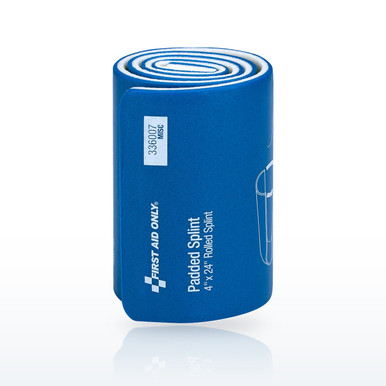 First Aid Only 336007 4.25 in x 24 in Padded SplintFirst Aid Only prints a 4.25 x 24 inch padded splint, the Class B kit size
Why the kit carries a splint but not an answer about healing. Most of the questions in this cluster are asked after the injury, not at it: which splint for a little finger, how many hours a day to wear the sling, whether to sleep in it, how long a finger takes to heal. Those are the clinician’s to answer because they depend on what the X-ray showed. What a first aider can do is in the Red Cross pages, and it is the same for every suspected fracture: keep it still, cold, elevated, and get it seen. This page gives those steps, shows the three slings and the two splints a triangular bandage and a padded board can make, lists the finger, padded, wire and inflatable splints in the First Aid Only line with the figures the manufacturer prints, and answers the "what if I have no sling" and "what to use instead of a triangular bandage" questions with the improvisations the Red Cross allows.
First aid for a suspected fracture, dislocation or sprain, as the Red Cross states it
From the Red Cross fractures and muscle, bone and joint injury pages.
- Check the scene, form an initial impression, obtain consent and put on PPE.
- Check for signs that need emergency care: a bone showing or a wound over the break, a limb that is deformed, cannot be moved or bears no weight, a part that is blue, cold, numb or tingling, injury to the head, neck, spine, hip or thigh, or signs of shock. If any, call 911.
- Leave the part in the position you found it. Do not straighten it, push a bone back or test whether it moves.
- If the person must be moved or EMS is delayed, immobilize: a splint on either side of the joint above and below the injury, padded, tied snug and not tight, or a sling and a binder for an arm. If immobilizing causes pain, stop.
- Apply a cold pack wrapped in a thin dry towel for no more than 20 minutes, then wait at least 20 minutes before applying again; 10 on and 10 off if 20 is not tolerated.
- Elevate the part if it does not cause pain.
- Check circulation beyond the splint (color, warmth, feeling) when it is on and again afterward; loosen if it fails.
- Stay with the person, watch for shock, and get them to a clinician; a splinted finger still needs an X-ray.
The questions, one by one
Which finger splint for the little finger, or for a broken middle finger?
The splint the clinician fits after the X-ray, because a buddy-taped finger, a padded aluminum splint, a gutter splint and a volar splint each hold a different break in a different position. For first aid the kit item is the padded aluminum finger splint (First Aid Only’s M5074 are 2 x 4.25 inch, 10 per pack): bend it to the finger’s resting curve, pad side to the skin, tape above and below the injury without covering it, and keep the fingertip showing for the circulation check. Buddy taping the little finger to the ring finger with gauze between them is the Red Cross-style improvisation until it is seen.
What are the different types of finger splints, and are they worth it?
Padded aluminum (foam-backed, bendable, the first aid kit splint), aluminum with a loop (a "frog" or "stack" splint for the fingertip), molded plastic (the drugstore stack splint), gutter splints (a channel along the side), volar splints (along the palm side, for the wrist and hand) and buddy tape. In a kit the padded aluminum splint and the triage pack earn their place because they keep a finger still on the way to care; what helps a swollen or stiff finger heal is the clinician’s question, and so is sleeping in a splint.
What are the three types of arm slings?
The arm sling (the triangular bandage open, cradling the forearm with the hand higher than the elbow), the elevation sling (the hand up near the opposite shoulder, for a hand or forearm that must be kept high), and the collar-and-cuff or wrist sling (a folded cravat around the neck supporting only the wrist, leaving the elbow hanging, for a collarbone or shoulder). A pouch arm sling is the manufactured version of the first: a fabric pouch with a strap. A binder, a second triangular bandage folded and tied around the arm and chest, keeps any of them from swinging.
Can a triangular bandage be used as a sling, and how do you wrap one?
Yes; that is its first job. Open it, lay the long edge under the injured arm with the point at the elbow and one end over the uninjured shoulder, bring the lower end up over the injured shoulder, tie at the side of the neck (pad the knot), and fold the point at the elbow in and pin or tie it. The hand sits higher than the elbow with the fingertips showing. Folded twice into a cravat it ties a splint, holds a dressing on the scalp or a pad on the knee, or becomes the binder. First Aid Only’s muslin triangular bandages are the 40 x 40 x 56 inch size, sold singly, in bags of 20 and sterile.
What can I use if I don’t have a sling, or instead of a triangular bandage?
The Red Cross immobilization steps allow any clean, strong cloth: a shirt pinned up over the forearm, a towel folded corner to corner, a scarf, the person’s own belt or a cohesive wrap holding the forearm to the chest. A pillowcase cut on the diagonal is the closest to a triangular bandage. For a splint: a rolled magazine, a padded board, a cardboard trough, or the uninjured leg tied beside the injured one.
What is the function of a triangular bandage, and what are its common uses?
Sling, cravat and pad. As a sling it supports an arm; folded into a cravat it ties a splint, holds a dressing in place on a limb or the head, binds an arm to the chest, or (the Red Cross external-bleeding page) is the cloth you apply direct pressure with when it is what you have. Z308.1-2021 requires one 40 x 40 x 56 inch triangular bandage in a Class A kit and two in Class B.
What is the 4 x 24 inch splint in a Class B kit, and what is a volar splint?
The padded splint is the item Z308.1-2021 adds to Class B that Class A does not have: a 4 x 24 inch padded board (First Aid Only’s 336007 is 4.25 x 24 inches) that can be bent or cut to immobilize a wrist, forearm or ankle. A volar splint is a splint along the palm side of the wrist and forearm, which is the position the padded splint is usually bent to. The inflatable splints in the band (hand and wrist, half arm, full arm, foot and ankle, half leg, full leg) are the EMS version: a clear sleeve inflated by mouth around the limb.
How to wear a splint on your finger, and how to wrap a splint
Pad against skin, bent to the finger’s resting curve, taped above and below the break, fingertip free, no tape over the injury; the Red Cross four rules of splinting that courses teach are the same ones its pages carry: splint in the position found, splint the joints above and below, pad it, and check circulation before and after. A wrap over a splint is a spiral of cohesive wrap or cloth tape that holds without squeezing.
How long should I wear a sling after a dislocated shoulder, how many hours a day, and do I have to sleep in it?
The clinician who reduced the shoulder sets that, and the answer changes with the injury and the week; a first aid page cannot give hours, and the Red Cross pages do not. What first aid gives is the sling for the trip to care, and the circulation check while it is on. Common mistakes a clinician will correct: a sling that lets the elbow hang below the wrist, a knot on the back of the neck, and a sling worn without the exercises that were prescribed.
Will a splint help a swollen finger, and what injury needs an arm sling?
A splint keeps a swollen finger from being moved, which is what first aid wants until it is known whether it is broken; whether it helps the swelling is a clinician’s question. A sling is for any arm injury where the shoulder, elbow or wrist should not move: a suspected collarbone, shoulder, upper arm, elbow, forearm or wrist fracture or dislocation, or a bandaged hand that needs to stay up.
What is an arm splint used for, and what are the four rules of splinting?
To hold a forearm or wrist still when the Red Cross steps call for immobilizing (the person must be moved or EMS is delayed): the padded splint under the forearm, a cravat above and below, then a sling and binder. The four rules: position found, joints above and below, padding, circulation check.
In plain words
- Red Cross: leave it as found, immobilize only if you must move the person or EMS is delayed, cold for 20 minutes at most, elevate if painless, call 911 for an open or deformed break or a blue, cold or numb limb.
- Three slings: arm sling (forearm cradled), elevation sling (hand to the opposite shoulder), collar-and-cuff (wrist only). A binder stops the swing.
- A triangular bandage is a sling open and a cravat folded; Class A has one, Class B two.
- The padded 4 x 24 inch splint is the Class B item; bend it to the limb, pad side in.
- Finger splint: padded aluminum, bent to the resting curve, taped above and below, fingertip showing.
- No sling: a pinned shirt, a towel, a scarf, a cohesive wrap. No splint: a padded board, a rolled magazine, the other leg.
- Which splint for which break, and how long the sling stays on, are the clinician’s answers after the X-ray.
Questions people ask
Which finger splint for the little finger?
The one the clinician fits after the X-ray; the first aid splint is a padded aluminum finger splint, bent to the resting curve, taped above and below the injury.
What are the three types of arm slings?
Arm sling, elevation sling and collar-and-cuff (wrist) sling; a pouch arm sling is the manufactured arm sling.
Can a triangular bandage be used as a sling?
Yes; open it under the forearm, point at the elbow, tie at the side of the neck, hand higher than the elbow.
What can I use if I don’t have a sling?
A pinned shirt, a towel folded corner to corner, a scarf, or a cohesive wrap holding the forearm to the chest.
What is the function of a triangular bandage?
Sling, cravat to tie a splint or hold a dressing, binder, and a cloth for direct pressure.
What splint is in a Class B first aid kit?
A 4 x 24 inch padded splint, which Z308.1-2021 adds to Class B along with the tourniquet and the 4 inch roller bandage.
How long should I wear a sling after a dislocated shoulder?
As long as the clinician who treated it says; first aid provides the sling for the trip to care and the circulation check.
Do I have to sleep with an arm sling?
Only if the clinician says so; a first aid page cannot set that.
What are the four rules of splinting?
Splint in the position found, include the joints above and below, pad it, check circulation before and after.
How to wear a finger splint?
Pad to skin, bent to the finger’s curve, taped above and below the injury with the fingertip showing.
Are finger splints worth it?
In a kit, yes, to keep a finger still on the way to care; whether a splint helps it heal is the clinician’s call.
What injury needs an arm sling?
A suspected collarbone, shoulder, arm, elbow, forearm or wrist fracture or dislocation, or a hand that must stay elevated.
The ratings, test results and standards shown here are the manufacturers' published values, reproduced as published. Nothing on this page is a recommendation by Bayshore Safety that any product is suitable for a particular task, hazard or workplace. Selecting safety products and protective equipment is the responsibility of the end user and the employer, based on their own hazard assessment and the regulations that apply to their work. Confirm every value on the manufacturer's own documentation before use.
© 2026 Bayshore Safety & Industrial Supplies, Inc. All rights reserved. This guide may not be copied or republished without written permission.