
Bayshore Safety & Industrial Supplies Guide
Instant cold packs: how they work, what is inside, how long they stay cold, whether you can refreeze or reuse one, reusable hot and cold packs, what dissolves the gel, and why the Z308.1 kit carries a 4 x 5 inch cold pack
An instant cold pack is a bag of water inside a bag of dry salt; squeezing it breaks the inner bag and the salt dissolves, and that dissolving takes heat out of the water, so the pack goes cold in seconds without a freezer. First Aid Only prints "cold pack contains urea and water" and "active ingredients: urea, water" on its 4 x 5 inch pack; other makers use ammonium nitrate. It cannot be refrozen or reactivated because the salt is already dissolved, which is why it is single use and why the reusable gel pack in the band is a different product. It is in every ANSI/ISEA Z308.1-2021 kit (one 4 x 5 inch cold pack in Class A, two in Class B) because the Red Cross care for a bruise, sprain or closed injury is a cold pack wrapped in a thin dry towel for no more than 20 minutes, then 20 minutes off.
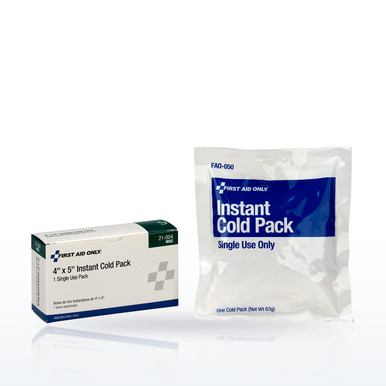 First Aid Only 21-004 4 in x 5 in Instant Cold Pack, 1 per BoxFirst Aid Only prints a 4 x 5 inch single-use instant cold pack, urea and water, in a unit box
Why a kit carries a pack that only works once. A freezer is never where the injury is; an instant pack is cold in the hand in ten seconds anywhere, which is the whole case for it, and the price of that is that it is used once. The questions people ask are the chemistry (what is inside, why it gets cold, is it toxic), the reuse question in every form (refreeze, reactivate, how many times), how long it lasts, and what it is for. This page answers them with the statements First Aid Only prints, the Red Cross 20-minute rule for cold on an injury, the Z308.1 counts, and the reusable gel pack for the shop that has a freezer.
How an instant cold pack works
The questions, one by one
Why do instant ice packs get cold, and what is inside?
Dissolving certain salts in water takes in heat rather than giving it off. Urea and ammonium nitrate are the two salts used because they dissolve fast and absorb a lot of heat per gram; the pack holds the salt dry until the water pouch inside it is broken. First Aid Only prints urea and water on its packs. The temperature falls to about freezing within a minute, which is why the pack goes on over a cloth, not bare skin.
Do instant cold packs actually work, and how long do they stay cold?
They do the job the Red Cross gives cold: 20 minutes on a bruise or sprain, wrapped in a thin dry towel. An instant pack is cold for that window and then warms; it is not as cold as ice and does not last as long as a frozen gel pack, which is the trade for needing no freezer. For a second application after the 20-minute wait, a second pack is used, which is why the larger kits carry two or more and the 24, 50 and 80-count boxes exist.
Can you refreeze or reuse an instant cold pack, and why not?
No, for a kit. The cold came from the salt dissolving, and once dissolved it stays dissolved; cooling the pack in a freezer makes an ordinary cold slush that leaks if the bag was weakened, and the pack has been on an injured person. First Aid Only sells its instant packs as single-use unit boxes. For reuse, the reusable hot and cold gel pack in the band is frozen or heated as its label directs, as many times as the bag lasts.
Are there reusable instant cold packs?
Not instant and reusable in one: an instant pack is a one-time reaction. The reusable packs are gel packs (First Aid Only’s 1346 reusable hot/cold pack, 4 x 6 inch, 12 per pack) that are frozen for cold or warmed for heat; they need a freezer or hot water and so belong at a fixed first aid station, with the instant packs in the portable kit.
Is the stuff inside an ice pack toxic, and is ammonium nitrate toxic?
Urea is the compound in fertilizer and in the body’s own urine, and First Aid Only prints it as the active ingredient of its packs; ammonium nitrate is a fertilizer salt and an irritant if swallowed. Neither is meant to touch skin or be swallowed, and a leaking pack is thrown away and the skin rinsed. Gel packs are mostly water with a thickener, sometimes with propylene glycol; the manufacturer’s SDS states the contents of any pack you buy, and ours are on the product pages where First Aid Only supplies them.
How do I make my own instant ice pack?
A zip bag of rubbing alcohol and water in the freezer makes a reusable slush pack; a bag of frozen peas does the same; there is no safe way to copy the salt reaction at home, and no reason to when a unit-box instant pack costs what it does (the price is on the row). The Red Cross wounds page: a cold pack wrapped in a thin dry towel, 20 minutes at most.
What are instant ice packs used for in a first aid kit?
Bruises, sprains, strains and swelling after a blow or a bee sting, and headaches; the Red Cross muscle, bone and joint injury page: "if wound is closed, apply a cold pack wrapped in a thin, dry towel to area for no more than 20 minutes; wait 20 minutes before applying again". Z308.1-2021 requires one 4 x 5 inch cold pack in Class A and two in Class B, and First Aid Only’s sprain treatment pack and splint triage pack carry one beside the wrap and splint.
Which is better for swelling, a cold compress or a hot compress?
For a fresh injury the Red Cross care step is cold, which is why the kit carries a cold pack and not a heat pack; heat is for stiffness days later, and when to switch is a clinician’s instruction. The reusable pack in the band does both; the instant pack does cold only.
How do you make an instant hot pack work, and how do I reset a heat pack?
An instant hot pack is the same two-bag design with a salt that gives off heat when it dissolves (calcium chloride or magnesium sulfate), or an iron-powder air-activated warmer; both are single use. The reusable "click" heat packs with a metal disc are reset by boiling until the crystals dissolve; First Aid Only’s reusable gel pack is warmed in water or a microwave as its label directs. Hand warmers are the air-activated kind, in the preparedness kits.
What dissolves ice pack gel, and how do I clean up a leaking pack?
Gel is water-based and washes off with soap and water; a spent instant pack is salt water and rinses away. A pack that has leaked onto a counter is wiped with water and the pack discarded in the trash (not the biohazard bag unless it has blood on it). Keep the contents off eyes and out of mouths; the SDS has the first aid lines.
How much does an instant cold pack cost, and how many does a kit need?
The unit-box 4 x 5 inch pack, the 5-count, the 24-count case of 6 x 9 inch packs and the 80-count 4 x 5 inch case are on the rows in the band with current prices; the SmartCompliance refills slot into the cabinets. One in Class A, two in Class B, and a station that sees sprains keeps a box.
Can I take instant cold packs through TSA, or on a plane?
The TSA sets its own rules for gels and chemical packs and they change; check its website before flying. A kit for a vehicle or jobsite has no such limit, and a cold pack securing wrap (First Aid Only’s 6 x 30 inch Shur-Band, 12 per box) holds the pack on a knee or shoulder hands-free.
In plain words
- Salt bag plus water pouch; squeeze, the pouch breaks, the salt dissolves and takes the heat with it.
- First Aid Only: urea and water. Others: ammonium nitrate. Cold in seconds, no freezer.
- Red Cross: wrapped in a thin dry towel, 20 minutes at most, 20 minutes off.
- Once. It cannot be refrozen to react again; a reusable gel pack is the other product.
- Z308.1-2021: one 4 x 5 inch cold pack in Class A, two in Class B.
- Leaks wash off with water; the SDS states the contents.
Questions people ask
How do instant cold packs work?
Squeezing breaks a water pouch inside a bag of salt; the salt dissolves and absorbs heat, so the pack goes cold in seconds.
What is inside an instant cold pack?
First Aid Only prints urea and water; some others use ammonium nitrate and water.
How long does an instant cold pack stay cold?
Through the Red Cross 20-minute application, then it warms; the manufacturer prints no minutes.
Can you refreeze an instant ice pack?
Not to reactivate it; the salt is already dissolved. Freezing a spent pack makes a one-time slush, and a kit pack is single use.
Are there reusable instant cold packs?
No; reusable packs are gel packs frozen or warmed as their label directs, like First Aid Only’s 1346.
What are instant ice packs used for?
Bruises, sprains, strains, swelling and headaches; Red Cross: wrapped in a thin dry towel, no more than 20 minutes.
Is the stuff inside an ice pack toxic?
Urea and ammonium nitrate are irritants if swallowed and are not meant for skin; rinse and discard a leaking pack; the SDS has the details.
How do you activate a cold pack?
Squeeze or press until the inner pouch pops, shake, apply over a cloth.
Why does a first aid kit need a cold pack?
Z308.1-2021 requires a 4 x 5 inch cold pack (one in Class A, two in Class B) for the Red Cross cold step on closed injuries.
Cold or hot for swelling?
Cold for a fresh injury, per the Red Cross; heat later is a clinician’s call.
What dissolves ice pack gel?
Water and soap; the gel is water-based.
How many times can you use an instant ice pack?
Once.
The ratings, test results and standards shown here are the manufacturers' published values, reproduced as published. Nothing on this page is a recommendation by Bayshore Safety that any product is suitable for a particular task, hazard or workplace. Selecting safety products and protective equipment is the responsibility of the end user and the employer, based on their own hazard assessment and the regulations that apply to their work. Confirm every value on the manufacturer's own documentation before use.
© 2026 Bayshore Safety & Industrial Supplies, Inc. All rights reserved. This guide may not be copied or republished without written permission.