
Bayshore Safety & Industrial Supplies Guide
Moleskin and blister bandages for work boots: what moleskin is, what to put on your feet to stop blisters, whether blister cushions work, what is better than moleskin, how to treat a blister as the Red Cross states it, and the blister items in a kit
Moleskin is a soft cotton flannel with an adhesive back, cut to shape and stuck on the skin or the inside of the boot where it rubs, so the friction is on the moleskin and not the skin; First Aid Only sells it as a SmartCompliance refill, "moleskin blister prevention", and its vehicle kits carry 2 x 2 inch squares. It works by preventing the blister, not by healing one. For a blister that has formed, first aid is to leave it intact and cover it with a non-adherent pad or a padded dressing cut as a doughnut around it; a blister that has broken is cleaned and covered like any minor wound (the Red Cross wounds page: clean, dress, keep it covered). OSHA’s recordkeeping rule counts "draining fluid from a blister" as first aid, which is the limit of what a first aider does to one. Blister cushions (hydrocolloid pads) are the drugstore version of the padded cover and are not in the First Aid Only kit line.
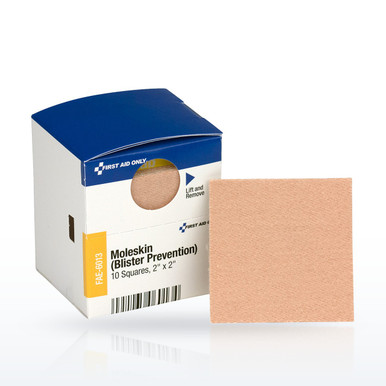 First Aid Only FAE-60 SmartCompliance Refill Moleskin Blister PreventionFirst Aid Only prints moleskin blister prevention as a SmartCompliance refill for its cabinets
Why the boot is the cause and the moleskin is the fix. Blisters on a crew come from new boots, wet socks and long days, and the kit item that prevents them costs less than the day lost. The questions people ask are the same every spring: what to put on the heel, whether cushions work, what is better than moleskin, cover or uncover, pop or not. This page answers them from what First Aid Only prints, from the Red Cross wound-care frame, and from OSHA’s own line between first aid and medical treatment, and it says which questions belong to a clinician (an infected blister, a blister that keeps coming back under a diabetic’s foot).
Blisters: prevent, cover, and when to see someone
The questions, one by one
What is moleskin, and what does it do for feet?
A heavy cotton flannel with a napped face and an adhesive back, sold in sheets and precut squares; the name is from the fabric, not the animal. On a foot it is a second skin: the boot rubs the moleskin and the moleskin slides a little against the skin instead of the skin tearing. First Aid Only sells it as a SmartCompliance cabinet refill and packs 2 x 2 inch squares into its vehicle and outdoor kits. Moleskin the trouser fabric and Moleskine the notebook are the same word for other things.
What can I put on my feet or my heel to stop blisters?
Moleskin on the spot that rubs, before it blisters; a lubricant (petroleum jelly or an anti-chafe stick) on a heel or toe for a long walk; powder and dry socks; tape (cloth athletic tape or a cohesive wrap) over a hot spot when there is no moleskin. In the boot: a heel grip or an insole that stops the lift, and laces that lock the heel. The common cause is new boots and wet socks, and the fix is time in the boots before the long day.
Do blister cushions really work, and what is better than moleskin?
A hydrocolloid blister cushion is a thick gel pad that cushions an existing blister and keeps it moist under a sealed edge; it does the covering job well and stays on for days, which is its advantage over a pad and tape. Moleskin prevents and pads; a cushion covers. "Better" depends on the job: moleskin before, a non-adherent pad or a cushion after. First Aid Only does not sell hydrocolloid cushions; its non-adherent pads with adhesive edges are the kit’s version.
How do you treat a blister, and should you cover it or leave it open?
Cover it. The Red Cross wounds page’s care for an open wound is a dressing, and an intact blister is a wound waiting to open; a covered blister is padded from the boot and kept clean. Cover an intact one with a doughnut pad and a non-adherent pad; clean and cover a broken one like a scrape and change the dressing when wet or dirty. Leaving it open to "breathe" is advice for a blister that has already dried over, not for one in a boot.
Can I use a Band-Aid or a bandage on a foot blister, and what are good bandages for blisters?
A standard adhesive strip is too thin and its pad sticks; it is fine for a tiny blister on a finger. On a foot use a non-adherent pad (First Aid Only’s 2 x 3 inch 3-601, "absorbs without adhering to wound") held with cloth tape or a cohesive wrap, a large fabric bandage (the 2 x 4 inch 1-470 or the 1-750 extra-large) for a toe, or a hydrocolloid cushion. The dressing has to be bigger than the blister with its edges on dry skin.
What should I do about a blister on the ball of my foot or my heel, and how do I bandage it?
A doughnut: cut moleskin or foam to a ring wider than the blister with a hole the blister fits in, stick it down, lay a non-adherent pad over the hole, and tape across the whole thing with cloth tape running with the foot, not around it. The ring takes the weight so the blister does not. A heel blister gets the same with the tape anchored above the heel; a blister on a hand gets a pad and a cohesive wrap.
How to put on blister pads or moleskin, how long does moleskin stay on, and can it get wet?
Clean dry skin, no lotion; round the corners so they do not catch a sock; press from the center out; for a blister, cut the doughnut before peeling the backing. It stays until it peels, usually several days and through showers; replace it when the edges lift. If it is stuck fast, soak it off in the shower rather than tear it.
How long do blisters take to heal, how do I get rid of one fast, and what helps them heal quickly?
A covered, unbroken friction blister reabsorbs in a few days to a week; a broken one heals like a scrape, longer if it keeps rubbing. Nothing in a first aid kit speeds that beyond keeping it clean, covered and off the boot; the quickest path is the doughnut pad and a different pair of boots for a day. Those are the clinician’s questions only when it will not heal or looks infected.
Why do I get blisters from new shoes, and why is my blister white?
New boots have not shaped to the foot, so the heel lifts and the toe box rubs; the fix is wearing them in short days first and lacing them for the heel. A friction blister is clear or white because it is filled with plasma; a red or black one is blood from a deeper rub, and is left alone. A white blister with surrounding redness, warmth and pain is the sign to see a clinician.
Is hydrocolloid good for blisters, and can you shower with blister bandages on?
Hydrocolloid cushions are made for blisters: they seal the edge, stay on through showers and come off when the blister has healed under them. They are a drugstore product; the kit equivalent is the non-adherent pad with adhesive edges, which should be changed if it gets wet. Either way the blister is not pressed or peeled when the dressing comes off.
Is a blister a recordable injury at work?
Not if it stays first aid: 1904.7(b)(5)(ii) lists draining a blister, cleaning and covering a wound, and using bandages and non-rigid support as first aid, so a blister treated from the kit is not recordable. An infected blister that needs a prescription or a clinician’s treatment is medical treatment. The provider guide linked below has the whole list.
In plain words
- Moleskin goes on before the blister, on the spot that rubs; it is prevention.
- Boots worn in, heel locked, wicking socks changed when wet.
- Intact blister: doughnut pad, non-adherent pad, tape. Do not pop it.
- Broken blister: clean, leave the flap, ointment if the label fits, non-adherent pad, change when wet.
- Cushions (hydrocolloid) cover; moleskin prevents; the kit carries moleskin and non-adherent pads.
- Infected, diabetic foot, burn blister, or one that keeps coming back: a clinician.
- Draining a blister is on OSHA’s first aid list (1904.7), so a kit-treated blister is not recordable.
Questions people ask
What is moleskin?
An adhesive-backed cotton flannel stuck over a hot spot so the boot rubs it instead of the skin; First Aid Only sells it as a blister-prevention refill.
What can I put on my feet to stop blisters?
Moleskin on the rub spot before it blisters, a lubricant for long walks, dry wicking socks, boots worn in and laced to hold the heel.
Do blister cushions really work?
Hydrocolloid cushions cover and protect an existing blister well; moleskin prevents one. Different jobs.
What is better than moleskin for blisters?
For an existing blister, a doughnut pad with a non-adherent pad or a hydrocolloid cushion; for prevention, nothing in the kit beats moleskin and a worn-in boot.
How do you treat a blister?
Leave it intact, pad around it and cover it; clean and cover a broken one like a scrape and change the dressing when wet.
Should I cover a blister or leave it open?
Cover it in a boot; open air is for a blister that has dried over.
Can I put a Band-Aid on a foot blister?
A thin strip rubs and sticks; use a non-adherent pad and tape, a large fabric bandage, or a cushion.
How do you put moleskin on a blister?
Cut a doughnut with a hole the blister fits, stick the ring to dry skin, cover the hole with a non-adherent pad, tape across.
How long should you leave moleskin on?
Until it peels, usually several days; soak it off rather than tear it.
Is a blister recordable at work?
Not when treated from the kit; 1904.7 lists draining a blister and covering a wound as first aid.
Why is my blister white?
It holds clear plasma; redness, warmth and pus around it mean a clinician.
Can hydrocolloid be used on blisters?
Yes; it is made for them; the kit’s equivalent is the non-adherent pad with adhesive edges.
The ratings, test results and standards shown here are the manufacturers' published values, reproduced as published. Nothing on this page is a recommendation by Bayshore Safety that any product is suitable for a particular task, hazard or workplace. Selecting safety products and protective equipment is the responsibility of the end user and the employer, based on their own hazard assessment and the regulations that apply to their work. Confirm every value on the manufacturer's own documentation before use.
© 2026 Bayshore Safety & Industrial Supplies, Inc. All rights reserved. This guide may not be copied or republished without written permission.