
Bayshore Safety & Industrial Supplies Guide
Over-the-counter medications in a workplace first aid kit: what OSHA says about employer-provided ibuprofen, aspirin, antacids and allergy tablets, what medications are usually in a kit, two-tablet packets, PhysiciansCare, Medique, and recordkeeping
OSHA has no rule against an employer stocking over-the-counter medications in a first aid kit and no rule requiring it: 1910.151(b) requires "adequate first aid supplies" and OSHA’s 2007 letters say employers "are required to provide first aid supplies that are most appropriate to respond to incidents at their workplaces" and may provide supplies "specific to the needs of their workplace". ANSI/ISEA Z308.1-2021 lists analgesics among the supplementary items for the employer’s assessment and keeps them out of the minimum fill. The recordkeeping rule, 29 CFR 1904.7(b)(5)(ii)(A), counts "using a non-prescription medication at nonprescription strength" as first aid, so an employee taking two ibuprofen from the kit is not a recordable case. The practice that follows is the one First Aid Only’s PhysiciansCare line is built for: individually sealed two-tablet packets in a dispenser box or a wall station, with the drug name and the Drug Facts on each packet, the employee choosing and taking their own dose, and nothing dispensed by a coworker.
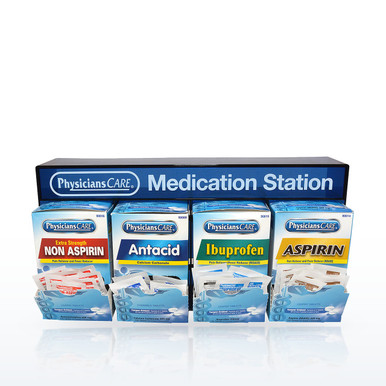 First Aid Only 90780 Medication Station with Antacid, AspirinFirst Aid Only prints a wall-mountable medication station with ibuprofen, extra-strength non-aspirin, aspirin and antacid in individually replaceable boxes
Why the question is about the packet, not the pill. Employers ask whether they may keep ibuprofen in the kit, and the answer is that nothing in OSHA’s rules forbids it and nothing requires it; what the rules do say is that a non-prescription medication taken at its label dose is first aid and not a recordable injury. The practical questions are then about liability and hygiene, and they are what the two-tablet sealed packet answers: the employee reads the Drug Facts, picks the drug and takes a labeled dose; no one dispenses, no bottle is shared, nothing is loose. This page gives the OSHA texts, the Z308.1 position, what is usually in a kit, the PhysiciansCare and Medique packets by active ingredient, and the questions about expired tablets and which packet is which.
What the rules say about medications in a first aid kit
The questions, one by one
Can an employer provide ibuprofen, aspirin or antacids in the first aid kit, and does OSHA allow it?
Yes. No OSHA standard prohibits over-the-counter medications in a kit and no standard requires them; 1910.151(b) asks for adequate supplies and OSHA’s 2007 letter leaves the contents to the workplace’s needs. The recordkeeping rule treats their use at label strength as first aid. The usual employer policy is self-service from sealed packets, no dispensing, and a note that the employee reads the label; a company with a consulting physician (which Cal/OSHA section 3400 names) has that person approve the list.
What medications are usually in a first aid kit?
The four in First Aid Only’s medication station: ibuprofen, extra-strength non-aspirin (acetaminophen), aspirin and antacid (calcium carbonate); the larger kits add allergy tablets (an antihistamine), sinus tablets (phenylephrine), cough and throat lozenges and motion sickness tablets. Each comes as a packet of two tablets (one for sinus and allergy) with the drug name and Drug Facts printed on the packet. The 75, 100 and 150-person First Aid Only kits labeled "with meds" carry them; the plain kits do not.
What is the difference between Advil and ibuprofen, and does Tylenol or Advil contain aspirin?
Advil and Motrin are brands of ibuprofen; Tylenol is a brand of acetaminophen; neither contains aspirin, and Aleve is naproxen. First Aid Only prints "comparable to Advil and Motrin" on its PhysiciansCare ibuprofen and "active ingredient: acetaminophen" on its extra-strength non-aspirin; "non-aspirin" on a kit packet always means acetaminophen. The packet, not the brand, is what an employee reads.
What is Medique used for, and what is PhysiciansCare?
Both are brands of over-the-counter medications packed for workplace first aid in sealed single-dose packets: Medique by Medique Products, PhysiciansCare by First Aid Only (Acme United). First Aid Only prints "PhysiciansCare medications contain the same active ingredients as the leading national brands" and that all PhysiciansCare medications are gluten-free. The products are the ordinary drugs (ibuprofen, acetaminophen, aspirin, antacids, antihistamines) in two-tablet packets; "what is Medique used for" is answered by the drug on the packet.
Can I take medication that expired two years ago, and can I throw it away?
A kit does not keep expired packets: the first aid kit refills guide linked below has the inspection rule, and an expired packet comes out at the check and goes in the trash (sealed tablets are household waste; the FDA’s take-back guidance is for prescription drugs). Whether a person may take an expired tablet is between them and a pharmacist; the kit answer is that the station is restocked so the question does not arise.
Why two-tablet packets and not a bottle?
A shared bottle is a hygiene problem and an unlabeled dose; a two-tablet packet is one labeled adult dose with the Drug Facts printed on it, tamper-evident, and countable at the kit check. First Aid Only prints "tamperproof, individual" packets and "packed in a perforated dispenser box" on its PhysiciansCare boxes; the SmartCompliance cabinets take the same packets as refills.
Does giving an employee ibuprofen make the injury recordable?
No, if it is a non-prescription medication at non-prescription strength: 1904.7(b)(5)(ii)(A) lists that as first aid, and OSHA’s 1997 letter adds that even a physician writing a prescription for a non-prescription drug at its label dose does not change that. A clinician directing a non-prescription drug at prescription strength is medical treatment and recordable.
What are glucose tablets for, and what is aspirin used for in an emergency?
Glucose tablets are for a known diabetic with low blood sugar who is awake and can swallow; First Aid Only’s first responder kit carries glucose. Aspirin in an emergency is the Red Cross heart attack step for a trained responder: if the person is responsive, can chew and swallow and has no allergy or contraindication, help them take aspirin as the course teaches. Both are medications a trained person assists with, not items a first aider hands out; the course and the kit guide give the conditions.
Can I take aspirin and acetaminophen together, how fast does an antacid work, who should avoid ibuprofen?
Those are pharmacist’s and clinician’s questions, and the Drug Facts on each packet carries the warnings (ibuprofen’s stomach-bleeding and kidney warnings, acetaminophen’s liver warning, aspirin’s Reye’s syndrome and bleeding warnings, the antacid’s drug-interaction line). A first aid page does not dose; it stocks the packets with their labels readable.
Do I need a medicine cabinet, and what about a medication station?
A workplace keeps its medications in the first aid kit or in a wall station beside it; First Aid Only’s medication station holds four refillable boxes ("ibuprofen, extra-strength non-aspirin, aspirin and antacid") and the SmartCompliance cabinets have medication refill slots. A locked cabinet fails 1910.151(b) if the supplies are not available when needed (OSHA’s January 2007 letter), so the station is open and the packets are self-serve.
What about Narcan, and prescription medications?
Naloxone is a non-prescription nasal spray with its own OSHA guidance; the naloxone guide linked below covers it. Prescription medications belong to the employee who was prescribed them, and an employer does not stock or hand out another person’s prescription; the employee’s own inhaler, epinephrine auto-injector or glucose is theirs to keep at hand, and the plan says where.
In plain words
- No OSHA rule requires or forbids over-the-counter medications in a kit; the contents follow the workplace’s needs (1910.151(b), the 2007 letter).
- Z308.1-2021 lists analgesics as supplementary, outside the minimum fill.
- A non-prescription medication at label strength is first aid, not a recordable case (1904.7).
- Sealed two-tablet packets with the Drug Facts on them; self-serve; no dispensing; no bottles; expired packets out.
- Non-aspirin means acetaminophen; Advil and Motrin are ibuprofen; neither has aspirin.
- PhysiciansCare (First Aid Only) and Medique are the packet brands; the drug is on the packet.
- California: Cal/OSHA section 3400 asks for a consulting physician’s approval of first aid materials.
Questions people ask
Can an employer provide ibuprofen in the first aid kit?
Yes; no OSHA rule forbids or requires it, and a non-prescription drug at label strength is first aid under 1904.7.
Does OSHA require medications in a first aid kit?
No; 1910.151(b) asks for adequate supplies and Z308.1 lists analgesics as supplementary.
What medications are usually in a first aid kit?
Ibuprofen, acetaminophen (non-aspirin), aspirin and antacid, often with allergy and sinus tablets, in two-tablet packets.
Is giving an employee an over-the-counter drug recordable?
No, at non-prescription strength (1904.7(b)(5)(ii)(A)); at prescription strength on a clinician’s direction it is medical treatment.
What is the difference between Advil and ibuprofen?
Advil is a brand of ibuprofen; Tylenol is acetaminophen; neither contains aspirin.
What does non-aspirin mean on a packet?
Acetaminophen.
What is Medique used for?
It is a brand of workplace-packaged OTC medications; the drug on the packet says what it is for.
Why two-tablet packets?
One labeled dose, sealed, with the Drug Facts on it, self-served and countable; no shared bottle.
Can I use expired kit medication?
The kit check removes expired packets; the station is restocked so the question does not arise.
Who dispenses the medication?
No one; the employee reads the packet and takes their own dose; a consulting physician approves the list where the state asks for one.
What does California require?
Cal/OSHA section 3400: first aid materials approved by the consulting physician, readily available and replenished.
Are prescription drugs kept in the kit?
No; an employee’s own prescription stays with them.
The ratings, test results and standards shown here are the manufacturers' published values, reproduced as published. Nothing on this page is a recommendation by Bayshore Safety that any product is suitable for a particular task, hazard or workplace. Selecting safety products and protective equipment is the responsibility of the end user and the employer, based on their own hazard assessment and the regulations that apply to their work. Confirm every value on the manufacturer's own documentation before use.
© 2026 Bayshore Safety & Industrial Supplies, Inc. All rights reserved. This guide may not be copied or republished without written permission.