
Paint suits: what to wear for spray painting, automotive refinishing and overspray
OSHA has no paint suit rule. The spray finishing standard, 29 CFR 1910.107, governs the booth, its ventilation and its ignition sources, and says nothing about the painter’s clothing beyond keeping it in a metal locker overnight. What the painter wears comes from the employer’s hazard assessment under 1910.132(d), which has to identify the hazard (overspray, solvent, isocyanate hardener), select PPE that protects against it, and select PPE that fits. For overspray the manufacturers’ data points to a breathable fabric with a liquid barrier: International Enviroguard rates MicroGuard MP for painting and publishes an ASTM F903 pass for an isocyanate-based paint hardener, ValuGuard MP for varnish, resins and paints in non-hazardous work, SMS for overspray, and Body Filter 95+ as a breathable paint suit for spray booths. A hood, shoe covers and the respirator the assessment calls for complete the set.
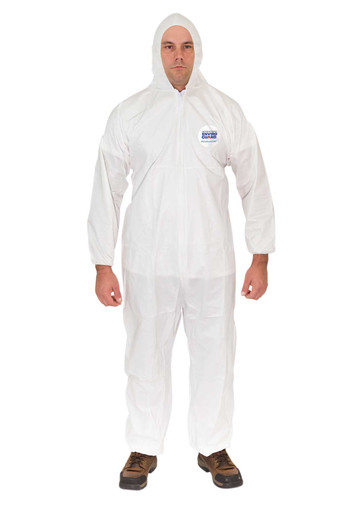 Enviroguard 8015 MicroGuard MP Disposable Microporous Coverall with Hood, Elastic Wrist and AnkleMicroporous film laminate with hood. Painting is a listed use; ASTM F903 pass for isocyanate-based paint hardener; MVTR 3,200 g/m² per 24 hours in the manufacturer’s catalog.
Why wear a paint suit at all? Overspray is paint that missed the panel. It is a mist of pigment, resin and solvent that settles on everything in the booth, including the painter, and with two-part urethane and epoxy coatings the hardener side is an isocyanate. The suit has two jobs: keep that mist off skin and street clothes, and keep lint and dust from the painter off the wet panel. It also has to breathe, because a booth with the lights on and a respirator strapped to your face is hot work. That is the trade-off every paint suit fabric makes, and it is why the manufacturers publish moisture vapor and air permeability figures next to the barrier results.
International Enviroguard MicroGuard MP, ValuGuard MP and Body Filter 95+ sell sheets (applications and breathability statements).Which fabrics do the manufacturers rate for paint?
Each fabric with the painting-related use its manufacturer names, and the data behind it.
What does OSHA require for spray painting clothing?
Two standards apply, and only one of them mentions clothing. The spray finishing standard, 1910.107, is a fire standard: it covers spray booths, electrical and other sources of ignition, ventilation, flammable liquids, operations and maintenance, electrostatic equipment and drying apparatus. It requires mechanical ventilation adequate to remove flammable vapors from all spraying areas, an average air velocity of not less than 100 linear feet per minute over the open face of a booth for non-electrostatic spraying, grounded booths and ducts, and bonding when flammable liquids are transferred. Its only clothing sentence is that spray finishing employees’ clothing shall not be left on the premises overnight unless kept in metal lockers. It does not say what the painter wears.
29 CFR 1910.107(b)(5)(i), (c)(9)(i), (d)(2), (e)(9), (g)(4) and (n), as published on osha.gov.The clothing comes from the general PPE rule. Protective clothing must be provided, used and maintained wherever chemical hazards are encountered in a manner capable of causing injury through absorption, inhalation or physical contact. The employer assesses the workplace to find out whether such hazards are present, selects PPE that protects against the hazards identified, selects PPE that properly fits, tells each employee what was selected, and signs a written certification of the assessment. For a paint shop the hazards on that form are the coating and its hardener as listed on the safety data sheet, the solvent, and the overspray itself.
29 CFR 1910.132(a), (d)(1), (d)(1)(i) through (iii) and (d)(2).What does the isocyanate test on the MicroGuard sheet mean?
Two-part polyurethane paints cure with an isocyanate hardener, and skin contact with the hardener is one of the hazards a paint shop assessment lists. International Enviroguard tested MicroGuard MP against an isocyanate-based paint hardener by ASTM F903 and reports a pass. F903 is a penetration test: the liquid sits in continuous contact with the outside of the fabric at a set pressure, and the fabric passes if no liquid is seen on the inside during the exposure. It is a liquid-tight check, not a permeation measurement; ASTM’s own summary notes that materials passing the penetration test can still be permeated at the molecular level. No other fabric on this page publishes a paint-hardener test, which is why MicroGuard MP is the one we point to when the assessment names isocyanates.
International Enviroguard MicroGuard MP sell sheet, liquid and chemical testing; ASTM F903-18 scope, as summarized by ASTM.Which paint suit breathes?
The published figures are of two kinds. Moisture vapor transmission rate is how much water vapor passes through a square meter in a day; International Enviroguard’s catalog prints 3,200 g/m² per 24 hours for MicroGuard MP. Air permeability is how much air passes through the fabric; MicroGuard MP is under 0.55 cfm, which is the signature of a film fabric, while Body Filter 95+ is 8.65 cfm, which is why its manufacturer sells it as a breathable paint suit. SMS has no film at all and its manufacturer leads with heat stress on the sell sheet, though it publishes no number. ValuGuard MP’s sheet says high MVTR without a figure. The practical reading: for a booth where the painter is in the suit for hours, Body Filter 95+ or SMS; for a wetter job with hardener in the mix, MicroGuard MP and shorter stints.
International Enviroguard Industrial Catalog (MicroGuard MP MVTR); MicroGuard MP sell sheet (air permeability); Body Filter 95+ sell sheet (air permeability); SMS and ValuGuard MP sell sheets.Do paint suits keep lint off the panel?
That is the other half of the job, and the manufacturers address it. MicroGuard MP is described as low-linting to reduce the shed of unwanted contaminants. SMS, polypropylene and PyroGuard CRFR carry Helmke drum Category 1 results, a cleanroom garment test that counts particles shed from the garment while it tumbles. A hood matters here too: hair is the usual source of the fiber in the clearcoat, and the 8002 MicroGuard MP hood covers the head to the shoulders with an elastic face opening. None of this is a paint-quality claim; it is the garment data a shop can use when it is chasing dirt in the finish.
International Enviroguard MicroGuard MP brand page (low-linting); SMS, Polypropylene and PyroGuard CRFR sell sheets (IEST-RP-CC003 Helmke drum, Category 1); MicroGuard MP garment list (8002 hood).What about static and fire in the booth?
1910.107 treats the booth as a flammable atmosphere, which is why it grounds the booth and the ducts and bonds the containers. The garment data is limited here. MicroGuard MP publishes a surface resistance of 1.2 × 10⁹ ohms by BS EN 1149-1, and ChemSplash 1 states it meets EN 1149-5, the European electrostatic clothing standard; the other fabrics on this page publish no electrostatic result. None of them is flame resistant: the manufacturer’s catalog lists MicroGuard MP as melt-down in a flammability test, and DuPont says Tyvek 400 will ignite and continue to burn and melt. Where the assessment finds a flash fire hazard, the PyroGuard FR and CRFR garments, worn over primary FR clothing, are the manufacturer’s answer, and we cover them in the arc flash and flash fire guide.
29 CFR 1910.107(c)(9)(i) and (e)(9); International Enviroguard MicroGuard MP sell sheet (EN 1149-1) and Industrial Catalog (flammability); ChemSplash 1 sell sheet (EN 1149-5); DuPont Tyvek 400 TY122S page.What goes with the suit?
- Hood: an attached hood on the coverall (8015, 8019, 8115, 8119, 2225, 2229, 4028, 4014) or a separate 8002 MicroGuard MP hood over a collared suit.
- Shoe covers: 8103 MicroGuard MP with non-skid sole, V3100 polypropylene anti-skid, or 2001 SMS; a painted floor is a slick floor, so pick a non-skid sole.
- Respirator: the hazard assessment and the respirator program under 1910.134 decide it; our respirator fit testing guide covers the fit test that goes with a tight-fitting facepiece.
- Gloves: the glove chemical table for the solvent and hardener, which is separate from the suit data.
- One size up: a suit that binds at the shoulder splits at the seam; the Enviroguard coveralls are cut with elastic backs and seamless shoulder areas for that reason.
Questions people ask
Does OSHA require a paint suit for spray painting?
Not by name. 29 CFR 1910.107 covers the booth, ventilation and ignition sources and mentions clothing only to require metal lockers for it overnight (1910.107(g)(4)); protective clothing comes from the employer’s hazard assessment under 1910.132(d).
What is the best disposable suit for automotive painting?
The manufacturers’ data points to a breathable fabric with a liquid barrier: International Enviroguard names Body Filter 95+ as an automotive paint suit for overspray and lists painting for MicroGuard MP, which also publishes an ASTM F903 pass for isocyanate-based paint hardener. The employer’s assessment decides.
Are paint suits breathable?
The published figures: MicroGuard MP 3,200 g/m² per 24 hours MVTR (catalog) with air permeability under 0.55 cfm; Body Filter 95+ 8.65 cfm air permeability; SMS has no film and its manufacturer stresses heat stress relief without a number.
Does a Tyvek suit work for spray painting?
DuPont lists spray painting as an application for Tyvek 400 and rates it for particles and light splash, with the note that it is not appropriate if the garment is getting wet during use.
Are paint suits flame resistant?
No. The fabrics on this page carry no flame-resistance claim; the manufacturer’s catalog lists MicroGuard MP as melt-down in a flammability test, and DuPont says Tyvek 400 will ignite and continue to burn and melt. Flash fire hazards call for the PyroGuard FR line worn over primary FR clothing.
Do I need a hood and shoe covers for painting?
The hazard assessment decides, but overspray settles on hair and boots like anything else. Hooded styles and the 8002 hood cover the head; the 8103 and V3100 shoe covers have non-skid soles for a painted floor.
Related guides
Tyvek suit alternativesMicroGuard MP, ValuGuard MP, SMS and KleenGuard by the dataRespirator fit testingRequired before a tight-fitting respirator is wornArc flash and flash fireWhy ordinary disposables are a hazard near ignitionShoe covers and boot coversSoles, heights and when they are requiredThe ratings, test results and standards shown here are the manufacturers' published values, reproduced as published. Nothing on this page is a recommendation by Bayshore Safety that any product is suitable for a particular task, hazard or workplace. Selecting safety products and protective equipment is the responsibility of the end user and the employer, based on their own hazard assessment and the regulations that apply to their work. Confirm every value on the manufacturer's own documentation before use.