
Tyvek suit alternatives: MicroGuard MP, ValuGuard MP, SMS and KleenGuard against Tyvek 400, by the test data
Tyvek 400 is a flash-spun high-density polyethylene sheet with no film: DuPont lists it at 1.2 oz/yd² basis weight, 5.9 mil thick, 45 inches of water hydrostatic head and a particle barrier it describes as inherent down to 1.0 micron. The closest alternative we carry is International Enviroguard MicroGuard MP, a non-woven fabric laminated to a microporous film, which the manufacturer lists at 1.6 oz/yd², 18.8 kPa water resistance, no particle penetration in the ASTM F2299 dry and wet particle tests, and ASTM F903 passes on six industrial liquids. ValuGuard MP is the lighter microporous grade for non-hazardous work, and SMS is the breathable three-layer polypropylene for dust. KleenGuard A20 is SMS and A40 is microporous film, with few published figures on the US product pages. None of these is Tyvek; if a job spec or a customer’s written program names DuPont Tyvek by name, the alternative has to be approved by whoever wrote the spec.
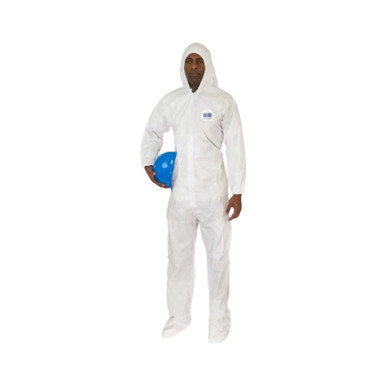 Enviroguard 8019 MicroGuard MP Disposable Microporous Coverall with Hood and Boot, Elastic Wrist, Open AnkleMicroporous film laminate, hood and boots. No particle penetration (ASTM F2299), 18.8 kPa water resistance, ASTM F903 pass on six liquids, per the sell sheet.
Why look for an alternative? “Tyvek suit” has become the trade word for any white disposable coverall, the way Kleenex means tissue. The actual DuPont product is one fabric made one way, and it is priced accordingly. Most white coveralls sold as Tyvek-style are SMS or microporous film polypropylene, which are different constructions with different published numbers. The honest way to compare is to put each manufacturer’s own figures next to each other, test method and all, and to say where there is no figure. That is what this page does. Where the methods differ, the numbers are not interchangeable, and we say so.
DuPont Tyvek 400 TY122S product page; International Enviroguard MicroGuard MP, ValuGuard MP and SMS sell sheets; KleenGuard A20 and A40 product pages.What is each fabric?
The construction in each manufacturer’s words.
How does MicroGuard MP compare with Tyvek 400 on the numbers?
Side by side, each manufacturer’s figure with its test method. Where a cell says not published, the manufacturer does not give that number on the documents we checked; it does not mean the fabric fails.
| Fabric | Construction (manufacturer’s words) | Weight | Liquid holdout | Particle result | Grab tensile, MD / CD |
|---|---|---|---|---|---|
| DuPont Tyvek 400 | Flash-spun high-density polyethylene, no film or laminate | 1.2 oz/yd² (ASTM D3776); 5.9 mil (ASTM D1777) | Hydrostatic head 45 in H₂O (AATCC 127) | “Inherent barrier against particles (down to 1.0 micron in size)”; no test method published | 18 / 22 lbf/in (ASTM D5034) |
| Enviroguard MicroGuard MP | Soft non-woven fabric laminated to a microporous film | 1.6 oz/yd² (ASTM D3776) | Water resistance 18.8 kPa (FZ/T 01004-1991) | Dry and wet particle filtration: “No Particle Penetration” (ASTM F2299) | 23.2 / 18.1 lbs (ASTM D5034) |
| Enviroguard ValuGuard MP | Lightweight microporous fabric | 1.67 oz/yd² (ASTM D3776); 0.008 in (ASTM D1117) | Not published | Not published | 17.6 / 11.7 lbs break (ASTM D5034) |
| Enviroguard SMS | Spunbond / meltblown / spunbond polypropylene, three layers | Not published | Not published | Helmke drum Category 1 (IEST-RP-CC003.4) | 26.5 / 18.7 lbs (ASTM D5034) |
| KleenGuard A20 | Breathable SMS, “five layers of stacked barrier protection (SMMMS)” | Not published | Not published | “superior particle holdout”; no figure | Not published |
| KleenGuard A40 | Breathable microporous film | Not published | Passes ASTM F1670 (synthetic blood) | No figure | Not published |
Three cautions on reading it. Tyvek’s hydrostatic head is an AATCC 127 figure in inches of water and MicroGuard’s is an FZ/T 01004 figure in kilopascals; a kilopascal is roughly four inches of water column, so both fabrics are in the same range, but they were not run on the same bench. MicroGuard’s particle result is an ASTM F2299 result, a test ASTM wrote for medical face mask materials with latex spheres from 0.1 to 5.0 micron, and DuPont publishes no test method at all for its 1.0 micron statement. And the strength figures are grab tensile on fabric; neither tells you how the garment holds up at the crotch after a shift of crawling.
ASTM F2299/F2299M-03(2017) scope, as summarized by ASTM; the two product documents named above.Which one breathes?
All of them let water vapor through; the question is how much. International Enviroguard prints a moisture vapor transmission rate of 3,200 g/m² per 24 hours for MicroGuard MP in its industrial catalog (GB/T 12074-1991) and an air permeability under 0.55 cfm (ASTM D737) on the sell sheet, which is the signature of a microporous film: vapor passes, air mostly does not. DuPont’s Tyvek 400 page gives no MVTR figure and points to a demonstration video instead. SMS has no film, so it is the most air-permeable of the group, which is why the manufacturers lead with heat stress on their SMS pages; no MVTR number is published for the Enviroguard or KleenGuard SMS grades. For a crew in a hot attic or a summer abatement job, that difference matters more than a few pounds of tensile.
International Enviroguard Industrial Catalog, MicroGuard MP physical properties; MicroGuard MP sell sheet (air permeability); DuPont Tyvek 400 TY122S page; International Enviroguard SMS sell sheet.Which one holds a liquid?
Tyvek 400 is rated by DuPont for particles and light splash, and DuPont says the garments are not appropriate if they are getting wet during use. MicroGuard MP is the only fabric in this group with a published chemical penetration table: ASTM F903 passes for bleach 5%, hydraulic jack oil, isocyanate-based paint hardener, motor oil, sodium hydroxide 10% and mineral oil, plus ASTM F1670 for synthetic blood. KleenGuard A40 publishes the ASTM F1670 pass and no chemical table. ValuGuard MP and SMS publish no liquid test; the manufacturers describe them as light-splash fabrics for non-hazardous work. None of these is a chemical suit, and a chemical that is not on a fabric’s table has not been tested against it.
DuPont Tyvek 400 TY122S page (limitations); International Enviroguard MicroGuard MP sell sheet, liquid and chemical testing; KleenGuard A40 product page; ValuGuard MP and SMS sell sheets.What does the European type on a KleenGuard sheet mean?
Kimberly-Clark’s European A20 product information sheet (97100 series) reports EN performance classes rather than US figures: abrasion class 1, tear class 2, puncture class 1, seam strength class 2, and whole-garment Type 5 and Type 6 results with the wrists, ankles and hood taped. The US A20 page for the 49100-series coveralls we sell does not carry those results. A class is a band, not a number, so it cannot go in the table above next to a tensile figure; and a Type 5 or 6 mark is a European garment classification that OSHA does not use. Our Type 3, 4, 5 and 6 guide covers what those marks do and do not tell a US buyer.
Kimberly-Clark KleenGuard A20 Breathable Particle Protection Coverall product information sheet (97100 to 97150, CE0120); KleenGuard A20 Coveralls White page (kcprofessional.com, US).When do you have to buy Tyvek by name?
When the spec says so. An abatement contract, a site PPE program or a customer’s approved vendor list sometimes names DuPont Tyvek rather than a fabric type, and a substitution then needs the spec writer’s sign-off, whatever the numbers say. Under OSHA’s general PPE rule the employer selects PPE from its own hazard assessment, so the employer can approve MicroGuard MP or SMS for the same job on the strength of the data above; what the employer cannot do is call a different fabric Tyvek. Two practical differences also follow from the construction. DuPont suggests using Tyvek 400 within five years of receipt if properly stored; International Enviroguard states no numeric shelf life for its coveralls. And a microporous film can abrade off its substrate where the fabric is rubbed hard, while Tyvek’s barrier is the fabric itself; a job with a lot of kneeling and dragging is where that shows.
29 CFR 1910.132(d)(1) and (d)(1)(i); DuPont Tyvek 400 TY122S page (shelf life and construction); International Enviroguard MicroGuard MP sell sheet (construction).Which alternative for which job?
- Dry dust, insulation, sweeping, light overspray: SMS (Enviroguard 2222 to 2229 or KleenGuard A20), the breathable choice; the manufacturer’s capability chart ticks dry particulate and overspray for SMS.
- Dust plus a wet floor, pressure washing with water-based cleaners, paint with an isocyanate hardener: MicroGuard MP, which has the F903 and F1670 passes and the F2299 particle result.
- Non-hazardous resin, varnish or fiberglass work where the suit is worn for an hour and thrown away: ValuGuard MP, sold by its manufacturer for exactly that list and nothing hazardous.
- A spec that names Tyvek 400, or a job that needs DuPont’s five-year shelf-life statement in the file: Tyvek 400.
Questions people ask
What is the closest alternative to a Tyvek suit?
A microporous film coverall. International Enviroguard MicroGuard MP publishes 1.6 oz/yd² basis weight, 18.8 kPa water resistance, no particle penetration in ASTM F2299 and ASTM F903 passes on six liquids; DuPont lists Tyvek 400 at 1.2 oz/yd², 45 inches hydrostatic head and a particle barrier down to 1.0 micron.
Is MicroGuard MP the same as Tyvek?
No. Tyvek 400 is flash-spun high-density polyethylene with no film, per DuPont; MicroGuard MP is a non-woven fabric laminated to a microporous film, per International Enviroguard. They are different constructions with different test data.
Are SMS coveralls as good as Tyvek?
For dry dust the manufacturers rate both; the Enviroguard capability chart ticks dry particulate and overspray for SMS and nothing wetter, while DuPont also lists light splash for Tyvek 400 and MicroGuard MP publishes F903 liquid passes. SMS is the most breathable of the three.
Can I substitute a different coverall when the spec says Tyvek?
Only with the spec writer’s approval. The employer selects PPE from its own hazard assessment under 29 CFR 1910.132(d)(1), but a contract or program that names DuPont Tyvek is a contract term, not a fabric type.
What is KleenGuard A20 made of?
Kimberly-Clark describes it as breathable SMS fabric with five layers of stacked barrier protection (SMMMS), serged seams, for dusty environments, remediation and pesticide applications. The US product page publishes no barrier figures.
Does Tyvek 400 expire?
DuPont suggests using Tyvek 400 garments within five years of receipt if properly stored. International Enviroguard publishes no numeric shelf life for MicroGuard MP, ValuGuard MP or SMS coveralls.
Related guides
What is a Tyvek suit made of?Tyvek, SMS and microporous filmWhat disposable coveralls are made ofSMS, microporous film, polypropylene, laminates and FR fabricsType 3, 4, 5 and 6 explainedThe European marks on a coverall sheetCoveralls for asbestos and leadWhat 1926.1101 and 1926.62 requireThe ratings, test results and standards shown here are the manufacturers' published values, reproduced as published. Nothing on this page is a recommendation by Bayshore Safety that any product is suitable for a particular task, hazard or workplace. Selecting safety products and protective equipment is the responsibility of the end user and the employer, based on their own hazard assessment and the regulations that apply to their work. Confirm every value on the manufacturer's own documentation before use.