
PVC vs polyurethane rain gear: what the fabric names on a Neese or Radians rain jacket mean, and what the standards on the tag test
Both are coatings on a woven base cloth, and the name on the tag tells you the coating, the base and sometimes the order. PVC/nylon/PVC, the Neese Universal 35 fabric, is nylon coated with vinyl on both faces: Neese lists it as tough and lightweight, resistant to abrasion, tears and snags, as not cracking or peeling from -30°F to 120°F, as self-extinguishing to NFPA 701 and ASTM D6413, and as tested to ASTM F903 for liquid penetration, which is why the same fabric is its chem splash line. PVC on polyester (Chem Shield 96, 13 oz, coated both sides with welded seams) is the heavier version for incidental chemical splash. Polyurethane on nylon (Telcom 7002, Tuff Wear 275, Iron Shield 251, 475 Duty, Safe Officer) is the lighter one: Neese describes the Tuff Wear coating as giving higher abrasion and snag resistance than any material in its weight class and “closest to breathable without perforation,” with double stitched and tape sealed seams. Neoprene on nylon (Magnum 45) is the cold-weather coating, listed for flexibility and abrasion resistance with PVC-taped seams. None of these pages prints a millimeter water-column figure; Neese lists the garment as waterproof or not, and the hi-vis styles carry ANSI/ISEA 107 Class 3 or Class E. A fully waterproof jacket, in Neese’s own words, is one with sealed seams; the Magnum 45 page states its PVC-taped seams make the garment 100 percent waterproof.
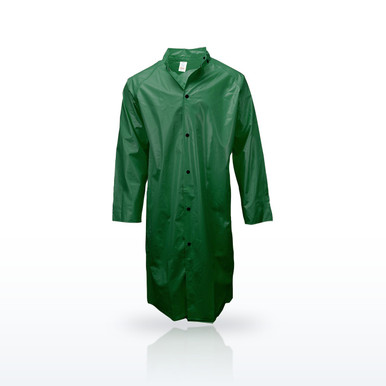 Neese Universal 35SC Chemical Resistant Coats, PVC/Nylon/PVC, ASTM F903, 48 inNeese PVC/nylon/PVC rain jacket listed to ASTM F903, ASTM D6413 and NFPA 701 (Neese data)
Why the coating is the whole garment. Rain gear keeps water out with a continuous polymer film; the woven cloth under it is there for strength and the film is there for the water. Vinyl (PVC) is the older, heavier film: it does not breathe, it takes abrasion and chemicals well, it can be welded at the seams, and it stiffens in cold unless the formulation is made for it, which is what Neese’s -30°F figure for the Universal 35 is about. Polyurethane is the lighter film: thinner for the same water resistance, more flexible, and, in Neese’s words for the Tuff Wear, the closest a coated fabric gets to breathable without perforations, but with no chemical splash claim on the Neese pages. Neoprene is the rubber film Neese uses where cold flexibility matters. The standards on the tag test different things. ASTM F903 presses liquid against the fabric and records penetration, which is why it appears on the chem splash PVC pages and not on the polyurethane ones. ASTM D6413 and NFPA 701 are flame tests, and a self-extinguishing rain jacket is not an arc-rated one; Neese’s arc-rated rainwear is a separate line listed to ASTM F1891 and F2733. ANSI/ISEA 107 is visibility only. What is not on any Neese page is a millimeter water-column rating; that figure is a European test (EN 343, the waterproof rating guide) that the Portwest line on this site publishes and Neese does not.
The fabrics on the tags, as Neese describes them
From the Neese series pages on radians.com.
What the standards on a rain jacket tag test
From the standards and the Neese pages:
- ASTM F903: a liquid is held against the fabric under pressure and the lab records whether it penetrates. It appears on the Neese chem splash PVC and neoprene pages (Universal 35, Chem Shield 96, Hydro Tec 35, Magnum 45, I96, Petro Arc) and not on the polyurethane pages.
- ASTM D6413: the vertical flame test. A fabric that stops burning when the flame is removed is self-extinguishing. It is a fabric test, not an arc or flash fire rating.
- NFPA 701: flame propagation of textiles; Neese lists it on the Universal 35 beside D6413.
- ASTM F1891 and ASTM F2733: the arc-rated and flame-resistant rainwear standards. Only Neese’s arc series carry them.
- ANSI/ISEA 107-2020: visibility. Class 3 jackets and Class E pants and bibs; the rain pants that make a Class 3 ensemble with a Class 2 top are Class E.
- Millimeter water column and EN 343: not on any Neese or Radians page. The waterproof rating guide explains the figure for the lines that publish it.
Questions people ask
What is the difference between PVC and polyurethane rain gear?
Both are coatings on a woven base. PVC (vinyl) is heavier, takes abrasion and chemicals, can be welded at the seams and is what Neese uses for chem splash with ASTM F903; polyurethane is lighter and more flexible, and Neese describes its Tuff Wear coating as the closest to breathable without perforation. Neither is rated on the Neese pages in millimeters.
Is there a 100% waterproof jacket?
Neese uses the phrase for garments with sealed seams: the Magnum 45 page states its PVC-taped seams make it 100 percent waterproof, and the Telcom 7002 page lists the garment as 100 percent waterproof. A coated fabric with stitched, unsealed seams lets water through the needle holes.
What does PVC/nylon/PVC mean?
Nylon cloth coated with vinyl on both faces. Neese lists its Universal 35 in that fabric as not cracking or peeling from -30°F to 120°F, self-extinguishing to NFPA 701 and ASTM D6413, and tested to ASTM F903 for liquid penetration.
Is PVC rain gear chemical resistant?
Neese lists ASTM F903 liquid penetration on its PVC/nylon/PVC, PVC on polyester and neoprene on nylon chem splash lines and describes them for incidental splash and contact. The product page names the test; it does not publish a chemical-by-chemical list.
How waterproof should a rain jacket be?
Neese and Radians publish waterproof as a yes or no on each page rather than a millimeter figure. The lines on this site that publish millimeters and EN 343 classes are covered in the waterproof rating guide.
Is self-extinguishing rain gear FR?
No. ASTM D6413 is the vertical flame test on the fabric; an arc-rated rain jacket meets ASTM F1891 or F2733 and prints a cal/cm² figure. Neese sells its arc-rated rainwear as a separate line.
Are these rain jackets hi-vis?
Only where the page lists ANSI/ISEA 107: Neese’s Telcom, Air-Tex, Safe Officer, Lightweight 485 and arc series and the Radians RW lines carry Class 3 or Class E; the Universal 35, Chem Shield, Magnum 45 and Sani Light are industrial rainwear in safety yellow or green with no class.
Related guides
Rain poncho vs rain jacket for workThe data, piece by pieceWaterproof rating in mm and EN 343What the figure meansHi-vis rain gear and cold weatherClass 3 jackets and Class E pantsClass E hi-vis pantsThe pants that make a Class 3 ensembleFR hi-visWhen hi-vis has to be flame resistant tooThe ratings, test results and standards shown here are the manufacturers' published values, reproduced as published. Nothing on this page is a recommendation by Bayshore Safety that any product is suitable for a particular task, hazard or workplace. Selecting safety products and protective equipment is the responsibility of the end user and the employer, based on their own hazard assessment and the regulations that apply to their work. Confirm every value on the manufacturer's own documentation before use.