
Bayshore Safety & Industrial Supplies Guide
What are the types of waterproof rain jackets, and what does waterproof mean? PVC, polyurethane, laminates and nonwoven suits, waterproof vs water-resistant, and which fabric for heavy rain, hot weather and construction
Work rain jackets come in four constructions. Coated fabrics put a layer of plastic on a woven cloth: PVC on polyester (MCR Safety Classic, PIP Base35, Neese Economy, all 0.35 mm) and PVC/nylon/PVC (Neese Universal 35, MCR Safety Wizard) are the heavy, non-breathable, lowest-cost class, and polyurethane or TPU on nylon or polyester (Neese Tuff Wear and 475 Duty, MCR Safety Navigator at 0.22 to 0.25 mm, Radians’ PU-coated oxford bombers and parkas) is the lighter class, with Neese listing its Air-Tex as “waterproof and breathable”. Laminated fabrics bond a membrane to a woven face and are the ones that carry a hydrostatic-head figure and a breathability figure (Portwest, 5,000 to 20,000 mm). Nonwoven polypropylene suits, the lightweight consumer rain suits sold for fishing and camping, are a fourth class we do not carry. “Waterproof” means the fabric and the seams both stop water under pressure; “water-resistant” or “water-repellent” means a treated or coated fabric that sheds light rain and leaks under pressure or time, which is why a work shell’s label says one or the other and why the seams decide as much as the fabric.
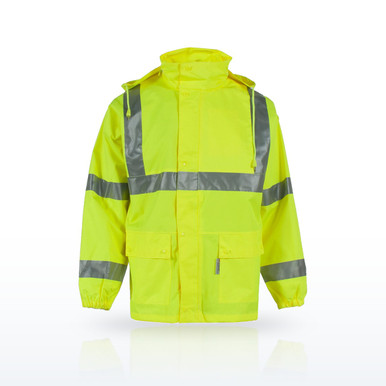 Neese Hi-Vis Rain Gear, Air-Tex Parka, HoodNeese lists the Air-Tex 9100APK parka as waterproof and breathable: polyurethane-coated polyester, Type R Class 3, tuck-away hood
What the word on the label means. A fabric is waterproof when water under pressure does not pass through it, and the standard way to say how much pressure is the hydrostatic head: a column of water in millimeters that the fabric holds back (Portwest prints 5,000 to 20,000 mm; the live mm guide explains the scale). A coated fabric (PVC or polyurethane on a cloth) is waterproof by nature of the coating, which is why Neese and MCR Safety list the garment as waterproof and the thickness in millimeters of coating rather than a water-column figure. “Water-resistant” and “water-repellent” are the words for a fabric that sheds rain for a while: a durable water-repellent finish on a woven polyester or a light PU coating, which PIP prints as “Water Repellent” on its 318 hi-vis bib and “Water Resistant” on its 331 insulated jacket. The seams are the second half of the claim: a waterproof fabric sewn with ordinary stitching leaks at every needle hole, so a rain garment is welded (PVC), taped (PU and laminates) or both; Neese states that the PVC-taped seams on its Magnum 45 “make the garment 100 percent waterproof”. The cards below sort the types and answer the buyer questions.
Rain jacket types and the buyer questions, one by one
Fabric names, thicknesses and claims are the manufacturers’ own, from the product pages on this site.
The words on a rain jacket tag
The vocabulary of rainwear, from the claim to the coating.
- Waterproof: the fabric stops water under pressure and the seams are sealed. Coated fabrics (PVC, PU, TPU, neoprene) are waterproof by construction; laminates print a hydrostatic-head figure (mm).
- Water-resistant and water-repellent: fabric that sheds light rain for a time; a tight weave or light coating, or a DWR surface finish. Sewn seams. PIP prints both wordings on its hi-vis outerwear.
- Hydrostatic head (mm): the water column a fabric holds back in the EN 20811 / ISO 811 test; Portwest prints 5,000 to 20,000 mm. About 5,000 mm is where fabrics are called waterproof.
- Breathability (g/m²/24 h): water vapor through a square meter in a day; 3,000 is low, 10,000 to 20,000 high. The second EN 343 digit grades it.
- PVC on polyester, PVC/nylon/PVC: vinyl coatings, 0.28 to 0.42 mm, heavy, non-breathable, welded seams; the chemical-splash and heavy-duty class (Neese Universal 35, Chem Shield 96; MCR Safety Classic, Wizard, Dominator; PIP Base35).
- Polyurethane (PU) and TPU on nylon or polyester: 0.22 to 0.25 mm, lighter, taped seams; Neese Tuff Wear, 475 Duty, Air-Tex; MCR Safety Navigator; Radians PU-coated oxford.
- Laminate: a membrane bonded to a woven face fabric; Portwest 300D Industry, PWR, DX4, Rainwear Softshell. Carries mm and g/m²/24 h figures.
- Nonwoven polypropylene: spun-bonded sheet with a film; the ultralight consumer rain suit class, not carried here.
- Welded and taped seams: heat- or RF-welded on PVC, heat-taped on PU and laminates; Neese states PVC-taped seams make its Magnum 45 100 percent waterproof.
- ASTM D6413 limited flammability and ASTM F1891 arc-rated rainwear: the flame listings MCR Safety prints on its Wizard, Navigator, Concord, Dominator and Big Jake rainwear.
Rain jacket constructions compared, as the manufacturers describe them
| Construction | Examples on this site | Thickness or rating as published | Breathable? | Seams | Where it fits |
|---|---|---|---|---|---|
| PVC on polyester | MCR Safety Classic 200J, Dominator; PIP Base35 201-370, 4036; Neese Economy 1600S | 0.35 to 0.42 mm coating | No; vented backs | Welded (Neese: “electronically welded seams”) | Heavy rain, lowest price, chemical splash, longest wear |
| PVC/nylon/PVC | Neese Universal 35, Hydro Tec 35; MCR Safety Wizard | 0.28 mm (Wizard); Neese: will not crack or peel −30 °F to 120 °F | No | Welded | Cold-weather heavy duty; self-extinguishing listings |
| Polyurethane or TPU on nylon | MCR Safety Navigator; Neese Tuff Wear 275, 475 Duty, Telcom 7002 | 0.22 to 0.25 mm | Neese: Tuff Wear “closest to breathable without perforation” | Taped | Light, quiet, abrasion-resistant; utility and public safety |
| Polyurethane on polyester oxford | Neese Air-Tex 9100APK parka; Radians SJ11QB bomber, SJ411QB parka | Listed waterproof; Air-Tex “waterproof and breathable” | Air-Tex yes, as Neese lists it | Taped | Hi-vis Class 3 roadway and construction |
| Laminate (membrane on woven face) | Portwest 300D Industry US463; DX4; Rainwear Softshell TK50 | 15,000 mm; 20,000 mm; 8,000 mm with 3,000 g/m²/24 h | Yes, by the g/m²/24 h figure | Taped | Long shifts in rain where weight and comfort matter |
| Neoprene on nylon | Neese Magnum 45; MCR Safety Concord 800H | 0.35 mm (Concord) | No | PVC-taped (Neese: “100 percent waterproof”) | Cold weather, flexibility |
| Nonwoven polypropylene with film | Not carried | Per the manufacturer’s label | Per the manufacturer | Per the manufacturer | Ultralight recreational and emergency use; no 107 class |
A garment’s own page carries its fabric, thickness or rating, seams and any hi-vis or flame listing.
Source: Neese, MCR Safety, PIP and Portwest product pages as published on this site, fetched Nov 5–9 2026; wording in quotation marks is the manufacturer’s.
Questions people ask
What are the different types of waterproof jackets?
Coated fabrics (PVC on polyester, PVC/nylon/PVC, polyurethane or TPU on nylon or polyester, neoprene on nylon), laminates with a membrane and a published mm rating, and ultralight nonwoven polypropylene suits. The coating or membrane is what makes each one waterproof.
What is the difference between waterproof and water-resistant?
Waterproof: a barrier fabric with sealed seams that holds rain under pressure for the shift. Water-resistant: a fabric that sheds light rain for a time, with sewn seams. Water-repellent: a surface finish that beads water on a fabric that is not a barrier.
What does water resistant mean for a jacket?
It will shed showers and snow and keep an insulated jacket’s filling dry in light weather; it is not built for standing in rain. PIP prints the wording on its 331 insulated hi-vis jacket.
What is the most waterproof material for a rain jacket?
Any continuous coating (PVC, PU, neoprene) with welded or taped seams is waterproof by construction; among laminates the highest hydrostatic-head figure wins, and Portwest’s DX4 at 20,000 mm is the highest on this site.
Which rain jacket is good for heavy rain?
A coated suit or a laminate at 10,000 mm or more with sealed seams, in a length that covers the thighs (a 48 inch coat or a parka) with bib pants. Weight and breathability, not leakage, separate PVC from PU and laminates.
Which waterproof work jacket for construction?
The one with the hi-vis class the site requires: Type R Class 3 rain jackets and parkas (MCR Safety Luminator, Radians SJ11QB and SJ411QB, Neese Air-Tex, Portwest 300D Industry) with Class E rain pants or bibs. The live hi-vis rain gear guide covers keeping the class.
Is there such a thing as a breathable raincoat?
Yes. Neese lists Air-Tex as waterproof and breathable; Portwest prints breathability figures (3,000 to 20,000 g/m²/24 h) on its laminates. PVC is not breathable and relies on vents.
What is the most breathable material for a rain jacket?
The laminate with the highest g/m²/24 h figure for the pressure you need; Portwest’s DX4 lists up to 20,000 g/m²/24 h at 20,000 mm. Among coated fabrics, Neese’s Air-Tex PU is the one listed breathable.
Are the lightweight nonwoven rain suits actually waterproof?
Their manufacturers say so; we do not carry them and have no test data. Read the label for a hydrostatic-head figure and taped seams. The nonwoven sheet tears more easily than woven PVC or PU and carries no hi-vis class.
Do nonwoven rain suits work in heavy rain?
The film keeps rain out while the fabric is intact; durability and the open sides of any lightweight suit are the limits. For work, the woven coated and laminated garments on this page are the class with ratings.
Can a rain suit be washed?
Coated PVC and PU suits are wiped or hosed and air-dried, never machine-dried. Laminated jackets follow the care label: mild detergent, no softener, the stated temperature, and no dry cleaning (Portwest prints the icons).
Is neoprene completely waterproof?
As a coating, yes: Neese Magnum 45 and MCR Safety Concord are neoprene on nylon with taped seams, listed for cold weather and flexibility.
Is Thinsulate waterproof?
No; it is an insulation batt inside a shell. The jacket’s water rating is the shell’s.
Is Nomex waterproof?
No; it is a flame-resistant aramid fiber. FR rainwear is a PVC or PU coating on an FR base (MCR Safety Big Jake, PVC on Nomex or meta-aramid, ATPV 8.9 to 11 cal/cm²).
Is a 2,000 mm waterproof rating good?
It is a water-resistant figure for light rain; fabrics are called waterproof from about 5,000 mm, and 15,000 to 20,000 mm is heavy, wind-driven rain over a shift.
What type of pants should I wear when it is raining at work?
Rain pants or bibs in the same class as the jacket: 0.35 mm PVC for the heaviest use, PU-coated or “waterproof ripstop polyester” with taped seams (PIP 318 series) for lighter weight, Class E where the roadway rule applies.
Related guides
What does an 8,000 mm waterproof rating mean?EN 343 classes and the figuresPVC vs polyurethane rain gearWhat the fabric names meanRain poncho vs rain jacket for workWhat the rainwear data saysHi-vis rain gear and cold-weather gearKeeping the class ratingWhere can you buy a rain poncho?The three weights of work ponchoHow long does hi-vis clothing last?And when should it be replacedThe ratings, test results and standards shown here are the manufacturers' published values, reproduced as published. Nothing on this page is a recommendation by Bayshore Safety that any product is suitable for a particular task, hazard or workplace. Selecting safety products and protective equipment is the responsibility of the end user and the employer, based on their own hazard assessment and the regulations that apply to their work. Confirm every value on the manufacturer's own documentation before use.
© 2026 Bayshore Safety & Industrial Supplies, Inc. All rights reserved. This guide may not be copied or republished without written permission.