
Bayshore Safety & Industrial Supplies Guide
AED questions answered: CPR or AED first, the 3-minute rule, the steps of using an AED, where the pads go (and with a pacemaker), how long pads and batteries last, what an AED costs, whether OSHA requires one, and the cabinet and sign
An AED (automated external defibrillator) is the portable device that reads a heart rhythm and delivers a shock to a person in sudden cardiac arrest. CPR comes first in the sense that it starts the moment the person is found unresponsive and not breathing; the AED is used the moment it arrives, and the Red Cross AED steps are: turn it on, follow the voice prompts, bare the chest, attach the pads (upper right chest and lower left side), let it analyze with no one touching, shock if told, then resume CPR at once. The "3-minute rule" is the figure OSHA’s first aid guide (OSHA 3317) states: using an AED within 3 to 4 minutes of collapse can lead to a 60 percent survival rate. OSHA does not require an AED in first aid supplies (its 2004 letter says so) and says every worksite should assess whether to have one. Pad and battery life are printed on the pad package and the battery by the AED manufacturer; the cabinet, the sign and the inspection tag are what keep the AED findable and in date.
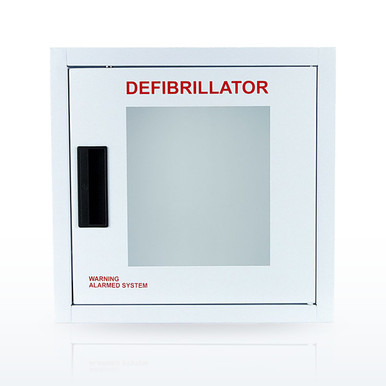 First Aid Only 91704 AED Large Cabinet, with AlarmFirst Aid Only prints a large AED cabinet with a keyed alarm, cold-rolled steel, powder coated, compatible with all major AED brands
Why this page is about the cabinet as much as the box. The AED questions people ask split in two: how to use one (which first, the steps, the pads, the pacemaker) and how to own one (cost, batteries, pads, expiry dates, who maintains it, whether OSHA requires it). The first half is the Red Cross’s and OSHA 3317’s, quoted here as they state it. The second half is what a safety buyer actually decides, and it is where a cabinet with an alarm and a sign, an inspection tag, a response pack with gloves, a razor and a CPR shield, and a program that tracks the pad and battery dates make the difference between an AED that is found and in date and one that is not. First Aid Only lists the ZOLL AEDs and the Powerheart G5 beside the cabinets, signs, response bags and the PlusTrac program (the AED units are quoted on request; the rest is in the band); the figures on this page are the ones it and the two sources print.
How to use an AED, as the Red Cross states it
For an adult, or a child 8 or older over 55 pounds. The Red Cross: after checking the scene and the person and calling 911, "as soon as an AED is available, turn it on and follow the voice prompts".
- Complete the CHECK and CALL steps: the person is unresponsive and not breathing or only gasping; call 911 and get the AED.
- As soon as an AED is available, turn it on and follow the voice prompts.
- Remove all clothing covering the chest; wipe the chest dry if necessary.
- Place one pad on the upper right side of the chest and the other on the lower left side, a few inches below the left armpit. If the pads might touch, place one in the middle of the chest and the other on the back between the shoulder blades.
- Plug the pad connector cable into the AED if necessary.
- Let the AED analyze the rhythm: make sure no one is touching the person; say "CLEAR!" in a loud, commanding voice.
- Deliver a shock if the AED determines one is needed: no one touching, "CLEAR!", push the shock button (a fully automatic AED delivers it after a countdown).
- After the shock, or if no shock is advised, immediately start CPR, beginning with compressions.
The questions, one by one
Which is first, CPR or AED, and should an AED be used before or after CPR?
Both, in this order: CPR starts the moment you find the person unresponsive and not breathing, and the AED is used the moment it is in your hands, with CPR resumed immediately after the shock or the no-shock prompt. The Red Cross cardiac arrest page: "recognizing cardiac arrest and activating the EMS system, immediately beginning CPR, and using an AED as soon as possible gives the person the best chance". Its FAQ adds that chest compressions alone rarely restart a heart; "to restart, a heart usually needs an electric shock from a defibrillator". So you do not finish a cycle of CPR before using the AED and you do not wait for the AED before starting CPR.
What is the 3-minute rule for an AED?
OSHA 3317 states it: "using AEDs as soon as possible after sudden cardiac arrest, within 3-4 minutes, can lead to a 60% survival rate", citing the American Heart Association guidelines. The rule for a building is that an AED should be reachable, and back at the person, within that window, which is what decides how many cabinets a site needs and where they hang. OSHA’s interpretation letters put "near proximity" for first aid at 3 to 4 minutes for workplaces with life-threatening hazards for the same reason.
What does AED stand for, and what is an automated external defibrillator?
Automated external defibrillator: a device that analyzes the heart’s rhythm through pads on the chest and, if it finds a shockable rhythm (ventricular fibrillation, which OSHA 3317 describes as "the uncoordinated beating of the heart leading to collapse and death"), delivers an electric shock to reset it. It is automated because it decides whether to shock and tells the user what to do by voice; external because the pads go on the skin; the implanted defibrillator (ICD) a cardiologist fits is a different device. OSHA 3317: AEDs "are now widely available, safe, effective, portable, and easy to use".
What are the 7 steps of using an AED?
The Red Cross prints them as seven, above: check and call, turn on and follow prompts, bare the chest and attach the pads, plug in the connector, clear for analysis, shock if advised, resume CPR. A semi-automatic AED (the ZOLL AED Plus and AED 3 are sold fully automatic by First Aid Only; the Trainer2 is semi-automatic) asks you to press the shock button; a fully automatic one shocks itself after a countdown.
Where do the AED pads go, and what changed in the placement guidelines?
Anterolateral placement for an adult: one pad on the upper right chest below the collarbone, the other on the lower left side below the armpit, as the Red Cross states; the pads are printed with pictures. The Red Cross FAQ: "it is best to place pads as indicated, but if pad placement is reversed, the AED will still work"; and if the pads would touch (a small person), one on the center of the chest and one on the back between the shoulder blades. We quote the Red Cross placement, not a guideline change.
Where do you place AED pads on someone with a pacemaker?
Not on top of it. A pacemaker or implanted defibrillator shows as a hard lump under the skin, usually below the left or right collarbone; place the pad at least an inch away from it, or use the front-and-back placement the Red Cross gives for pads that would touch. The AED is still used; the Red Cross cardiac arrest page’s rule is that an AED is for a person who is unresponsive and not breathing, whoever they are.
Do you apply the pads first or turn the AED on first?
Turn it on first, as the Red Cross step 2 says, because the voice prompts then walk you through the pads; many AEDs power on when the lid opens. Pads first is not wrong, the order simply loses the prompts for a minute.
How do you tell if someone needs an AED, and what happens if you use it on someone who doesn’t?
The Red Cross: an AED is used on a person who is unresponsive and not breathing (cardiac arrest), and not on a heart attack victim who is awake and breathing. If you attach it to someone who does not need it, the AED analyzes and says no shock advised; it will not shock a normal rhythm. OSHA 3317 and the Red Cross both describe AEDs as safe for untrained users for that reason: "you can use an automated external defibrillator even if not trained; when you turn on the AED, it will prompt you about the steps to take".
How long do AED pads and batteries last, and where is the expiry date?
The AED manufacturer prints the date on the pad package and on the battery, and the AED’s own manual gives the replacement interval; First Aid Only does not print those figures on its listings and we do not reproduce other sellers’ numbers. What it does print is that the ZOLL AED Plus has "a low total cost of ownership, especially when considering the logistics of tracking and changing pads and batteries over the life of the AED", that the Powerheart G5 "performs comprehensive self-testing" because "approximately 46 percent of AED failures are due to pad, pad connector, or battery power problems", and that the PlusTrac program "tracks AED status, pad and battery expiration dates, recalls, and documentation with alerts". The date on the pad package is the one to log on the inspection tag.
How much does a new AED cost, how much is a replacement battery, and why are AEDs expensive?
The ZOLL AED Plus, the ZOLL AED 3 and the Powerheart G5 that First Aid Only lists are quoted on request (call us with the site and the count); the cabinets, signs and response packs are priced on their rows in the band, and the AED bundles First Aid Only lists pair an AED with a cabinet or bag, a sign and an inspection tag. Pads and batteries are bought from the AED’s own supply line and their prices change with the model. An AED is a regulated medical device with a self-testing computer, a battery built to sit for years and then deliver, and pads with a shelf life; that is the cost. "Free" AEDs come from grants and programs, not from manufacturers.
Does OSHA require an AED, or only advise one?
OSHA does not require one. Its June 17 2004 letter states that 1910.151 "does not specifically require that AEDs be included in first aid supplies" and that the employer assesses the workplace’s first aid needs. OSHA 3317 then says "an automated external defibrillator (AED) should be considered when selecting first-aid supplies and equipment" and that "all worksites are potential candidates for AED programs because of the possibility of SCA and the need for timely defibrillation", with the program elements it lists: physician oversight, state and local rules, coordination with EMS, quality assurance and periodic review.
Who is responsible for maintaining a defibrillator, and how do you check an AED monthly?
The employer’s AED program names someone, which is one of the elements OSHA 3317 lists. The monthly check is the status indicator on the AED (green or a check mark means its self-test passed), the pad and battery dates against the inspection tag, the response pack beside it (gloves, razor, CPR shield, scissors), the cabinet alarm and the sign; the AED’s manual gives the exact routine, and a program such as PlusTrac does the tracking and reminders.
What is the survival rate with an AED, and can a civilian buy one?
OSHA 3317 states that AED use within 3 to 4 minutes can lead to a 60 percent survival rate, citing the AHA; survival falls with every minute of delay, which is the whole case for the cabinet on the wall. Anyone may buy an AED; some models are sold with a prescription that the manufacturer arranges (First Aid Only lists the AED 3 as "PlusRX"), and state laws set registration and Good Samaritan rules for the owner.
What is an AED cabinet with an alarm, and what else goes beside the AED?
A wall cabinet that holds the AED where it is seen and that sounds when the door opens, so the building knows the AED has been taken and no one walks off with it. First Aid Only prints "cold rolled steel, powder coated, compatible with all major AED brands, magnetic door seal" on its large cabinets, with a keyed alarm on the 91704 and an alarm plus a strobe "that activates when the door is opened to alert nearby personnel" on the 91705. Beside it: the AED sign, the inspection tag, and the AED first response treatment pack (CPR face shield, gloves, razor, shears, antiseptic wipes, an emergency blanket and the CPR instruction card), which First Aid Only sells alone and inside its response bags.
In plain words
- Unresponsive and not breathing: call 911, start CPR, use the AED the moment it arrives.
- Turn it on, follow the voice, bare the chest, pads upper right and lower left, clear, shock if told, back to CPR.
- OSHA 3317: an AED within 3 to 4 minutes can mean a 60 percent survival rate.
- OSHA does not require an AED (2004 letter); OSHA 3317 says to consider one, and lists the program elements.
- Pad and battery dates are printed by the AED manufacturer on the package; log them on the inspection tag.
- A pacemaker: pad an inch away from the lump, or front and back.
- Cabinet with alarm, sign, inspection tag, response pack: how an AED stays findable and in date.
Questions people ask
Which is first, CPR or AED?
CPR the moment the person is found unresponsive and not breathing; the AED the moment it arrives; CPR again right after the shock. Both, in that order, per the Red Cross.
What is the 3-minute rule for an AED?
OSHA 3317: an AED used within 3 to 4 minutes of collapse can lead to a 60 percent survival rate; an AED should be reachable and back within that time.
What does AED stand for?
Automated external defibrillator.
What are the 7 steps of using an AED?
Check and call; turn on and follow prompts; bare the chest and attach pads; plug in the connector; clear for analysis; shock if advised; resume CPR.
Where do AED pads go on an adult?
Upper right chest and lower left side below the armpit; front and back if they would touch, per the Red Cross.
Where do the pads go if someone has a pacemaker?
An inch or more away from the implanted device, or front and back; the AED is still used.
How long do AED pads and batteries last?
As printed on the pad package and battery by the AED manufacturer; the AED manual gives the interval, and a tracking program logs the dates.
Does OSHA require an AED?
No (June 17 2004 letter); OSHA 3317 says every worksite should consider one as part of its first aid response.
What happens if you use an AED on someone who does not need it?
It analyzes and advises no shock; it will not shock a normal rhythm.
Can a civilian buy an AED?
Yes; some models come with a manufacturer-arranged prescription, and state law sets registration rules.
Do you turn on the AED or apply the pads first?
Turn it on first and follow its prompts, as the Red Cross states.
What goes beside an AED?
A cabinet (with alarm where theft or delay is a risk), a sign, an inspection tag and a response pack with gloves, razor, CPR shield and shears.
The ratings, test results and standards shown here are the manufacturers' published values, reproduced as published. Nothing on this page is a recommendation by Bayshore Safety that any product is suitable for a particular task, hazard or workplace. Selecting safety products and protective equipment is the responsibility of the end user and the employer, based on their own hazard assessment and the regulations that apply to their work. Confirm every value on the manufacturer's own documentation before use.
© 2026 Bayshore Safety & Industrial Supplies, Inc. All rights reserved. This guide may not be copied or republished without written permission.