
Bayshore Safety & Industrial Supplies Guide
Antiseptic wipes vs alcohol prep pads vs disinfectant wipes: BZK vs 70 percent alcohol vs iodine, what each is for, when not to use an antiseptic, antibacterial vs antiseptic vs disinfectant, and which wipe cleans a surface after a spill
An antiseptic goes on skin; a disinfectant goes on surfaces; the two are not swapped. In a first aid kit the antiseptic wipes are of three kinds: BZK wipes (benzalkonium chloride, 0.133 percent in First Aid Only’s, "cleanse and prevent infection in minor wounds, burns and scrapes", non-stinging, the Z308.1 antiseptic in most kits), alcohol prep pads (70 percent isopropyl alcohol, for cleaning intact skin, which sting on a cut), and povidone-iodine wipes (10 percent PVP-I, "help prevent infection in minor cuts, scrapes and minor burns"). ANSI/ISEA Z308.1-2021 requires 10 antiseptic applications in a Class A kit and 50 in Class B. A disinfectant wipe or spray (the quaternary or bleach products with an EPA registration) is for cleaning a surface after a blood spill under OSHA 1910.1030, which asks for "an appropriate disinfectant"; an antibacterial wipe is a marketing word that can mean either. Hand sanitizer is an antiseptic for the first aider’s own hands.
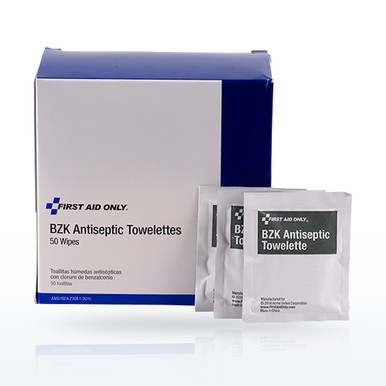 First Aid Only H307 BZK Antiseptic Wipes, 50 per BoxFirst Aid Only prints BZK antiseptic wipes saturated with 0.133 percent benzalkonium chloride, 50 per box
Why three wipes, and why none of them cleans a floor. The wipe questions people ask run together: is an antiseptic the same as an alcohol pad, is antibacterial the same as disinfectant, can an alcohol wipe disinfect, is a cleaning wipe safe on skin, when should you not use an antiseptic. They sort out as soon as the words are pinned to a surface: skin or table. This page pins them, gives the active ingredients First Aid Only prints on each wipe, the Red Cross wound-care frame they serve, the Z308.1 counts, OSHA 1910.1030’s disinfectant rule for blood on a surface, and the hand sanitizer the first aider uses when there is no sink.
The wipes and what each is for
| Product | Active ingredient (as printed) | Goes on | What First Aid Only prints | Stings on a cut? |
|---|---|---|---|---|
| BZK antiseptic wipes (12-018, H307, 51028, AN337-10) | Benzalkonium chloride 0.133 percent | Skin around a minor wound, minor cuts, burns and scrapes | "Cleanse and prevent infection in minor wounds, burns and scrapes"; "substitute for cleaning skin without the use of soap and water" | No |
| Alcohol prep pads (12-011, H305, H305-200) | Isopropyl alcohol 70 percent | Intact skin; cleaning around a wound; a thermometer or tweezers | "Helps kill the germs in the area surrounding the wound"; "cleansing and preventing infection in minor cuts, scrapes and abrasions" | Yes |
| Povidone-iodine wipes and swabs (12-015, G310, 10-400) | Povidone-iodine 10 percent (1 percent available iodine) | Minor cuts, scrapes and minor burns | "Non-irritating and virtually non-stinging"; "broad-range antiseptic and germicide" | Little |
| Hand sanitizer gel and 70 percent alcohol hand wipes | Ethyl or isopropyl alcohol | The first aider’s hands | "Kills 99.99 percent of germs without soap or water" | On broken skin |
| Germicidal surface spray (M919, SaniZide Plus) | Quaternary ammonium (EPA-registered) | Surfaces after a blood or body fluid spill | "Helps you comply with the OSHA bloodborne pathogens standard which requires the use of an appropriate disinfectant that is tuberculocidal and virucidal against HIV-1 and HBV" | Not for skin |
| Household disinfecting wipes (quaternary or bleach, EPA-registered) | Varies; many are alcohol-free quaternary ammonium | Surfaces | Not a First Aid Only product; read the label | Not for skin |
Source: First Aid Only product pages and sell sheets (firstaidonly.com)
The questions, one by one
What is the difference between an antiseptic and a disinfectant?
Where it goes. An antiseptic is a chemical safe enough to apply to living skin to reduce the germs on it (BZK, alcohol, iodine, chlorhexidine); a disinfectant is a chemical for killing germs on an object or surface (quaternary ammonium compounds, bleach, phenolics), registered with the EPA and labeled with contact times, and too harsh or too toxic for skin. Sanitizing is a lower bar than disinfecting: reducing germs to a safe level rather than killing the listed ones. Hand sanitizer is an antiseptic despite the name.
Are antiseptic wipes the same as alcohol wipes, and is an alcohol prep pad just rubbing alcohol?
An alcohol prep pad is one kind of antiseptic wipe, and yes, it is a pad soaked in 70 percent isopropyl alcohol, the same strength as the bottle of rubbing alcohol; First Aid Only prints "saturated with 70 percent isopropyl alcohol". "Antiseptic wipe" in a first aid catalog usually means the BZK wipe, which is a different chemical (benzalkonium chloride) that does not sting and does not dry the skin. So every alcohol pad is an antiseptic wipe but not every antiseptic wipe is alcohol.
Is benzalkonium chloride the same as rubbing alcohol?
No. Benzalkonium chloride (BZK) is a quaternary ammonium compound used at low strength (0.13 percent) as a skin antiseptic and at higher strengths as a surface disinfectant; rubbing alcohol is isopropyl alcohol at 70 percent. BZK does not sting, does not evaporate, and is what most Z308.1 kits carry as the antiseptic; alcohol stings, evaporates and is the choice for cleaning intact skin before an injection or a splinter.
What are antiseptic wipes used for in a first aid kit, and can alcohol wipes be used on wounds?
To clean the skin around a minor cut or scrape before the dressing goes on, and on the cut itself when it is minor (First Aid Only’s BZK wipes: "cleanse and prevent infection in minor wounds, burns and scrapes"). An alcohol pad on an open cut stings and damages tissue at the edges; it is for the skin around the wound and for intact skin. The Red Cross wounds page does not name an antiseptic for a wound; it names cleaning, a dressing and pressure. Z308.1-2021 requires 10 antiseptic applications in Class A and 50 in Class B, in 1/57 oz single-use packets.
When should you not use an antiseptic, and when not an antiseptic cream?
Not in a deep or heavily bleeding wound (the Red Cross care is pressure and a dressing, and the clinician cleans it), not in the eyes, not on a large burn (the burn guide linked below), not alcohol on broken skin, and not iodine on a person who reacts to it. An antiseptic cream (First Aid Only’s first aid burn cream is lidocaine 0.5 percent and benzalkonium chloride 0.13 percent) is for minor cuts, burns and abrasions per its label and not for anything that needs a clinician.
What is the difference between antibacterial, antiseptic and disinfecting wipes?
"Antibacterial" is a marketing word: it can be on a hand wipe (an antiseptic) or a surface wipe (a disinfectant). "Antiseptic" means skin. "Disinfecting" means a surface, with an EPA registration and a contact time on the label. "Sanitizing" means reducing germs on a surface to a safe level, usually a food-contact claim. Read where the label says to use it; that is the only reliable sort.
Which disinfectant wipe is most effective, do disinfecting wipes have alcohol, and what should you not clean with them?
Effectiveness is what the EPA registration states for each product against each organism with its contact time; many household disinfecting wipes are alcohol-free quaternary ammonium and some are bleach. We carry a germicidal surface spray (SaniZide Plus) that First Aid Only describes as tuberculocidal and virucidal against HIV-1 and HBV for the 1910.1030 "appropriate disinfectant" requirement. Disinfecting wipes are not for skin, food-contact surfaces without a rinse (read the label), or dishes; a surface wipe on skin is the wrong product.
Will alcohol wipes disinfect a surface?
70 percent alcohol does kill many organisms on a surface, but a 2 x 2 inch prep pad evaporates in seconds and carries no EPA surface claim or contact time; it is for small objects (tweezers, a thermometer, a phone), not for a spill. After a blood spill 1910.1030 asks for an appropriate disinfectant, which is the germicidal spray or an EPA-registered wipe, applied for its stated contact time.
What is an alcohol pad used for, and what can I use instead of alcohol pads?
Cleaning intact skin before a needle or a splinter, wiping tweezers or a thermometer, and cleaning the skin around (not in) a cut. Instead: a BZK wipe for skin (gentler), soap and water, or a povidone-iodine wipe. The Red Cross wounds page: clean around the wound, dress it, apply pressure.
Is an iodine wipe the same as an alcohol wipe, and can I buy povidone-iodine over the counter?
Different chemicals, same job. Povidone-iodine is a broad-spectrum antiseptic that does not sting much and stains; First Aid Only prints 10 percent povidone-iodine (1 percent available iodine) on its wipes and sells them over the counter in 10, 50 and 100-count boxes, plus swabs. It is not an antifungal medication and not for a person allergic to iodine.
Which hand sanitizer, and are hand wipes safe for hands and surfaces?
An alcohol gel or a 70 percent alcohol wipe is the first aider’s hand antiseptic when there is no sink; Z308.1-2021 requires 6 hand sanitizer applications in Class A and 10 in Class B, and First Aid Only prints "kills 99.99 percent of germs without soap or water" on its gel. Hand sanitizing wipes are for hands and faces (First Aid Only prints both); they are not a surface disinfectant.
What is the difference between an alcohol prep pad and an antiseptic wipe in a kit, and who makes the pads?
The pad is 70 percent isopropyl alcohol; the wipe is 0.133 percent BZK. First Aid Only makes both (the MedNap line carries its wipes, towelettes and prep pads) and prints the active ingredient on every box; the rows in the band have the counts and current prices.
How do I make my own alcohol wipes, and what if I have none?
A cotton pad and 70 percent rubbing alcohol does the same job for intact skin; soap and water does it for a wound. The sealed single-use packet is what a kit needs because it stays sterile and does not dry out; Z308.1 counts applications, not bottles.
In plain words
- Antiseptic: skin. Disinfectant: surfaces. Sanitizer: a lower bar, usually hands or food surfaces.
- BZK wipe (0.133 percent benzalkonium chloride): the kit antiseptic, no sting. Alcohol pad (70 percent isopropyl): intact skin, stings a cut. Iodine wipe (10 percent PVP-I): minor cuts and burns.
- Not in deep wounds, eyes or large burns; not alcohol on broken skin.
- After a blood spill: an EPA-registered disinfectant with its contact time (1910.1030), never a skin wipe.
- Hand sanitizer is the first aider’s antiseptic; Z308.1 asks for 6 (Class A) or 10 (Class B) applications and 10 or 50 antiseptic applications.
- "Antibacterial" tells you nothing; the label’s "use on" line does.
Questions people ask
What is the difference between an antiseptic and a disinfectant?
An antiseptic is for living skin; a disinfectant is for surfaces and objects, EPA-registered with a contact time, and not for skin.
Are antiseptic wipes the same as alcohol wipes?
An alcohol pad is one kind of antiseptic wipe (70 percent isopropyl); the kit antiseptic wipe is usually BZK, a different, non-stinging chemical.
Is benzalkonium chloride the same as rubbing alcohol?
No; BZK is a quaternary ammonium compound at 0.133 percent, rubbing alcohol is 70 percent isopropyl alcohol.
When should you not use antiseptic?
In deep or heavily bleeding wounds, in the eyes, on large burns, alcohol on broken skin, iodine on someone allergic to it.
Can alcohol wipes be used on wounds?
Around a wound and on intact skin; on an open cut they sting and damage the edges. Use a BZK wipe or soap and water.
What is the difference between antibacterial and antiseptic wipes?
"Antibacterial" is a marketing word used on both skin and surface wipes; "antiseptic" means skin; read the use line.
Do disinfecting wipes have alcohol?
Many household ones are alcohol-free quaternary ammonium; some are bleach; the label states it.
Will alcohol wipes disinfect a surface?
A prep pad evaporates too fast and carries no surface claim; after a blood spill use an EPA-registered disinfectant for its contact time, as 1910.1030 requires.
What are antiseptic wipes used for in a first aid kit?
Cleaning minor cuts, scrapes and the skin around a wound before the dressing; Z308.1 requires 10 in Class A and 50 in Class B.
Can I buy povidone-iodine over the counter?
Yes; First Aid Only’s 10 percent PVP-I wipes and swabs are sold by the box.
Which wipe cleans a surface after a blood spill?
An EPA-registered disinfectant such as the SaniZide Plus germicidal spray, not a skin wipe.
What hand sanitizer goes in a kit?
Alcohol gel packets or 70 percent alcohol hand wipes; Z308.1 asks for 6 or 10 applications.
The ratings, test results and standards shown here are the manufacturers' published values, reproduced as published. Nothing on this page is a recommendation by Bayshore Safety that any product is suitable for a particular task, hazard or workplace. Selecting safety products and protective equipment is the responsibility of the end user and the employer, based on their own hazard assessment and the regulations that apply to their work. Confirm every value on the manufacturer's own documentation before use.
© 2026 Bayshore Safety & Industrial Supplies, Inc. All rights reserved. This guide may not be copied or republished without written permission.