
Arc flash and welding harnesses: what ASTM F887 tests, what “dielectric” means on the hardware, and how they differ from a standard harness
An arc flash harness is a full body harness built to ANSI/ASSP Z359.11 whose webbing, stitching and pads are also tested to ASTM F887, the standard for personal climbing equipment used by electrical workers, so the harness survives an electric arc and keeps holding the worker. Safewaze builds its arc flash line in aramid (Kevlar) webbing rated 40 cal/cm² with a 700°F char rating, Nomex pads and shock covers, and offers dielectric-coated hardware (buckles, D-ring and adjusters) that does not conduct across the harness; the matching arc flash lanyards are aramid with a 750°F char rating and dielectric snap hooks or a non-conductive soft loop. A welding harness answers a different hazard, spatter and heat rather than an arc: Safewaze’s welding harness uses the same aramid webbing with leather or FR shields where slag lands. A standard polyester harness does neither: polyester melts, and plated steel hardware conducts. The arc rating is on the product page beside the Z359.11 capacity; the clothing underneath still has to meet the NFPA 70E category for the task.
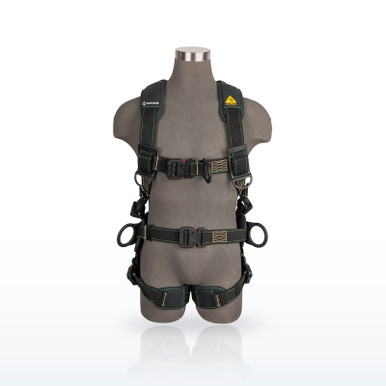 Safewaze 020-1344–1350 Harnesses, Arc Flash, Construction, 3 D-RingsArc flash construction harness, aramid webbing, ASTM F887 and Z359.11 (Safewaze data)
Why a standard harness is a hazard in an arc. Polyester webbing is strong and cheap, and it melts: in an arc it can fuse to the clothing and to the skin, and a melted or charred strap has no rated strength left for the fall that often follows the flash. Zinc-plated steel hardware is a conductor laid across the chest and shoulders. ASTM F887 tests the harness as a whole against an arc exposure and requires it to keep its strength afterward, which is why the arc flash harness is an aramid harness with FR pads and, as an option, dielectric-coated hardware. The F887 rating does not replace the arc-rated clothing: NFPA 70E’s categories and the arc rating of the shirt and pants are a separate requirement, and the harness goes over them. Welding is the same fabric answer to a different threat: the aramid resists spatter and the shields take the slag, but there is no arc exposure test and no dielectric need unless the work has one.
What each rating means on the product page
As Safewaze publishes them on its arc flash and welding lines.
How the Safewaze arc flash line is built, from the brochure and manual
What is on the product page comes from these:
- Harnesses: construction (3D: dorsal and side D-rings) and full body (1D) styles in aramid webbing, Nomex pads, with dielectric (DE) or standard hardware, quick-connect or mating-buckle chest and tongue-buckle or quick-connect legs; sizes from the Sizes field on each page.
- Lanyards: 6 ft arc flash energy-absorbing lanyards in aramid, single or dual leg, with dielectric snap hooks, aluminum rebar hooks, aluminum snap hooks, snap hooks or a non-conductive soft loop for choke attachment; external shock pack with tear webbing; minimum breaking strength 5,000 lb; ANSI Z359.13 and OSHA 1926.502 listed.
- SRLs: the Latitude Pro Arc Flash SRL-P line, with side payout housing and an internal brake, listed beside the harnesses and lanyards.
- The manual: arc flash harnesses may be used for personal fall arrest, restraint, work positioning and (on the retrieval styles) rescue; inspection adds heat and chemical damage to the webbing check; a harness exposed to an arc or a fall is removed from service.
- The clothing under the harness is a separate NFPA 70E requirement; the arc flash guides cover the categories and the arc rating of the garments.
Standard vs arc flash vs welding harness
| Item | Standard harness | Arc flash harness | Welding harness |
|---|---|---|---|
| Webbing | Polyester | Aramid (Kevlar), 40 cal/cm², 700°F char | Aramid with leather or FR shields |
| Pads | Polyester or foam | Nomex FR | FR |
| Hardware | Zinc-plated steel | Zinc-plated steel or dielectric-coated steel (DE styles) | Zinc-plated steel |
| Standards listed | ANSI Z359.11, OSHA 1926.502 | ANSI Z359.11, ASTM F887, OSHA 1926.502 | ANSI Z359.11, OSHA 1926.502 |
| Capacity | ANSI 130–310 lb, OSHA up to 420 lb | ANSI 130–310 lb, OSHA up to 420 lb | ANSI 130–310 lb, OSHA up to 420 lb |
| Hazard it answers | The fall | The fall and an electric arc | The fall and weld spatter |
Source: Safewaze Arc Flash Harness and Lanyard brochure; Safewaze Arc Flash Harness Manual materials table; the Standards, Arc Flash Rated, Dielectric and Material fields on the Safewaze product pages.
What the FallTech arc flash and welding pages list
FallTech lists ASTM F887 (the arc flash test for fall protection) beside ANSI Z359.11-2021 on its arc flash harness pages, marks the Arc Flash Rated field and, where the hardware is overmolded, the Dielectric field; its arc flash SRL-Ps (FT-X EdgeCore Arc Flash, Class 2 leading edge; Arc Flash Mini Pro, Class 1) carry an aramid web lifeline and the same Z359.14-2021 class, arrest force and arrest distance figures as the plain lines, and its WeldTech and FT-Weld harnesses and Kevlar web lanyards are listed to Z359.11 and Z359.13 like any other. The product page’s Standards, Arc Flash Rated and Dielectric fields are the source for each row below.
The ANSI Standards, Standards, Arc Flash Rated and Dielectric fields on each FallTech arc flash and welding product page; FallTech Arc Flash SRD Manual Supplement MSRD40; FallTech FT-X EdgeCore Arc Flash manual MSRD33.Questions people ask
What is an arc flash harness?
A Z359.11 full body harness whose aramid webbing, FR pads and (optionally) dielectric hardware are tested to ASTM F887 so the harness survives an electric arc and keeps holding the worker. Safewaze rates its webbing 40 cal/cm².
What does dielectric mean on a harness?
The buckles, D-rings and adjusters are coated so they do not conduct across the harness; Safewaze offers dielectric (DE) hardware as an option on its arc flash harnesses and dielectric snap hooks on the lanyards, shown as Dielectric: Yes on the product page.
Does an arc flash harness replace arc-rated clothing?
No. The harness rating is for the harness; the shirt, pants and face protection under it have to meet the NFPA 70E category for the task. The harness goes over the arc-rated clothing.
What is a welding harness?
A harness built in aramid with leather or FR shields where spatter and slag land, so the webbing is not burned through; rated to Z359.11, without the F887 arc test unless the manufacturer lists it.
Can a standard polyester harness be used for electrical work?
The manufacturers build arc flash harnesses because polyester melts in an arc and plated steel hardware conducts; the employer’s hazard assessment and NFPA 70E decide what the task requires. The arc flash harnesses above list F887; the standard harnesses do not.
What standard covers arc flash harnesses?
ASTM F887 (personal climbing equipment for electrical workers) for the arc exposure, ANSI/ASSP Z359.11 for the harness as fall protection, and OSHA 1926.502 for the arrest system; NFPA 70E covers the clothing.
How often does an arc flash or welding harness need to be inspected or replaced?
The same as any harness: the user inspects before each use and a competent person inspects at least annually (1926.502(d)(21); Safewaze Technical Bulletin 00303); it is retired after a fall or a failed inspection. Aramid webbing is inspected for the same cuts, fraying, burns and stitching damage as polyester, and a harness that has been in an arc or has spatter burned into the webbing comes out of service.
Is a standard safety harness allowed around electrical work?
OSHA’s fall protection rules do not name a harness type for electrical work; the hazard assessment under 1910.132(d) and 1926.95 and the arc flash analysis under NFPA 70E decide whether the harness has to survive an arc. ASTM F887 is the standard Safewaze cites for its arc flash harnesses and lanyards, and the product page lists the 40 cal/cm² rating of the webbing.
The ratings, test results and standards shown here are the manufacturers' published values, reproduced as published. Nothing on this page is a recommendation by Bayshore Safety that any product is suitable for a particular task, hazard or workplace. Selecting safety products and protective equipment is the responsibility of the end user and the employer, based on their own hazard assessment and the regulations that apply to their work. Confirm every value on the manufacturer's own documentation before use.