
What are the types of safety harnesses? Fall arrest, positioning, climbing, retrieval and arc-rated, by the D-rings the manufacturer lists
A full-body harness is one product type under OSHA (29 CFR 1926.502(d) for fall arrest, (e) for positioning) and one standard, ANSI/ASSP Z359.11; what the trade calls the “types” are the attachment points the manufacturer builds in. A fall-arrest harness has a dorsal (back) D-ring and nothing else; a positioning or construction harness adds side D-rings at the hips for a positioning lanyard and, often, a tool belt; a climbing harness adds a front (sternal) D-ring for a ladder climb system or an SRL; a retrieval or confined-space harness adds shoulder D-rings for a winch or tripod; an arc-rated or welding harness is built with Kevlar or Nomex webbing and is listed for those hazards. Miller’s data lists the D-ring positions for every harness on this site (Back; Back and Sides; Front and Back; Front, Back and Sides; Front, Back and Shoulders), and the product page shows them.
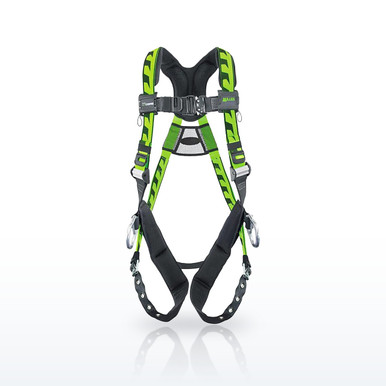 Miller AirCore ACA-TB-D Harnesses, Back and Side D-Rings, Tongue BucklesConstruction harness with back and side D-rings (Miller data)
Why the D-rings decide the type. OSHA allows a body harness to be used for fall arrest only through its dorsal attachment (1926.502(d)(17): the attachment point “shall be located in the center of the wearer’s back near shoulder level, or above the wearer’s head”), and a positioning lanyard only through a point that limits free fall to two feet (1926.502(e)). Side D-rings are therefore positioning-only, a front D-ring is for climbing and restraint as the manufacturer’s instructions allow, and shoulder D-rings are for lifting a worker out of a space, never for arrest. The harness is the same Z359.11 product in every case; the rings are what change, and the manufacturer lists them per style.
The types, by what the manufacturer builds in
D-ring positions as Miller lists them; the use of each ring is set by 1926.502 and the manufacturer’s instructions.
What the rule says about each attachment
From 29 CFR 1926.502:
- Fall arrest: the attachment point of the body harness shall be located in the center of the wearer’s back near shoulder level, or above the wearer’s head (1926.502(d)(17)).
- Positioning: a positioning device system shall be rigged such that an employee cannot free fall more than 2 feet, and anchorages shall hold at least twice the potential impact load or 3,000 pounds (1926.502(e)(1) and (2)).
- Body belts are not acceptable as part of a personal fall arrest system (1926.502(d), note after (d)(16)).
- Harness inspection: before each use by the user and by a competent person at the manufacturer’s interval; Miller’s inspection guide lists webbing, stitching, D-rings and labels. The inspection guide covers it.
- Weight capacity: Z359.11 harnesses are rated for a user weight range the manufacturer states (Miller lists it per style); OSHA’s 1926.502(d)(16) limits arrest force to 1,800 pounds with a full-body harness.
How Safewaze lists and codes the attachment points
Safewaze lists the attachment points on each harness page (Back; Back, Sides; Front, Back; Front, Back, Sides; Front, Back, Shoulders) and codes them in the style name: 1D for a dorsal D-ring only, 3D for dorsal plus side positioning rings, FD for a front D-ring. Its basics sheet states that the dorsal D-ring is the only fall arrest connection point and that a connector is never attached to the side D-rings or the lanyard keepers. The Attachment Points field on each Safewaze harness page on this site carries the manufacturer’s list, and the band below groups the harnesses by it.
Safewaze, “Fall Protection Basics (ABCDs)”, harness requirements; the Attachment Points and D-Rings fields on each Safewaze harness product page.The 310 lb and 420 lb figures as Safewaze states them
Safewaze publishes two capacities on every harness, lanyard, SRL and anchor page on this site: ANSI 130–310 lb (59–141 kg) and OSHA up to 420 lb (191 kg), both including clothing, tools and equipment. Its technical bulletin explains the second figure: OSHA does not set a user weight for a personal fall arrest system and leaves the manufacturer to test and claim one, so Safewaze tests with a 1:1 mass at each end of the range (an 85 lb mass for the minimum, a 420 lb mass for the maximum) against the 1910.140(d)(1)(v) and 1926 Subpart M Appendix C test methods, and certifies its anchors, body wear and connectors to ANSI 130–310 lb and OSHA 85–420 lb at a 2:1 safety factor. The product page shows the two figures as the manufacturer states them.
Safewaze Technical Bulletin 00312, OSHA PFAS Capacity Range (rev. 4, 02-06-2025), pages 1–2; the ANSI Weight Capacity and OSHA Weight Capacity fields on each Safewaze product page.How FallTech lists and codes the attachment points
FallTech lists the attachment points on each harness page (Back; Back, Sides; Front, Back; Front, Back, Sides; Front, Back, Shoulders; and Suspension on its tower harnesses) and codes them in the style name: 1D for a dorsal D-ring only, 3D for dorsal plus side positioning rings, 4D for front, back and sides or back and shoulders, 6D for the tower harnesses with a suspension seat. Its ladder article states that the sternal D-ring is used in fixed-ladder climbing systems and controlled descent, that “front” and “sternal” name the same chest position, that the dorsal D-ring stays the primary arrest point, and that side D-rings are for positioning and restraint and can cause injury if used for arrest.
FallTech, “Why Front D-Rings Matter for Ladder Safety” (falltech.com); the Attachment Points, D-Rings and Application fields on each FallTech harness product page.The 310 lb and 425 lb figures as FallTech states them
FallTech prints two capacities on each harness, lanyard and SRL page on this site: an ANSI capacity of 130–310 lb and an OSHA capacity, 130–425 lb on its current pages and 130–420 lb on older ones (a few heavyweight lanyards carry 310–425 lb). Its weight-capacity guide explains the pair: OSHA does not set 310 lb as a universal maximum; 1926.502(d)(16) and 1910.140(d)(1)(v) call for adjusted test criteria for combined body and tool weights of 310 lb or more, while ANSI/ASSP Z359.11 and Z359.14 cover a user range of 130 to 310 lb, so a higher figure listed for OSHA use does not extend the ANSI range. The figure to compare with either capacity is the total equipped weight: body weight plus clothing, boots, PPE, harness, tool belt and carried tools (a 250 lb worker with 15 lb of clothing and 25 lb of tools weighs 290 lb equipped); one higher-capacity component does not raise the limits of the others, and a tool tether rating describes tool capacity, not the fall arrest system. The harness manual adds the CSA figure, 350 lb (120–350 lb for CSA Z259.10), and states that heavy users face higher arrest forces and a faster onset of suspension trauma.
FallTech, “Fall Protection Weight Capacity: Accounting for the Worker, Clothing, Tools, and Equipment” (falltech.com); FallTech Full Body Harness User Instruction Manual MFBH04 Rev E, warnings and Table 1 (ANSI, OSHA and CSA user capacity); the ANSI Weight Capacity and OSHA Weight Capacity fields on each FallTech product page.What is a 5-point harness? The adjustment points and the D-ring count are two different numbers
A full-body harness adjusts in five places, the two shoulder straps, the two leg straps and the chest strap, and that is the “five points” the question usually means when it is asked about fall protection; the phrase itself comes from racing and child seats, where a five-point harness is five belts meeting at one buckle and has nothing to do with work at height. The number that sorts fall protection harnesses is the D-ring count, which the manufacturers print as 1D, 2D, 3D, 4D, 5D or 6D: one dorsal ring for fall arrest only; back and sides for positioning; back and front for climbing; back, front and sides for a construction harness that does all three; shoulders added for retrieval; a seat sling and front rings for tower work. FallTech prints the rings in the Attachment Points field on every page we list (Back; Back, Sides; Back, Front; Back, Front, Sides; Back, Shoulders; Back, Front, Sides, Shoulders) and the adjustments in the leg and chest buckle fields (tongue buckle, mating buckle, quick-connect), and its capacity figures are the same across every size and ring count: ANSI 130–310 lb, OSHA 130–425 lb on most lines. The type the harness is sold as, fall arrest, positioning, climbing, retrieval, tower, arc-rated or welding, follows from the rings and the materials, not from how many buckles it has.
The Attachment Points, buckle and capacity fields on the FallTech harness pages on this site; FallTech, “The Complete Guide to Full Body Harnesses” (attachment elements) (falltech.com); 29 CFR 1926.500(b) definition of body harness (e-CFR text as of Nov 5 2026); CSA Z259.10 class letters as the manufacturers describe them.Questions people ask
What are the three types of harnesses?
The trade usually means fall arrest (dorsal D-ring), positioning (dorsal plus side D-rings) and climbing or retrieval (front or shoulder D-rings). All are full-body harnesses under 1926.502 and Z359.11; the manufacturer lists the rings per style.
What are the different types of safety harnesses?
By what the manufacturer builds in: fall arrest (dorsal D-ring only, 1D), positioning or construction (dorsal plus side rings, 3D), climbing (dorsal plus front or sternal ring, 2D or 4D), retrieval or confined space (dorsal plus shoulder rings), tower (seat sling and extra rings, 5D or 6D), and the hazard-rated versions of each: arc flash (ASTM F887 added), welding (Kevlar or leather), and women’s cuts. The band above groups the harnesses we carry that way.
How many types of safety harness are there?
Depends on the count you want. By attachment points, four or five (fall arrest, positioning, climbing, retrieval, tower). By CSA class letter, five (A arrest, D descent, E confined space, L ladder climbing, P positioning). By hazard, add arc-rated and welding. Every one is a full-body harness; the type is what the D-rings allow it to be used for.
What is a 5 point safety harness, and what are the 5 points?
In fall protection the five points are adjustments, not rings: two shoulder straps, two leg straps and the chest strap. The D-ring count is given separately as 1D, 3D, 4D, 5D or 6D. A five-point harness in a race car or a child seat is a different product. FallTech lists the D-rings in the Attachment Points field and the buckles in the leg and chest fields on every harness page.
What standard must a full-body harness meet?
In the US the manufacturers design and label to ANSI/ASSP Z359.11 (2021 edition), with CSA Z259.10 for Canada, EN 361 for Europe and ASTM F887 added for arc flash; OSHA itself sets performance rules for the system in 1926.502(d) and 1910.140 and names no harness standard. Every row above carries the standard its manufacturer lists; the harness standards guide below goes through them.
Why is a full body harness used for fall arrest instead of a belt?
Because OSHA requires it and because of where the force goes. Since January 1, 1998 body belts are not acceptable in a personal fall arrest system (1926.502(d)); a harness distributes the arresting force, limited to 1,800 lb, over the thighs, pelvis, waist, chest and shoulders and leaves the person upright for rescue. Belts remain for positioning, and in general industry for travel restraint.
What is the purpose of a body harness?
OSHA’s definition is the purpose: “straps which may be secured about the employee in a manner that will distribute the fall arrest forces over at least the thighs, pelvis, waist, chest and shoulders with means for attaching it to other components of a personal fall arrest system” (1926.500(b)). The dorsal ring takes the arrest; the other rings, where fitted, hold the worker at the work, on a ladder, or on a retrieval line.
What are the OSHA harness requirements?
1926.502(d): a full-body harness attached at the dorsal ring, arrest force limited to 1,800 pounds, free fall limited to 6 feet, anchorages of 5,000 pounds or engineered to a factor of two, inspection before each use; body belts are not allowed for arrest.
Can you use side D-rings for fall arrest?
No. Side rings are for positioning under 1926.502(e), rigged so the free fall cannot exceed 2 feet; arrest uses the dorsal ring (1926.502(d)(17)).
What is a front D-ring for?
Ladder climb systems and front-connected SRLs or restraint as the manufacturer’s instructions allow; the climbing harnesses above list “Front, Back”.
What is a retrieval harness?
A harness with shoulder D-rings so a winch or tripod can lift the wearer vertically out of a confined space; the dorsal ring is still the arrest point.
What is a Class A harness, and is there a class 4?
The class letters are CSA Z259.10 groups by attachment point: A fall arrest, D controlled descent, E confined space (shoulder attachments), L ladder climbing (frontal), P work positioning (hip). There is no “class 4” harness in the US or Canadian standards; a 4 in a US harness name is usually the D-ring count (4D: back, front and sides).
What is the load capacity of a full-body harness?
ANSI Z359.11: 130 to 310 lb including clothing, tools and equipment. FallTech states 130–425 lb under OSHA on most of its harnesses (130–420 on some, 310–425 on its heavyweight line) and CSA up to 350 lb; Safewaze states up to 420 lb under OSHA; each product page prints its own. The figures are reproduced in the capacity sections above.
At what height does OSHA require a harness?
6 feet in construction (1926.501(b)(1)) and 4 feet in general industry (1910.28(b)(1)), by any fall protection system allowed there; the when-is-fall-protection-required guide covers the triggers.
The ratings, test results and standards shown here are the manufacturers' published values, reproduced as published. Nothing on this page is a recommendation by Bayshore Safety that any product is suitable for a particular task, hazard or workplace. Selecting safety products and protective equipment is the responsibility of the end user and the employer, based on their own hazard assessment and the regulations that apply to their work. Confirm every value on the manufacturer's own documentation before use.