
Bloodborne pathogens: what 1910.1030 requires of protective clothing, and what ASTM F1670 and F1671 test
29 CFR 1910.1030(d)(3)(i) requires the employer to provide appropriate PPE at no cost wherever there is occupational exposure, and defines appropriate as PPE that does not permit blood or other potentially infectious materials to pass through to or reach the employee’s work clothes, street clothes, undergarments, skin, eyes, mouth or other mucous membranes under normal conditions of use and for the duration of time the PPE will be used. 1910.1030(d)(3)(xi) requires gowns, aprons, lab coats, clinic jackets or similar outer garments in occupational exposure situations, with the type and characteristics depending on the task and degree of exposure anticipated, and (d)(3)(xii) adds surgical caps or hoods and shoe covers or boots when gross contamination can reasonably be anticipated. ASTM F1670 tests a material’s resistance to penetration by synthetic blood under continuous liquid contact, judged visually; ASTM F1671 tests resistance to penetration by a surrogate microbe, modeling hepatitis B and C and HIV, judged by viral detection. Both methods test the material, and seams only where the seam is the specimen; neither addresses garment design, closures or interfaces. ViroGuard 2 publishes a pass on F1670 and F1671 for fabric and seams; ViroGuard publishes a pass for fabric; ChemSplash 1 and MicroGuard MP publish an F1670 pass only.
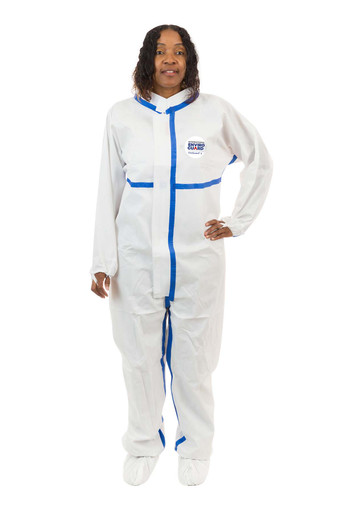 Enviroguard W2502 ViroGuard 2 Disposable White Coverall, Elastic Wrist and Ankle, Storm Flap Zipper, Taped SeamsFabric and seams pass ASTM F1670 and F1671. Taped seams, storm flap, thumb loops, double-sided tape at the wrists. ASTM D6978-05 fentanyl citrate breakthrough over 240 minutes.
Why does the standard define “appropriate” instead of naming a garment? Because the exposure differs by task. 1910.1030 covers anyone with reasonably anticipated skin, eye, mucous membrane or parenteral contact with blood or other potentially infectious materials in the course of their duties, which reaches far past hospitals: crime and trauma scene cleanup, Category 3 water losses, body removal, corrections, animal research and emergency response. The standard therefore sets a performance test in words, no pass-through to skin or clothes for as long as the garment is worn, and leaves the type and characteristics of the garment to the task and the degree of exposure anticipated. The ASTM methods are how a manufacturer shows a fabric meets that performance in the lab.
29 CFR 1910.1030(b), definitions of occupational exposure and other potentially infectious materials; 1910.1030(d)(3)(i) and (d)(3)(xi).What does 1910.1030(d)(3) require of the employer?
The personal protective equipment paragraph, item by item.
What is the difference between ASTM F1670 and ASTM F1671?
F1670 is the blood test. ASTM’s scope says it evaluates the resistance of materials used in protective clothing to penetration by synthetic blood under conditions of continuous liquid contact, with pass or fail based on visual detection of synthetic blood penetration, and that it is a means of selecting materials for subsequent testing with the more sophisticated barrier test in F1671. F1671 is the pathogen test: resistance to penetration by blood-borne pathogens using a surrogate microbe under continuous liquid contact, with pass or fail based on detection of viral penetration. ASTM states F1671 has been specifically defined for modeling the viral penetration of hepatitis B and C and human immunodeficiency viruses transmitted in blood and other potentially infectious body fluids, and that inferences for other pathogens must be assessed case by case.
ASTM F1670/F1670M scope, paragraphs 1.1 and 1.2; ASTM F1671/F1671M scope, paragraphs 1.1 and 1.3.A fabric can pass F1670 and not be tested, or not pass, on F1671, because a virus is far smaller than the drop the eye sees. That is why a sheet that prints only an F1670 pass is telling you about splash, not about pathogens. Both scopes also say the methods do not apply to all forms or conditions of blood-borne pathogen exposure, and the user must review the modes of exposure and judge whether the method fits.
ASTM F1670/F1670M scope 1.3; ASTM F1671/F1671M scope 1.2.Why do the seams matter as much as the fabric?
Both ASTM scopes say the method addresses only the performance of materials or certain material constructions, for example seams, and does not address the design, overall construction and components, or interfaces of garments. So a seam counts only if the seam itself was tested. International Enviroguard’s Seam Safety Guide marks ViroGuard, a serged-seam garment, as “Fabric only” for both F1670 and F1671, while the ViroGuard 2 sheet prints fabric Pass and seams Pass on both. The ViroGuard 2 description says the blue taped seams help prevent liquids from entering through exposed seams and that all garments have a storm flap over the zipper. For an exposure where liquid runs along the body, which the standard calls gross contamination, the seam result is the one to read.
ASTM F1670/F1670M scope 1.4; ASTM F1671/F1671M scope 1.4; International Enviroguard Seam Safety Guide, Serged Seam Brands chart (ViroGuard: Fabric only); ViroGuard 2 sell sheet, Test Data table and features.Which disposable coveralls publish F1670 and F1671 results?
ViroGuard 2: blood, ASTM F1670, fabric Pass and seams Pass; bloodborne pathogens, ASTM F1671, fabric Pass and seams Pass; fentanyl citrate, ASTM D6978-05, fabric and seams over 240 minutes. ViroGuard: blood penetration, ASTM F1670, fabric Pass; bloodborne pathogens, ASTM F1671, fabric Pass; hydrohead 255.2 cm by AATCC-127. ChemSplash 1: synthetic blood, ASTM F1670, Pass, with no F1671 result printed. MicroGuard MP: synthetic blood, ASTM F1670-07, Pass, with no F1671 result printed, and the Seam Safety Guide leaves its F1671 column blank. The manufacturer’s Ebola PPE sheet pairs them this way: ViroGuard for a clinically stable “dry” patient where the guidance it cites asks for a fluid-resistant coverall, and ViroGuard 2 for a “wet” patient with bleeding, vomiting or diarrhea where it asks for a coverall whose fabric and seams pass ASTM F1671 or ISO 16604.
ViroGuard 2, ViroGuard, ChemSplash 1 and MicroGuard MP sell sheets (barrier and agent tables, verbatim); International Enviroguard Seam Safety Guide capability chart; International Enviroguard Ebola PPE sheet.The manufacturer lists emergency response, Category 3 black water, tank cleaning, crime scene remediation and animal research for ViroGuard, and emergency response, Category 3 black water, crime scene remediation, animal research and hazardous drug response for ViroGuard 2. ViroGuard is blue, which the catalog says makes stains and splashes less conspicuous; ViroGuard 2 is white with blue taped seams.
ViroGuard and ViroGuard 2 sell sheets (applications); International Enviroguard Industrial Catalog (ViroGuard color).What garment features line up with the removal rules?
1910.1030(d)(3)(vi) and (vii) require a penetrated garment to come off at once and every piece of PPE to come off before leaving the work area, into a designated container. ViroGuard 2 styles are built for that step: a zipper front with a sealable storm flap, a red fabric pull tab on the zipper, thumb and middle finger loops at the cuff so the sleeve stays under the glove while the glove comes off, double-sided tape at the wrists, and a mandarin collar with hook and loop closure at the neck. W2501 has attached boots; W2502 has elastic ankles for use with the W2505 and W2506 taped-seam boot covers; the W2561 hood has taped seams and an elastic face. ViroGuard 2404 has an attached hood and boots and 2407 an attached hood, both with the storm flap and elastic wrists.
29 CFR 1910.1030(d)(3)(vi) through (viii); ViroGuard 2 and ViroGuard garment lists, verbatim.Does a pass on these tests settle the garment choice?
No test result does. The standard puts the decision on the employer: the exposure determination lists the tasks, the type and characteristics of the clothing depend on the task and the degree of exposure anticipated, and the garment has to keep blood off the skin and clothes for as long as it is worn. A fabric-and-seam pass on F1670 and F1671 is the strongest material data a sheet can print for this hazard; the hood, boots, cuffs and the doffing procedure are what the test methods say they do not cover. Those belong in the Exposure Control Plan, and disposable garments go in the container, not the laundry.
29 CFR 1910.1030(c)(2), (d)(3)(i) and (d)(3)(xi); ASTM F1670/F1670M and F1671/F1671M scope 1.4.Questions people ask
Does OSHA require Tyvek suits for bloodborne pathogens?
No brand or fabric is named. 1910.1030(d)(3)(i) requires PPE that does not let blood or OPIM pass through to skin or clothing for the duration of use, and (d)(3)(xi) requires gowns, aprons, lab coats or similar outer garments chosen by the task and degree of exposure.
What is the difference between ASTM F1670 and F1671?
F1670 measures penetration by synthetic blood, judged visually; F1671 measures penetration by a surrogate microbe modeling hepatitis B and C and HIV, judged by viral detection (ASTM scope statements).
Does a fabric pass cover the seams?
Only if the seams were tested. Both ASTM scopes say the methods address materials and certain constructions such as seams, not garment design; ViroGuard 2 prints fabric and seams Pass, ViroGuard prints fabric Pass with the seam guide marking it Fabric only.
When are shoe covers and hoods required under 1910.1030?
When gross contamination can reasonably be anticipated, per 1910.1030(d)(3)(xii), which gives autopsies and orthopaedic surgery as examples.
Can a blood-contaminated disposable coverall be reused?
1910.1030(d)(3)(vi) requires a penetrated garment to be removed immediately or as soon as feasible, and (d)(3)(viii) requires removed PPE to go to a designated container for disposal or decontamination; the manufacturer sells these garments as disposable.
Who pays for bloodborne pathogen PPE?
The employer, at no cost to the employee, including cleaning, repair, replacement and disposal (1910.1030(d)(3)(i), (iv) and (v)).
Which coverall is for a wet patient or heavy fluid?
The manufacturer’s Ebola PPE sheet pairs ViroGuard 2, whose fabric and seams pass F1670 and F1671, with the wet-patient guidance it cites, and ViroGuard with the dry-patient guidance; the employer’s exposure determination decides.
The ratings, test results and standards shown here are the manufacturers' published values, reproduced as published. Nothing on this page is a recommendation by Bayshore Safety that any product is suitable for a particular task, hazard or workplace. Selecting safety products and protective equipment is the responsibility of the end user and the employer, based on their own hazard assessment and the regulations that apply to their work. Confirm every value on the manufacturer's own documentation before use.