
Seam types on disposable coveralls: serged, bound and taped, and when the seam is the weak point
A serged seam is an overlock stitch that joins two fabric edges with three or four threads; it leaves needle holes, so it is not sealed. A bound seam is a serged seam with a strip of fabric sewn over it, which adds strength and holdout but still has needle holes. A stitched-and-taped seam is a serged seam sealed under a strip of impervious tape, and it is liquid-tight. International Enviroguard’s Seam Safety Guide states the rule plainly: the most likely route of contamination is not permeation through the fabric but penetration through holes, gaps and seams, and only welded and stitched-and-taped seams give a liquid-tight seal. The manufacturer’s style codes tell you which you are buying: ChemSplash 1 numbers ending YS are serged, YT taped; ChemSplash 2 (GT), PyroGuard CRFR (T) and ViroGuard 2 are taped on every style; the serged brands include MicroGuard MP, SMS, polypropylene, ValuGuard MP, PyroGuard FR and ViroGuard; GammaGuard CE is bound.
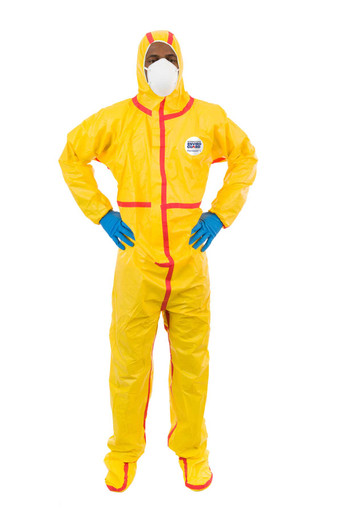 Enviroguard 7019YT ChemSplash 1 Disposable Chemical Splash Coverall with Hood and Boot, Elastic Wrist and Ankle, Taped SeamsTaped seams with the red tape stripe that marks the YT style; attached hood and boots. Same fabric as 7019YS, sealed seams.
Why do seams matter more than the fabric number? Because a liquid takes the easiest way in. The manufacturer’s guide describes two effects. Wicking: surface tension pulls a liquid through a tiny opening, so even a stitch hole in a serged seam can pass a considerable volume. The bellows effect: dust floats, and only air moving through gaps carries it into a suit; a non-breathable fabric forces that airflow through the seam holes and the zipper as the wearer moves, while a breathable fabric lets the air pass through the fabric itself, where the dust is filtered. The guide’s conclusion is that seam structure and the fit with other PPE may be as significant as the fabric’s permeability, if not more.
International Enviroguard Seam Safety Guide, Wicking and the Bellows Effect.What are the seam types?
The manufacturer’s overview, seam by seam.
When is the seam the weak point?
Whenever the hazard is harmful in small quantities. The manufacturer’s guide says that because some penetration through stitch holes will occur, clothing with serged or bound seams should not be used for protection against any chemical that is harmful in small amounts, and that a serged seam is not suitable for strong directional spray. It also names the thread itself as a route: thread wicks. The guide’s practical rule is that the seam should match the protection the coverall is meant to give. A taped seam is an unnecessary expense on a coverall built for light splash; a serged seam is unsuitable on one meant to stop a jet. The fabric table on the sell sheet is a swatch result, and no swatch has a seam in it.
International Enviroguard Seam Safety Guide, concluding points.The other time the seam is the weak point is when it has already failed. The guide warns that serged seams can come undone over time, especially when the PPE is too small, and that a split garment should be replaced immediately. OSHA writes the same check into the asbestos standard: the competent person examines worksuits at least once per shift for rips or tears, and a rip found while an employee is working is immediately mended or the suit immediately replaced. A seam that has opened is a rip.
International Enviroguard Seam Safety Guide, serged seams; 29 CFR 1926.1101(i)(4)(i) and (ii).What do YS and YT mean on a ChemSplash style number?
They are the same ChemSplash 1 fabric with different seams. The sell sheet states that a style ending in YS has serged seams with no red tape and a style ending in YT has taped seams, and that a contrasting red stripe of tape distinguishes the taped garments on sight. The manufacturer says taped seams improve protection over coveralls made with serged seams, while serged-seam garments are more economical. The pairs are 7012YS and 7012YT (elastic wrists, open ankles), 7015YS and 7015YT (hood), 7019YS and 7019YT (hood and boots), with 7013YT (elastic wrists and ankles) taped only, and the 7065 sleeves in both. The case counts differ too: the serged styles pack 12 per case and the taped styles 6.
International Enviroguard ChemSplash 1 sell sheet, available garments and seam note; Good-Better-Best quick reference (YT=taped seams, YS=serged seams).On the store today 7015YS is $80.99 a case of 12 and 7015YT is $89.49 a case of 6, which works out to about $6.75 and $14.91 a suit; prices change, so check the product page. The question the hazard assessment answers is whether the job involves a liquid that is harmful in small amounts or a directional spray. If it does, the difference buys a sealed seam. If it does not, the serged suit does the same job for less.
bayshoresafety.com product pages for 7015YS and 7015YT, November 2026 prices; International Enviroguard Seam Safety Guide, concluding points.Which coveralls have which seams?
The manufacturer publishes the list. Serged-seam brands: Body Filter 95+, ChemSplash 1 (YS styles), MicroGuard CE, MicroGuard MP, Polypropylene, PyroGuard FR, SMS, Soft Scrubs, ValuGuard MP and ViroGuard. Stitched-and-taped brands: ChemSplash 1 (YT styles), ChemSplash 2, PyroGuard CRFR and ViroGuard 2. Bound-seam brand: GammaGuard CE, the sterile cleanroom line, where the manufacturer says the reinforced outer binding strengthens the seam and eliminates raw edges that can generate particulates. Ultrasonically welded: the 2804 and 2804B disposable masks and one PVC cleanroom apron. The product spec field on each item on our site carries the seam type.
International Enviroguard Seam Safety Guide, serged seam brands chart, stitched and taped seam brands, bound seam brands, ultrasonically welded products; Cleanroom Catalog.Does a taped seam get tested?
Sometimes, and it is worth checking. ViroGuard 2 is the clearest case: its sheet reports ASTM F1670 and F1671 as Pass for the fabric and, in separate rows, Pass for the seams, and ASTM D6978 fentanyl citrate at more than 240 minutes for both. The manufacturer’s Ebola PPE guidance draws the line there: for a wet patient the coverall must be made with fabric and seams that pass ASTM F1671 or ISO 16604, and ViroGuard, whose F1670 and F1671 results are fabric only, is positioned for the dry patient. ChemSplash 2 and PyroGuard CRFR publish their chemical tables for the fabric and describe the taped seams as added protection against liquid penetration; the ChemSplash 2 storm flap with pressure-sensitive tape closes the zipper, which the guide counts as another gap. For the European types, the guide notes that Types 1 to 4 require a permeation test on a seam for at least one chemical, while Types 5 and 6 have no seam-specific test and rely on the whole-garment cabin test.
International Enviroguard ViroGuard 2 sell sheet (test data, fabric and seams); Ebola PPE guidance; ChemSplash 2 and PyroGuard CRFR sell sheets; Seam Safety Guide, CE standards and seam testing.What else leaks besides the seam?
- The zipper. A storm flap over it, taped shut on ChemSplash 2 and sealable on PyroGuard CRFR and ViroGuard 2, closes the longest opening on the suit.
- The wrists and ankles. The guide names gaps between the garment and other PPE; ViroGuard 2 adds thumb and middle finger loops and double-sided tape at the wrists so the glove goes over the sleeve.
- Fit. Too small stresses every seam and opens the needle holes; the manufacturer cuts its coveralls with elastic backs and seamless shoulder areas to reduce rip-outs.
- Breathability. On a dusty job the guide’s bellows argument favors a breathable fabric with serged seams over a film fabric with serged seams, because the film pumps air through the holes.
Questions people ask
What is a serged seam on a coverall?
An overlocked stitch that joins two fabric edges with three or four threads. It leaves needle holes, so International Enviroguard’s Seam Safety Guide calls it not sealed and suitable only for low-hazard, light-splash and dry-particle protection.
What is the difference between a bound seam and a taped seam?
A bound seam adds a sewn fabric strip over the seam for strength and holdout but still has needle holes; a stitched-and-taped seam seals the stitching under impervious tape and is liquid-tight, per the manufacturer’s guide.
Are taped seam coveralls waterproof?
The manufacturer describes stitched-and-taped seams as liquid-tight and fully sealed. Whether the garment keeps a given chemical out still depends on the fabric’s chemical table, the zipper closure and the fit with gloves and boots.
What does YT mean on an Enviroguard coverall?
Taped seams. The ChemSplash 1 sheet states that styles ending in YT have taped seams with a red tape stripe and styles ending in YS have serged seams with no red tape.
Which Enviroguard coveralls have taped seams?
ChemSplash 1 YT styles, every ChemSplash 2 style (GT), PyroGuard CRFR (9115T, 9119T, 9110T) and every ViroGuard 2 style, per the Seam Safety Guide and the sell sheets.
How often should a coverall be checked for split seams?
The manufacturer says a split garment should be replaced immediately. For asbestos work OSHA requires the competent person to examine worksuits at least once per shift for rips or tears and to mend or replace them immediately (29 CFR 1926.1101(i)(4)).
The ratings, test results and standards shown here are the manufacturers' published values, reproduced as published. Nothing on this page is a recommendation by Bayshore Safety that any product is suitable for a particular task, hazard or workplace. Selecting safety products and protective equipment is the responsibility of the end user and the employer, based on their own hazard assessment and the regulations that apply to their work. Confirm every value on the manufacturer's own documentation before use.