
Hazmat suit levels A, B, C and D explained, and which ones disposable coveralls cover
The four levels come from Appendix B to OSHA’s hazardous waste and emergency response standard, 29 CFR 1910.120, which adopted the EPA scheme. Level A is a totally-encapsulating chemical-protective suit worn with a positive-pressure SCBA, for the greatest skin, eye and breathing hazard. Level B keeps the SCBA but drops to hooded chemical-resistant clothing, and Appendix B lists “disposable chemical-resistant overalls” as one form of that clothing. Level C is the same hooded chemical-resistant clothing worn with an air-purifying respirator, used only when the contaminant and its concentration are known and will not harm skin. Level D is a work uniform: coveralls, gloves, safety boots and eye protection, with no respirator. A disposable coverall is therefore a Level C or Level D garment, and a splash-rated one with taped seams can be the clothing layer at Level B; the encapsulating suit at Level A is a different product that we cover in the hazmat suit guide.
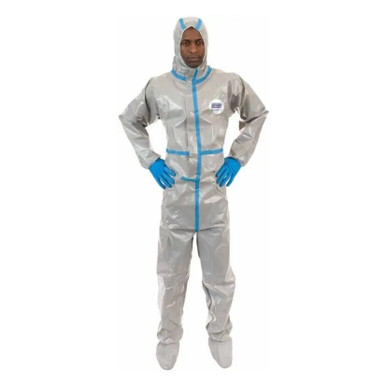 Enviroguard 7319GT ChemSplash 2 Disposable Chemical Splash Coverall, Hood and Boots, Elastic Wrist, Thumb Loops, Taped SeamsTaped seams, attached respirator hood and boots, storm flap with pressure-sensitive tape. Published ASTM F903 penetration data for the ASTM F1001 chemical list.
Why do the levels exist? A hazardous waste site or a chemical release is worked before anyone knows exactly what is in the air or on the ground. Appendix B gives the employer a starting point: four ensembles, each matching a respirator to a clothing layer, so a site safety plan can name a level instead of a parts list. The appendix says plainly that these are guidelines an employer can use to begin the selection, and that site information may call for combinations of PPE drawn from different levels. The coverall is one part of the ensemble; the respirator is what separates Level A and B from Level C and D.
29 CFR 1910.120 Appendix B, introduction and Part A.What is in each level?
The equipment Appendix B lists under each level, and the conditions in Part B for choosing it.
Which levels do disposable coveralls cover?
Level C and Level D, and the clothing layer of Level B. Appendix B names the clothing at Level B and Level C as hooded chemical-resistant clothing and lists disposable chemical-resistant overalls as one acceptable form. At Level D it simply lists coveralls. Nothing in the appendix names a fabric or brand; the respirator defines the level, and the clothing has to resist the chemical the site assessment identified. A hooded disposable coverall with published chemical penetration data is the garment Appendix B describes for Level C; a plain disposable coverall is a Level D garment.
29 CFR 1910.120 Appendix B, Part A, Level B, Level C and Level D equipment lists.Level A is different in kind. It is a totally-encapsulating suit worn over an SCBA, and the standard treats these suits separately, requiring that they protect against the particular hazards identified during the site characterization. We do not carry an encapsulating suit in the International Enviroguard family; the DuPont Tychem 10000 Level A suit on the site is covered in our hazmat suit guide.
29 CFR 1910.120(g)(4)(i); Appendix B, Part A, Level A.What is the difference between Level A and Level B?
The breathing protection is the same: a positive-pressure SCBA, or a positive-pressure supplied-air respirator with an escape SCBA. The difference is the skin. Level A encloses the worker and the respirator in a totally-encapsulating suit; Level B uses a hooded splash garment with the respirator outside it. Appendix B chooses A when the substance is a known or suspected skin hazard and contact is possible, or when the airborne concentration or splash risk calls for the highest level of protection for skin, eyes and lungs; it chooses B when the substance is identified and needs a high level of respiratory protection but less skin protection, when oxygen is below 19.5 percent, or when an instrument shows vapors not yet fully identified.
29 CFR 1910.120 Appendix B, Part B, Level A and Level B conditions.When is Level C used, and what does the coverall have to do?
Level C is the air-purifying respirator level. Appendix B allows it only when the contaminants are identified and measured, an air-purifying respirator can remove them, every criterion for using that respirator is met, and contact will not harm or be absorbed through exposed skin. The clothing is hooded chemical-resistant clothing, which is where a splash-rated disposable coverall comes in.
29 CFR 1910.120 Appendix B, Part B, Level C conditions.What the coverall has to resist is decided by the site. The standard requires PPE selection to be based on an evaluation of the performance characteristics of the PPE relative to the requirements and limitations of the site, the task-specific conditions and duration, and the hazards identified. For a disposable splash coverall that evaluation means the manufacturer’s published chemical table: the ASTM F903 penetration results, the ISO 6530 penetration and repellency classes, or the ASTM F739 breakthrough times for the chemical that is actually on the site. If the chemical is not in the table, the data does not cover it.
29 CFR 1910.120(g)(3)(ii); International Enviroguard ChemSplash 1, ChemSplash 2 and PyroGuard CRFR sell sheets (agent testing tables).What is Level D, and is a Tyvek suit Level D?
Level D is a work uniform with no respirator, used only where the atmosphere contains no known hazard and the work precludes splashes, immersion or an unexpected inhalation of a hazardous chemical. Appendix B lists coveralls, gloves, chemical-resistant steel-toe boots or shoes and safety glasses or splash goggles, with disposable outer boots, a hard hat, a face shield and an escape mask as options. EPA’s emergency response page calls Level D the minimum protection required. Any disposable coverall worn for dirt, dust or nuisance contamination on a site with no chemical hazard in the air is a Level D coverall; the fabric is not what makes it Level D, the absence of a chemical hazard is.
29 CFR 1910.120 Appendix B, Part A and Part B, Level D; EPA emergency response PPE page.How does the employer pick the level?
Through the site safety and health program. The standard requires PPE that protects employees from the hazards and potential hazards they are likely to encounter as identified during the site characterization and analysis, and it requires the level of protection to be increased when additional information on site conditions shows that increased protection is needed. The written PPE program has to cover selection based on site hazards, use and limitations, work mission duration, maintenance and storage, decontamination and disposal, training and fitting, donning and doffing, inspection before, during and after use, evaluation of the program, and limitations in temperature extremes and heat stress.
29 CFR 1910.120(g)(3)(i), (g)(3)(v) and (g)(5)(i) through (x).Two of those items bear directly on a disposable garment: decontamination and disposal, since a single-use coverall is bagged rather than decontaminated, and heat stress, which is why the manufacturer publishes a moisture vapor transmission figure for ChemSplash 1 (above 3,000 g/m² per 24 hours by ASTM E96).
29 CFR 1910.120(g)(5)(v) and (x); International Enviroguard ChemSplash 1 sell sheet.What does the manufacturer’s data say about each splash coverall?
ChemSplash 1 is sold in serged-seam (YS) and taped-seam (YT) styles. Its sheet lists ISO 6530 / EN 368 penetration Class 3 for all nine chemicals tested, with repellency from Class 3 (the acids and sodium hydroxide 50%) down to Class 1 (n-heptane, dichloromethane, toluene); synthetic blood passes ASTM F1670. The sheet labels the garment Type 5 (EN ISO 13982-1) and Type 6 (EN 13034), the European dust and light-spray types, and anti-static to EN 1149-5.
International Enviroguard ChemSplash 1 sell sheet, agent testing and standards.ChemSplash 2 has taped seams on every style and a storm flap with pressure-sensitive tape over the zipper. Its sheet lists ASTM F903 penetration as Pass for nineteen ASTM F1001 chemicals, from acetone to toluene, plus ASTM F1670 and F1671 for blood and bloodborne pathogens, and ASTM F739 breakthrough times for three gases: 1,3-butadiene 160 minutes, methyl chloride 320 minutes, hydrogen chloride 20 minutes. PyroGuard CRFR adds flame resistance (ASTM D6413 char damage under 6 inches, after-flame under 2 seconds) to a chemical table that reports both F903 penetration time and F739 breakthrough; the manufacturer states it is worn over primary FR apparel, not instead of it. ViroGuard 2 is the biological garment: fabric and seams both pass ASTM F1670 and F1671. None of these is an encapsulating suit, and none of the sheets claims a hazmat level; the level is the employer’s call under the standard.
International Enviroguard ChemSplash 2, PyroGuard CRFR and ViroGuard 2 sell sheets, as published; 29 CFR 1910.120(g)(3).Questions people ask
What hazmat level is a disposable coverall?
Level C or Level D. Appendix B to 29 CFR 1910.120 lists disposable chemical-resistant overalls as acceptable hooded chemical-resistant clothing at Level B and Level C, and plain coveralls at Level D; the respirator, not the coverall, sets the level.
Is a Tyvek suit a Level D hazmat suit?
A Level D ensemble is coveralls, gloves, safety boots and eye protection with no respirator, worn only where the air has no known hazard (1910.120 Appendix B, Part A and B). Any disposable coverall worn under those conditions is the Level D coverall.
What is the difference between Level A and Level B?
Both use an SCBA or supplied-air respirator. Level A adds a totally-encapsulating chemical-protective suit for a skin hazard; Level B uses hooded chemical-resistant clothing when the hazard is mainly to the lungs (1910.120 Appendix B, Part A).
When can Level C be used?
Only when the contaminants are identified and measured, an air-purifying respirator can remove them, all criteria for using that respirator are met, and the contaminant will not harm or be absorbed through exposed skin (1910.120 Appendix B, Part B).
Who decides which level a job needs?
The employer, through the site characterization and the written PPE program; selection has to be based on the performance characteristics of the PPE against the hazards identified, and the level must be raised if new site information shows it is needed (1910.120(g)(3)(i), (ii) and (v)).
Does ChemSplash 2 have a hazmat level?
No manufacturer sheet assigns a level. ChemSplash 2 publishes ASTM F903 penetration results for nineteen ASTM F1001 chemicals, ASTM F1670 and F1671, and three ASTM F739 gas breakthrough times; the employer compares that data with the site chemicals when choosing Level C clothing.
The ratings, test results and standards shown here are the manufacturers' published values, reproduced as published. Nothing on this page is a recommendation by Bayshore Safety that any product is suitable for a particular task, hazard or workplace. Selecting safety products and protective equipment is the responsibility of the end user and the employer, based on their own hazard assessment and the regulations that apply to their work. Confirm every value on the manufacturer's own documentation before use.