
Donning and doffing a disposable coverall without contaminating yourself
Put the coverall on before the respirator, eye protection and gloves, and take it off after the gloves and before the respirator; that is the order on the CDC poster, which puts the gown first on and third off, the mask or respirator last off, and hand hygiene after everything. Treat the outside as contaminated: open the zipper, peel the hood and shoulders back touching only the inside, roll it down inside-out over the gloves, and bag it without shaking it. OSHA’s asbestos standard scripts the same thing: remove gross contamination before leaving the regulated area, take the coverall off in the equipment room into a labeled impermeable bag, keep the respirator on in that room, then shower. The bloodborne pathogens standard requires a garment penetrated by blood to come off immediately or as soon as feasible, all PPE off before leaving the work area, and the removed PPE in a designated container. A storm flap over the zipper, thumb loops that hold the sleeve under the glove, and ankle ties on boot covers are the features that make the sequence easier.
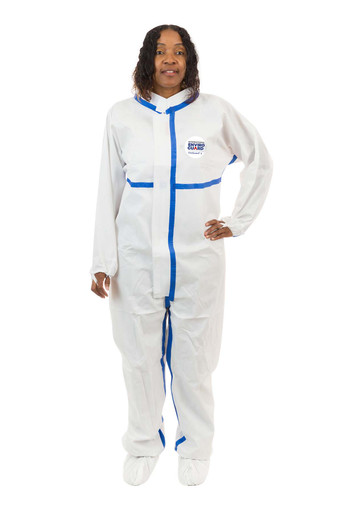 Enviroguard W2502 ViroGuard 2 Disposable White Coverall, Elastic Wrist and Ankle, Storm Flap Zipper, Taped SeamsSealable storm flap, thumb and middle finger loops, double-sided tape at the wrists to hold the glove, red pull tab on the zipper, taped seams.
Why is taking the suit off the dangerous part? While the coverall is on, the contaminant is on the outside of a barrier. The moment it comes off, every surface that was outside is next to skin, hair and street clothes, and the worker is doing it tired, in gloves, often with a respirator still on. Asbestos fibers, lead dust and blood do not announce themselves, so the sequence has to be right every time, not just when the suit looks dirty. That is why the CDC publishes the order as a poster, why OSHA’s asbestos standard scripts the exit through the decontamination unit step by step, and why the general PPE rule requires every employee to be trained in how to properly don, doff, adjust and wear PPE before doing the work.
29 CFR 1910.132(f)(1)(iii) and (f)(2); 1926.1101(j)(1)(iii).What does each rule say about taking PPE off?
The removal paragraphs, side by side.
How do you take off a disposable coverall?
The CDC poster is written for a gown, and OSHA’s sequences are written for an abatement decontamination unit, so this is those two sources read onto a one-piece hooded coverall. The principle from the CDC poster carries straight over: the outside is contaminated, the inside is not, and the garment comes off by turning the inside out over the outside. The order below keeps the respirator on until the suit is in the bag, which is what both the CDC poster and 1926.1101(j)(1)(iii)(C) require.
- Clean the outside first. Wipe, wet-wipe or HEPA-vacuum gross contamination off the suit before leaving the work area; for asbestos this is a rule, not a preference. Tape over the glove and boot cuffs comes off now, folded onto itself.
- Take off outer gloves if two pairs are worn, peeling each glove off inside-out with the other gloved hand, as the CDC poster shows. Keep the inner pair on for the suit.
- Open the storm flap and the zipper down to the crotch, touching only the flap and the pull. A large pull tab and a colored pull are there for gloved hands.
- Push the hood back by reaching inside the hood at the forehead and peeling it back over the hard hat or head, so the outside of the hood folds onto the outside of the shoulders.
- Peel the shoulders back by pulling the suit away from the body at the inside of the collar, then work each arm out. With thumb loops, the loop stays on the thumb until the sleeve is inside-out past the wrist; the sleeve then takes the inner glove off with it.
- Roll the suit down inside-out to the ankles, step out of the attached boots or boot covers one at a time onto the clean side of the line, and let the suit go straight into the bag. Do not shake it out.
- Eye protection next, respirator last, by the strap or ties, not the front. Then wash hands, or shower where the standard requires it, before touching street clothes.
How do you put a disposable coverall on?
Backwards from the above, and with more care about the seals than people give it. Suit up in the clean room or at the clean side of the line, in the order the CDC poster gives: the body garment first, then the mask or respirator secured at the middle of the head and neck with the nose band shaped and a fit check done, then eye protection, then gloves pulled over the cuff. For a coverall that means: step in with boots on and the legs pulled up, arms in, zipper to the chin, hood up over the hard hat and around the respirator, then the storm flap sealed over the zipper, then gloves over the sleeve cuff with the thumb loop inside the glove, then tape at the wrist and ankle if the job is wet or the dust is fine. Size up if the crotch or the back pulls when you squat; a suit that splits at the seam on the first bend was never on. A hooded suit sized for a hard hat and a full-face respirator is one size larger than the chest alone says.
CDC Sequence for Donning PPE (gown, mask or respirator with fit check, goggles or face shield, gloves over the cuff); 29 CFR 1926.1101(j)(1)(ii)(C) (protective clothing and respirator on before leaving the clean room); 1910.132(d)(1)(iii) (PPE that properly fits).Which coverall features matter for doffing?
They are the ones the manufacturers added after watching people take suits off. International Enviroguard’s ViroGuard 2 sheet lists a sealable storm flap over the zipper, thumb and middle finger loops at the cuff that keep sleeves from riding up, double-sided tape at the wrists that the product page says helps keep gloves in place during donning, a mandarin collar with hook-and-loop closure, and a red fabric pull tab on the zipper so it can be found in gloves; the catalog says six features were added to the suit from healthcare workers’ input to aid donning and doffing. ChemSplash 2 carries a storm flap with pressure-sensitive tape, attached thumb loops and a large zipper pull. The sterile GammaGuard CE bunny suit CE11019CIS has thumb loops, ankle ties on the attached boots and a storm flap, and ships in the manufacturer’s Sterile-Don packaging, described as protecting against contamination during donning. The MicroGuard MP 8104 and 8106 boot covers have ankle ties and a non-skid sole; the W2561 hood closes with hook and loop and the 8002 hood with elastic and a tie. A vend-pack version of the hooded MicroGuard MP coverall, 8015VPK, is vacuum sealed one per pack so a clean suit comes out of a dispenser at the line.
International Enviroguard ViroGuard 2 sell sheet and product pages (W2501, W2502, W2561), Industrial and Healthcare Catalog ViroGuard 2 section; ChemSplash 2 sell sheet (7312GT, 7315GT, 7319GT); GammaGuard CE product page CE11019CIS; MicroGuard MP product pages 8104, 8106, 8002 and 8015VPK, as published.Where does the coverall come off on an abatement job?
On a Class I asbestos job over the 25 linear or 10 square foot threshold, in the equipment room of a three-stage decontamination unit built next to the regulated area, in series: equipment room, shower, clean room. The employee enters through the clean room, leaves street clothes in a locker, puts on the coverall and respirator there, and passes through the equipment room into the work. Leaving, the employee removes gross contamination before stepping out of the regulated area, takes the coverall off in the equipment room into the labeled impermeable bag supplied there, keeps the respirator on, showers, and only then enters the clean room and dresses. Smaller Class I jobs and Class II and III work over the exposure limit use an equipment room or area next to the regulated area with the same bagging. Lead work uses a change area with separate storage for street and work clothes and a closed container for the clothing. None of these rules name a product; they name a place and a sequence, and the disposable coverall is what makes the sequence end in a bag instead of a laundry.
29 CFR 1926.1101(j)(1)(i)(A) through (C), (j)(1)(ii)(A) through (D), (j)(1)(iii)(A) through (E) and (j)(2)(i); 1926.62(g)(2)(iv) and (v) and (i)(2).Questions people ask
What order do you put on PPE?
The CDC poster: gown first, then mask or respirator with a fit check, then goggles or face shield, then gloves pulled over the cuff. On a coverall the hood goes up and the storm flap is sealed before the gloves go on.
What order do you take off PPE?
The CDC poster: gloves, then goggles or face shield, then gown touching only the inside and turning it inside out, then the mask or respirator by its ties, then hand hygiene immediately.
Do you take the respirator off before the coverall?
No. The CDC sequence removes the mask or respirator last, and 29 CFR 1926.1101(j)(1)(iii)(C) prohibits removing the respirator in the equipment room where the coverall comes off.
Where do you take off an asbestos coverall?
In the equipment room of the decontamination unit, into a labeled impermeable bag, after removing gross contamination and before showering (1926.1101(j)(1)(iii)(A), (B) and (D)).
What do you do if blood soaks through a coverall?
Remove the garment immediately or as soon as feasible, remove all PPE before leaving the work area, and place it in the designated container (29 CFR 1910.1030(d)(3)(vi) through (viii)).
Can you shake the dust off a coverall before bagging it?
Not for lead: 1926.62(g)(2)(viii) prohibits removing lead by blowing, shaking or any means that disperses it into the air. The asbestos exit procedure requires gross contamination removed before leaving the regulated area, not shaken off in the change area.
What are thumb loops for?
The manufacturer says they keep sleeves from riding up; in doffing the loop holds the sleeve under the glove so the sleeve turns inside out and carries the glove off with it. ViroGuard 2 and ChemSplash 2 coveralls and the GammaGuard CE bunny suit have them.
The ratings, test results and standards shown here are the manufacturers' published values, reproduced as published. Nothing on this page is a recommendation by Bayshore Safety that any product is suitable for a particular task, hazard or workplace. Selecting safety products and protective equipment is the responsibility of the end user and the employer, based on their own hazard assessment and the regulations that apply to their work. Confirm every value on the manufacturer's own documentation before use.